
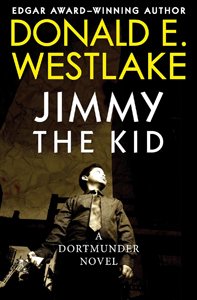
Donald E. Westlake (1933-2008) wrote more than 100 novels, so it’s no wonder he desired to have some fun and mix things up. Attacking the formula of crime fiction through a meta lens, his novels featuring angry and incompetent thief Dortmunder are set in a world that includes absurdities, random chance and unexpected twists that readers will recognize as often being more realistic than the genre’s core tropes.
Truth is stranger than fiction
Most fiction does not do this, and that’s why we have the incongruous phrase “truth is stranger than fiction.” Fiction generally is more organized, proper and predictable than truth. Westlake wrote straight crime fiction under the pen name Richard Stark, and — appropriately — he wrote comedically “realistic” fiction under his real name.
A prime example of Westlake’s craft is “Jimmy the Kid” (1974), wherein Dortmunder and a fellow thief he doesn’t like, Kelp, team up to carry out the plot of the Stark novel “Child Heist” (which doesn’t exist in our world). Their reasoning: If they follow the novel’s kidnapping and ransom like a blueprint, they will get rich.
“Jimmy the Kid” (1974)
Author: Donald E. Westlake
Series: Dortmunder No. 3
Genres: Crime fiction, comedy
Setting: New York City and rural surroundings, 1974
You can broadly see where this is going, and that’s both a strength and a weakness as “Jimmy the Kid” puts a comedic spin on chaos theory, showing that a complex process can’t be predicted down to the detail. The criminals – which also include Murch, Murch’s Mom (always identified that way) and Kay — plan it step by step, as per “Child Heist,” but don’t account for little kinks in the plan. Partly this is out of dumbness, partly out of dumb (bad) luck.
It’s in the broad surprises that “Jimmy the Kid” — a howcatchem told from the perspective of those not wanting to get caught — is worth a smile. Tween Jimmy Harrington, unlike Bobby in “Child Heist,” is not a stereotypical snot-nosed kid who needs reassurances, but rather a mini-adult. Not only is the kidnappers’ promise that they won’t hurt him genuine, but they’re even playing cards and watching TV with Jimmy before long.
And it’s in the specific kinks that “Jimmy the Kid” becomes almost laugh-worthy. Certainly never a mean-spirited novel, it nonetheless features a father who is so work-obsessed that he can’t set it aside even when his son is kidnapped.
Influence on Black and Whedon?
So when big-city businessman Mr. Harrington is being driven by an FBI agent (secretly standing in for his chauffeur) as they follow the criminals’ step-by-step instructions on where to drop the cash, he’s doing work-related business on his car phone. As such, the kidnappers can’t call him to communicate the next step in the journey, and hijinks ensue.
We can see the influence of Westlake today in the work of writer-director Shane Black, whose “The Nice Guys” (2016) is among my 10 favorite films. A scene in that movie finds a criminal tossing a gun to his colleague, but the colleague misses it and it goes out the window behind him. That’s Westlakean absurdity. The connection will become overt when Black makes Westlake’s novel “Play Dirty” into his next directorial effort.
Joss Whedon (apparently retired now) took Westlakean influences to a next level in the way his characters are aware they are playing out tropes. “Buffy” and “Firefly” characters often hang a lampshade on the situation’s torn-from-fiction nature via dialog, and sometimes turn the tables on the expected outcome. Or they get to the expected outcome in an unexpected way.
Black and Whedon have quick pacing and wit, though, whereas Westlake is blunt in “Jimmy the Kid.” Ironically, rather than keeping a reader on their toes, Westlake provides comforting familiarity for people who have read other Dortmunder novels. And for those newly discovering the Dortmunder series, the author holds their hand in multiple scenes where we’re reminded that the criminals are attempting to mirror “Child Heist.”
Rather than sneaking up on us, the premise of “Jimmy the Kid” is spelled out. As such, the novel takes a while to work up steam. But it’s ultimately a good-natured 185-page romp, with the comedy reaching high enough levels to balance out the low stakes. I might revisit Westlake’s catalog down the road, but for now I’m content to appreciate the influential formula of a prolific author who knew how to make his work fun.
Sleuthing Sunday reviews the works of Agatha Christie, along with other new and old classics of the mystery genre.