
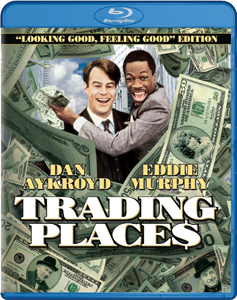
Although it’s set in a time when the idea of a computer instantly telling you the price of orange-juice concentrate stock is cutting-edge, “Trading Places” (1983) will be relevant as long as governments and corporations find ways to shunt money from the poor to the rich. I wish it could trade some of its dry intelligence for laughs, though.
Director John Landis’ brand of bludgeoning comedy from “Animal House” and “Blues Brothers” gets severely toned down except for a segment showing Wall Street like it really is, with people furiously buying and selling. Writers Timothy Harris and Herschel Weingrod – who would further explore the relationship between money and behavior in “Brewster’s Millions” (1985) – devise an experiment.
One of the brothers who heads stock-trading firm Duke & Duke (Ralph Bellamy’s Randolph) believes in the environmental inertia of richness or poorness, so – by cinematically plausible machinations – he makes his top market predictor, Louis Winthorpe III (Dan Aykroyd), into a broke homeless man. He then gives Win’s job to street hustler Billy Ray Valentine (Eddie Murphy). He believes they will naturally take over each other’s lots in life, while brother Mortimer (Don Ameche) believes good and bad breeding will win out.

“Trading Places” (1983)
Director: John Landis
Writers: Timothy Harris, Herschel Weingrod
Stars: Eddie Murphy, Dan Aykroyd, Ralph Bellamy
Pork belly futures, but no belly laughs
Landis crisply sets up the contrast, with montages of Louis and the Duke brothers enjoying the service of butlers, such as breakfast in bed and fresh newspapers in the morning. Billy Ray is a creative but not terribly successful panhandler. Then the expected happens: Randolph is right. Win and Val slot into each other’s roles.
Aykroyd and Murphy commit to their roles, too, and Bellamy is unintentionally likeable in that way of an old man with a gleam in his eye. He’s a villain, but “Trading Places” has an absurdist premise, so it’s all in good fun. But not all that funny. Harris and Weingrod have the premise, but few wild setups.
We get the broad point, and every sub-point, before the film gets to it. Consider this sequence that makes a fair yet flat point: When Val throws a party at his mansion, he behaves like a respectable host and is irked that his lower-class friends are disrespecting his home. We get the idea, but no laughs. Landis throws in a few topless women – and Jamie Lee Curtis as Louis’ ally Ophelia later strips down – as if bidding for our attention.
Some Christmas spirit boosts the proceedings. Winthorpe is more helpless on the streets of Philadelphia than a Bruce Springsteen character, but street-smart yet not-entirely-cynical prostitute Ophelia takes him in. He’s a human version of a futures stock. She’ll help Win regain his old position – how she has any power to do this is vague – and he’ll pay her for the help. It’s a sweet alliance, but shallower than better class-divide fables, such as 1991’s “Curly Sue.” (Incidentally, look for James Belushi in a small role here).

Gorillas of Wall Street
The final act starts with a buildup I might’ve been rubbing my hands for if the film had shown any comedic knack. Winthorpe and Valentine realize they are both patsies, so they team up. Aykroyd, Murphy, Curtis and Denholm Elliott (Coleman the butler) get to play their characters playing undercover roles. Murphy workshops African-native antics for Landis’ better “Coming to America” (1988) and Aykroyd shows up in blackface. I guess some people might be offended by this, but it’s hard to imagine “Trading Places” working a viewer up into any kind of emotion.
Despite the bombast of the Wall Street finale and a pitch-black side gag about gorilla rape of a henchman, this remains a yawner of a comedy. The point is well taken that the inertia of society’s systems helps rich people stay rich and keeps poor people poor, as is the point that it’s easier to adjust to being rich than it is to adjust to being poor (if you’re accustomed to the opposite).
Landis gets creative in a couple moments, using the rare technique of a character looking at the audience. Randolph patronizingly tells Val that bacon is used in “bacon, lettuce and tomato sandwiches” and Murphy stares at the camera. Aykroyd does the same when Winthorpe has a rock-bottom moment.
“Trading Places” isn’t rock bottom among comedies, but I wanted to “sell, sell, sell” rather than being stuck with it.