
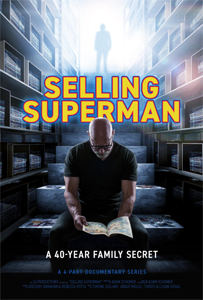
“Selling Superman” (2024, Amazon Prime) gets into the introspective aspects of collecting and dealing comic books by focusing on one family with a bizarre (now uncovered) secret. Though Adam Schomer’s four-episode series is a cautionary tale about obsession and hoarding, and also an appreciation of community and friendship, my favorite part is the lavish pans over thousands of comics from throughout the history of the medium.
The main character is middle-aged Darren Watts, who built his own thriving tech company but who has unresolved anger at his recently deceased father, who was emotionally distant. Dale had hoarded 300,000 comics, many valuable and in great condition. It’s an industry-shaking collection, even if the Wattses were to dump them all on eBay. The docu could shoot a spread of dozens of a “key” issue (one that has the first appearance of a classic character, or is notable in another way) merely for illustrative purposes, and it could reshape the market.
Schomer threads the needle of an impossible situation. “Selling Superman” is about the coldness from the autistic Dale toward his wife and two sons, but he’s not here to defend himself. This isn’t to say Darren is dishonest; he seems genuine, a likable guy to hang out with for four episodes. But the fact that we can never hear from Dale lingers.
This also creates a sense of mystery, and in the last episode Schomer finally addresses the elephant in the room: How did Dale – too young to have purchased it on the newsstand in 1939 — acquire “Superman” No. 1? Darren tracks down two Detroit-area comic book men who knew Dale. One of them says Dale, a successful lawyer, flat-out gave him a car when he needed one.
Still, Dale is the villain. He gave a friend a car, but also bought “Star Wars” merch solely for his off-limits room, not for his boys. The owner of Mile High Comics chats with Darren and suggests Dale left Darren and his brother these comics and toys as a way of showing his love. That’s a nice idea, Darren responds, but not accurate.
The value of comic gold
“Selling Superman” almost convinces me of an ephemeral notion: that inanimate objects can be a positive force by being sold and bought, even if there’s no charitable element. Dale hoarded comics, but now Darren is selling them and presumably making people happy. It’s heartwarming to see him recruit sellers – particularly one with lifelong kidney issues — to sell parts of the collection on commission.
A down side is that Schomer chooses an unsympathetic and padded-out through-line to fit with the title: Darren struggles with whether to sell or keep “Superman” No. 1. (At the time of the docu, the record sale of the 1939 book was $5.3 million; it has since gone for $9.12 million.) It doesn’t seem like a conflict. Since he has no memories associated with it (his dad didn’t let the kids be in the same room as the books, let alone read them), liquidate it and use the money for something that will make you happy. And stop fretting about any harm coming to it.

Granted, Darren’s struggle is a springboard for the wider, compelling issue of collecting things as physical investments versus collecting things to enjoy them. My favorite character is Darren’s best friend (one of several who assist in cataloguing the collection), who believes in “raw-dogging” his comics. He takes a high-graded key “Silver Surfer” out of its protective casing and puts it in a box (not even one designed to hold comics) with others of the series. It’s where it belongs, he says.
Other experts glowingly speak of the idea of someone buying “Superman” No. 1 and taking it out of its case and reading it. I’m not sure any of them would do that themselves, though. When the filmmakers drop “Superman” No. 1 and ding the protective case, Darren is distraught. He’s a contradiction.
“Selling Superman” hits us with a wider contradiction: Reading comics holds some appeal, but panning over piles of mint classics and seeing the values pop up on the screen is mesmerizing. The documentary’s lesson is perhaps accidental: We all have a little of the villain in us.