
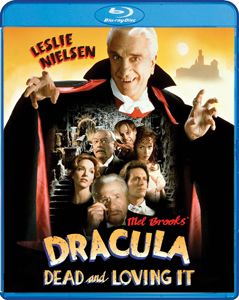
In his 2004 commentary track for 1974’s “Young Frankenstein,” Mel Brooks notes that it’s his best pure film – in the sense that it’s not merely a foundation for laughs; it has emotional punch. One gets the sense that he never went back to that style, but he did in his swansong film as a director, “Dracula: Dead and Loving It” (1995). Appropriate, since it marks his return to Universal Monsters.
Though its 5.9 IMDb rating isn’t insulting, “Dead and Loving It” is under-mentioned among Brooks’ films. I can see why. It’s not enough of a classic to be celebrated like “YF” and not controversial enough to be re-evaluated by the P.C. humor police, as has happened with “Blazing Saddles.”
It doesn’t have the gorgeous cinematography of “YF,” but set and costume details effectively take us to 1893 Transylvania. It’s in color, and vibrantly so, if with a backlot vibe. It lacks “YF’s” humor highs but also the slow-down lows.

“Dracula: Dead and Loving It” (1995)
Director: Mel Brooks
Writers: Rudy De Luca, Steve Haberman (screenplay, story); Mel Brooks (screenplay); Bram Stoker (novel)
Stars: Leslie Nielsen, Mel Brooks, Peter MacNicol
Though it has a couple very funny scenes – Renfield (Peter MacNicol) sneakily eating bugs, and Harker (Steven Weber) getting drenched in blood when staking a vampire – and it makes fun of “Bram Stoker’s Dracula” (1992) via the hairpiece of Dracula (Leslie Nielsen), the appeal goes beyond the gags.
It has laughs, but it’s also a faithful adaptation
“Dead and Loving It’s” mesmeric hook isn’t wall-to-wall chuckles, but rather that it’s a thoroughly pleasant adaptation of Stoker’s 1897 novel. Now, with “Dracula” having been translated to film more than 200 times, you might say “Why the Brooks version?” Because his troupe is so good and he provides an easy entry point to Stoker.
Brooks turns what’s usually a mood piece about vampiric allure into a smirky character piece. This switch happens immediately, since Nielsen is the title character, and he falls down the stairs in his introductory scene. As with Frank Drebin, Nielsen’s Count Dracula is a parody of suaveness, someone who fancies himself a sexy leading man but who isn’t quite.
As we soak up Stoker, we simultaneously revel in the Brooksian absurdities of old English and German accents and cultural mores. A great example of the latter comes when Harker is seduced by his fiancée, Mina (Amy Yasbeck), who is amid the vampire-turning process. “But I’m British!” he protests. “So are these!” she counters, displaying her cleavage.
The well-paced “Dead and Loving It” finds an elite troupe doing Stoker with the slightest touch of derangement. In that bug-eating scene, MacNicol is the showperson, but straight man Harvey Korman gets to make stuffy, jowl-enhanced pronunciations, like “razburry” for raspberry.
No cameras crash through windows, no one stops to pump up their basketball shoes. That stuff has its place, but Brooks and co-writers Rudy De Luca and Steve Haberman decide that place is “Men in Tights” (and it wouldn’t be long till the Wayans Bros. took the baton for that mode of spoof). “Dracula: Dead and Loving It” goes back to basics, realizing that “Dracula” – like “Frankenstein” before it – is ripe enough for parody within its own book covers.
For Mel Brooks’ 100th birthday year, RFMC is looking back at his catalog on some Mondays.