
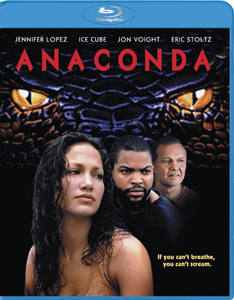
We were spoiled by great natural and supernatural scare flicks as part of the overall horror renaissance in the late 1990s. “Anaconda” (1997) was, at the time, one of many entertaining films in the genre, remixing the “Jaws” plot with a giant snake. But watched today – with the ability to contrast it with 2025’s legacy sequel by the same name – we see how lucky we were to get our B-movies in gorgeous natural locations with restrained but respectable CGI effects.
The time between the cheap practical effects of the 1970s and the 2020s money-saving reliance on greenscreen stages now looks like a golden age.
Due to the genre’s reinvigorated bankability, and enhanced by the burgeoning art of CGI, “Anaconda” draws a remarkably good cast. Jennifer Lopez and her rainforest-misted tank tops break through here (and in “Selena” the same year). She’s joined by an assured crew of Jon Voight (as a snake, but not the snake), Eric Stoltz (possibly getting an easier shooting schedule because he was among the bigger names), Ice Cube, Owen Wilson and MTV’s Kari Wuhrer.
“Anaconda” (1997)
Director: Luis Llosa
Writers: Hans Bauer, Jim Cash, Jack Epps Jr.
Stars: Jon Voight, Jennifer Lopez, Eric Stoltz
Paraguayan director Luis Llosa, in one of his few Hollywood detours, and cinematographer Bill Butler stylishly lens the foreboding Amazon River and jungle. They light Voight in red from beneath the chin to emphasize that reptilian smirk as he pilots the barge along the Amazon. Though some laugh at Voight’s turn as the snake trapper who slyly hijacks the documentarians, he stands as an example of how an actor can elevate a cliched role.
Rapid-fire exchanges allow us to get to know the crew and their relationships, and Voight’s Serone provides exposition through one-liners he forces into quotability, from the general (“This river can kill you in a thousand ways”) to the detailed: “They strike, wrap around you, hold you tighter than your true love. And you get the privilege of hearing your bones break before the power of the embrace causes your veins to explode.”
A monster flick worth embracing
Composer Randy Edelman’s slithering, intense score enhances a script by three writers that relies on what Spielberg accidentally discovered in “Jaws”: Don’t show too much of the monster, but keep us thinking about the monster. This principle starts with a cold open where a poacher (Danny Trejo) chooses suicide over facing the anaconda.
The special effects look good to a forgiving viewer. Sometimes the snake seems to float into the frame; I imagine that out of camera range, its strong tail has a purchase. The creepiness of a human’s specific outline being visible in the snake’s belly has stuck with me for decades, and the way the anaconda coils around a victim like a self-wrapping hose is chillingly otherworldly. Yet these creatures do exist.

“Anaconda” takes us to a part of the natural world we’d rather not go (except in the safety of cinema). There’s a tinge of humor in the movie’s rhythms, but not as much as you’d think. Really, the only non-straight performance comes from Voight, and – as noted – it’s a welcome choice. Perhaps he’s not even winging it; when Serone winks in his death scene, that suggests Llosa is wholly on board.
“Anaconda” is categorized with the faint praise of “cult classic” at best, with non-fans making sure to point out the embarrassing shot of the reversed waterfall. I don’t understand the dislike that puts it at 4.9 on IMDb. I’m not trying to be a hipster contrarian when I say “Anaconda” is a fine example of its form.