
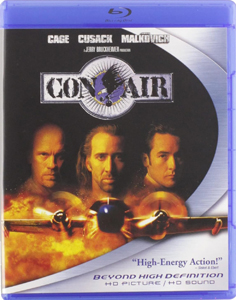
An unwritten rule of movies is viewers allow one massive implausibility, but not a mountain of small implausibilities. This is why “Con Air” (1997) is superficially in the same class as what Michael Bay was putting out at the time (“Bad Boys,” “The Rock,” “Armageddon”) but less satisfying.
The big unlikelihood of this film from director Simon West and writer Scott Rosenberg (“Disturbing Behavior,” “High Fidelity”) is simultaneously its flash of brilliance: The worst of the worst among federal prisoners hijack their transport plane and action ensues.
And then West (“Lara Croft: Tomb Raider”), perhaps following a directive from producer Jerry Bruckheimer, shoots in the Bay style with epic pans and fast-moving dollies and close-ups. One of the two composers is Trevor Rabin (“Armageddon”). This is all to the good.
“Con Air” (1997)
Director: Simon West
Writer: Scott Rosenberg
Stars: Nicolas Cage, John Cusack, John Malkovich
Money is on the screen in every set piece, including a grand finale in Las Vegas where Rosenberg and West insist that we immediately forget a concern voiced by multiple characters moments earlier: Many civilians will die in the plane’s crash landing along the Vegas strip. Instead, we get Trisha Yearwood’s “How Do I Live,” the pretty Monica Potter backlit by neon, and a poignant scene of a daughter (who looks like Potter) gradually accepting that the scary-looking Cameron Poe (Nicolas Cage) is her loving daddy. Canonically, no bystander is killed (somehow).
Why isn’t “Con Air” top shelf among its bombastic ilk? Because instead of nudging us along with bare-plausibilities, it insists we accept an endless stream of turnabouts, impossibilities and conveniences. It starts on the edge of reality but leaves it behind too fast. It tries to be sneaky but doesn’t succeed. For instance, Rosenberg waves the stupidity of one DEA agent bringing a handgun aboard Con Air in our face, trying to sneak in the bigger stupidity of there being a huge cache of weapons in the hold (as this will be necessary for a later sequence). I noticed the magician’s sleight of hand, and if I notice it, it’s a weak trick.
Imprisoned by one-dimensional roles
In terms of character behavior, Colm Meany has the most thankless role as Agent Malloy. He’s the enemy of hero Agent Larkin (John Cusack), stupid within the movie’s context. But he’s also stupid within any context. He follows the wrong plane 300 miles out of the way (the bad guys have switched the transponder box) even after Larkin tells him a body has fallen out of the sky with a message on it, clearly indicating it came from Con Air!

Malloy doesn’t make wrong decisions by misreading evidence, he makes wrong decisions because he can’t bring himself to agree with Larkin. If it’s building toward the revelation that Malloy is actually in league with Cyrus, fine; that could be an incredible twist. But it’s for the sake of (false) drama.
OK, but “Con Air” is a delicious parade of “I know that guy” actors as the prisoners, right? Well, it’s supposed to be, and John Malkovich gives a professional turn as Cyrus the Virus, a remarkably articulate genius among the criminal class. When he’s backstabbed by his allies at the middle-of-nowhere airstrip, it’s for no reason other than the script says so. (If they were planning on betraying him, why hang around to possibly be killed?) And because the good guys – Larkin and soon-to-be-paroled Poe – rely on script armor to survive, Cyrus is ironically weakened by not having a strong opponent.
The sub-villains rub me the wrong way (above and beyond the fact that they’re supposed to). Danny Trejo plays Johnny-23, so named because of his 23 rape convictions, but he notes Johnny-300 would be a more accurate name. Steve Buscemi’s Garland Greene, initially constrained like Hannibal Lecter, says serial killing is a logical response in an insane world. (Poe counters that serial killing remains insane in an insane world. Discuss.) There’s potential for pitch-black humor with these people, but “Con Air” doesn’t have time to focus on that; action must intercede.
West and Rosenberg broadly know what they’re making – as indicated when Poe responds to a car soaring behind the plane on a rope with: “On any other day, that might seem strange.” “Con Air” is deliberately strange, but the screenplay is lazily strange in too many places for me to say it’s anything more than an experiment that fails to achieve its sky-high aims.