
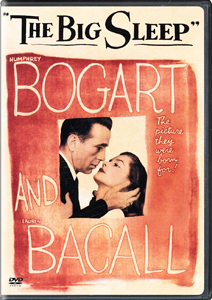
“The Big Sleep” (1946) features Humphrey Bogart as Philip Marlowe, five years after he played Sam Spade in “The Maltese Falcon.” Although in my review of Raymond Chandler’s 1939 novel I noted that Marlowe is a continuation of Spade, I also sensed that Marlowe is slightly younger and less world-weary. But when Bogart is in the role, it’s the same character; “Sam Spade” and “Philip Marlowe” mean something to readers, but cinema-goers of the Forties might’ve just heard “Humphrey Bogart.”
That’s a safe casting choice (and not one I have to accept, since there are at least 10 more actors who have played Marlowe). But I think it causes “The Big Sleep” to lean toward plot more than character because Bogart’s confidence and charisma are baked in; gone is the slight vulnerability of the book’s Marlowe.
Despite this being a core noir film adapted from a novel with first-person perspective, director Howard Hawks and his team of three writers choose to not use voiceover narration, so we are distanced from Marlowe, as we were from Spade. That’s how Hammett intended it; Chandler did not.
“The Big Sleep” (1946)
Director: Howard Hawks
Writers: William Faulkner, Leigh Brackett, Jules Furthman (screenplay); Raymond Chandler (novel)
Stars: Humphrey Bogart, Lauren Bacall, John Ridgely
I sense the hand of censors
Further hurting “The Big Sleep” are the censors. In the book, Marlowe finds Carmen Sternwood (Martha Vickers) drugged-up and nude when he busts in on a pornography photo shoot gone wrong, and later he enters his apartment to find Carmen naked in his bed. Carmen’s raw sexuality is stripped from the film, except for her first scene where she wears a high-cut dress that shows off her legs, and tries to sit in Marlowe’s lap while he’s standing up.
But in the two nude scenes, she is fully covered; there isn’t even an underwear-clad compromise like I would’ve guessed. The costuming decision is such that a viewer who never read the novel might not pick up on the black-market pornography angle at all.
Both book and film are filled with femme fatales. And actually there are a couple more in the screen version – the flirty bookshop clerk and the taxi driver who gives Marlowe her card and says call her at night, when she’s not likely to be working. But Carmen is Marlowe’s ultimate distracting danger in the book due to her aggressive sexuality.
That’s a misfire of the adaptation, but at other times, writers William Faulkner, Leigh Brackett and Jules Furthman make wise choices. As the plot winds to its end, they foreground Lauren Bacall’s Vivian – Carmen’s sister – more than Chandler did, pushing the film toward a bankable love story (but not so far as to force something that’s not in the text).

While both Carmen and Vivian are softened in the screenplay more than they should be, the actresses almost make up for it. Vickers is underused, never making more impact than in her introductory scene and seeing Carmen’s grand finale excised. Bacall, though, is an idiosyncratic presence, so non-actorly that I almost wondered if she could act, at first.
Distanced from Marlowe
“The Big Sleep’s” hardboiled feel fluctuates, connecting more often than not, but not as much as, say, “Double Indemnity,” the gold standard of voiceover and banter. Louis Jean Heydt has nice hardboiled rhythms as an early suspect, Joe Brody. Later, John Ridgely is decent as the antagonist, Eddie Mars.
The writers stick to Chandler’s metaphors and similes most of the time, and when they write new lines, they are usually good, like when Marlowe notes that once the police take a hard look at the Sternwood family, their closets will look like police conventions.
“The Big Sleep” is in black and white, and that’s part of why the colors of slightly pre-smog Los Angeles don’t pop. Even in films not featuring orange and lemon groves, it’s at least a bright, lively city (especially in the daytime). Shot entirely at WB’s Burbank studios, the movie is dark and bleak, lacking the distinct feel of a burgeoning L.A., a big part of the novel.
Though firmly operating in the genre, Chandler edges toward his own statement or style or sharp characters. But the adaptation reins everything closer to the middle of what film noir means in cinema: A P.I. doing meat-and-potatoes work while dodging (sometimes unsuccessfully) a femme fatale or two. And while the plot remains brisk and clear considering its complexity, any scenes of violence are as stagey as they come – something I also noticed in Hawks’ superior “Ball of Fire” (1941), which relies on action in its closing stretch.
Hawks and his team don’t fumble one of the greatest hardboiled novels of all time, but they do run a conservative play with it. A reasonable enough adherence to Chandler’s mystery plot and the sheer unusual quality of Bacall make it worth checking out, but in the heyday of film noir, “The Big Sleep” doesn’t rise to the level of masterpiece.
Sleuthing Sunday reviews the works of Agatha Christie, along with other new and old classics of the mystery genre.