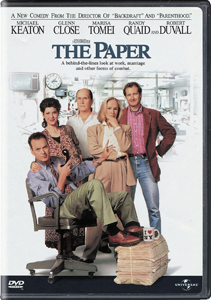
If you’re on a bender of newspaper movies, “The Paper” (1994) would make a good cleanser between “All the President’s Men” (1976) and “Spotlight” (2015). Indeed, if one squints, we can imagine Jason Robards continues from a respected editor role of “President’s Men” to that of a black-tie publisher in “The Paper,” and Michael Keaton goes from “The Paper’s” Coke-guzzling crime-desk boss to the seasoned prober of “Spotlight.”
Although a subplot follows black youths wrongly arrested for murders of white businessmen, “The Paper” is primarily a chuckle-every-10-seconds romp in a hilariously (accurately) messy newsroom. The twists and turns to get the story correct by deadline are frenzied yet immensely engaging under the keystrokes of uber-writer David Koepp (“Jurassic Park”) and his brother Stephen, in his only credit. But Stephen’s is the most important credit on this film, as his career in journalism clearly informs the nooks and crannies of the New York Sun.
The morning staff meeting run by Robert Duvall’s Bernie is spot on, from the messiness of the room to the zingers flung by everyone. An employee complains about Bernie’s smoking: “You know the doctor found nicotine in my urine again.” “Then keep your d*** out of my ashtray,” Bernie fires back. Everyone chuckles.
“The Paper” (1994)
Director: Ron Howard
Writers: David Koepp, Stephen Koepp
Stars: Michael Keaton, Glenn Close, Robert Duvall
1994 was the waning days of the smoker having the high ground in office politics, but the way everyone must swear and spew filth – or at least laugh along – lingered for many more years. It likely would’ve survived the latest PC push if newspapers still had big enough staffs for meetings. “The Paper” knows journalism is among the rare professions where you have to be more vulgar than in your daily life in order to fit in – although my newsrooms have always had one person who never swears, who we endearingly allow into the circle.
When good work is bad for you
Such a character is missing from “The Paper,” but most other personality types are accounted for, and they come at Keaton’s Henry Hackett from the top, bottom, both sides, inside the office, outside the office, and from his wife. They range from a reporter who demands a comfortable chair to the editor of the classier New York Sentinel who wants Henry’s quick answer to their job offer. Glenn Close’s Alicia is likewise aiming for a pay raise or a better job, and Mac (Randy Quaid) sleeps on the office couch. Mac is a columnist, a.k.a. “a reporter who writes long,” Henry says.
One minor misfire is that Henry’s severely pregnant wife, Marisa Tomei’s Marti, is also a reporter, so I’d think she’d be more understanding of his obsessive need for two things on this wild day — one admirable, the other at least understandable. He wants to scoop the other metros, and he wants to get the story right for the sake of truth and the teens’ lives.
The Koepps and director Ron Howard get away with the broad theme of workaholism by nailing the comic rhythms, starting with Henry guzzling a Coca-Cola for breakfast. Why not drink battery acid, Marti asks. No caffeine, he responds. “The Paper” is buzzed throughout, but the Koepps’ writing sings in a way Mac’s columns must, since he is racking up readers with a series on his car always getting towed.
I loved the characters due to recognizing them. And if you want to simply be star struck, this film boasts – in addition to the actors I’ve already mentioned – “Seinfeld’s” Jason Alexander, “Home Alone’s” Catherine O’Hara (in a scene-stealing lunchtime bit across from Tomei) and “Law & Order’s” Jill Hennessy, as Bernie’s estranged daughter.
Is the bar fight between Quaid’s columnist and Alexander’s bedraggled city official one subplot too many? Is the gloves-off showdown between Henry and Alicia in the press room after deadline a bit over the top? Yes to both. But you can’t easily slow down when you’re running on that much caffeine and adrenaline, with the possibility of all NYC learning the truth about a big story riding on your shoulders. At any rate, the movie has built up loads of goodwill. It might not be “President’s Men” or “Spotlight,” but it’s a “Paper” we can trust.