
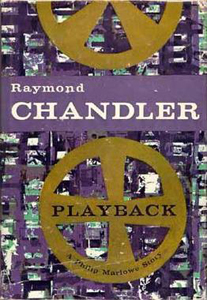
Hollywood’s loss becomes literature’s gain with “Playback” (1958), the last novel fully written by Raymond Chandler, who died in 1959. It seems odd for someone deep in the wonderful journey of the Philip Marlowe mysteries, but apparently Chandler (despite writing the Oscar-nominated original screenplay for 1946’s respected “The Blue Dahlia”) wasn’t sure-fire box-office gold.
The non-Marlowe “Playback” screenplay was rejected, and the author reworked it into the seventh Marlowe novel. Amazingly, it still hasn’t been made into a movie – the only Marlowe novel with that status.
Because something has to rank last among the seven novels, it’s usually “Playback” due to being slighter, at 166 pages over 28 chapters. This is because it’s only a movie’s worth of story, not because it’s lesser in terms of plot, characters or turns of phrase. It’s a page-turner like all of them.
“Playback” (1958)
Author: Raymond Chandler
Series: Philip Marlowe No. 7
Genre: Hardboiled mystery
Setting: 1958, suburban San Diego
The staples are in place, including a femme fatale, Betty Mayfield. She’s perhaps the most frustratingly mysterious of all the characters to fit this template, as Marlowe doesn’t know why she’s in trouble; his employer won’t tell. He’s just tasked with keeping tabs on Betty while a blackmailer, Roger Mitchell, seems to hold total sway over her.
But she does very much fit that template. Marlowe likes her beauty and is annoyed by everything else about her. He does quite well for himself in “Playback,” bedding two women, although granted both of those women have far more negative things to say about him to his face than positive.
Women troubles
Even with that caveat, Chandler tiptoes closer to the ladies’-man private-eye cliché he had resisted even though it’s present in Marlowe’s predecessor Sam Spade and Humphrey Bogart’s “Big Sleep” movie version of Marlowe, where every female character throws themselves at him. By this time, too, Mickey Spillane’s Mike Hammer, whose luck with women borders on the fantastical, had six novels on the spinner racks.
Despite originating as a screenplay that didn’t even feature Marlowe, “Playback” has striking continuity. Chandler had tied together novels before, notably via Marlowe’s run-ins with corrupt Bay City officialdom, but it’s a real eye-opener her when he notes that he still thinks of Linda Loring, a love interest from previous novel “The Long Goodbye.”
Even more surprising, Linda repeats her marriage proposal at this book’s end, and clearly Chandler has become interested in opening a new chapter of Marlowe’s life, something we unfortunately never got straight from Chandler’s typewriter (although Robert B. Parker completed that truncated manuscript as “Poodle Springs” decades later).
Another new tack in “Playback” is that Marlowe spends most of the adventure in Esmeralda, a suburb of San Diego. In a minor way, Chandler touches on Hammett’s “Red Harvest” in that Marlowe must understand the workings of Esmeralda politics in order to make headway. Refreshingly, it’s not too bad a place by hardboiled standards; even the police are fairly reasonable. Marlowe is taken aback by a civil encounter with Esmeralda police in chapter 21: “I wasn’t too used to cops who treated me as if I had the right to be alive.”

In the oddball chapter 20, Chandler outlines the history of Esmeralda and how one family runs it. He does so through the lens of Marlowe remembering what “a man named Fred Pope who ran a small hotel told me.” Usually, the author would show Marlowe and Pope having a dialog, but this is an information dump. It’s very readable, but it is strange that Chandler changes his usual style.
He can’t trust her even in the end
It’s one small indicator that perhaps Chandler rushed through this one a little more than usual. A cynic might also point to the ambiguous resolution, but I rather like it.
(SPOILERS FOLLOW.)
As it turns out, Betty Mayfield is on the run from her father-in-law who promised to hound her after she got off on a murder charge in North Carolina in the death of her husband via a broken neck. While certainly the correct verdict, as there is no solid evidence, it’s interesting to note that Mitchell dies of a broken neck in Betty’s vicinity also. Again, there’s no solid evidence of her guilt – just enough awkwardness that we’d believe she’s a tempting and frightened blackmail target.
Since Betty is the typical untrustworthy femme fatale throughout “Playback” – pushing $5,000 in checks on Marlowe but possibly it’s to entangle him as a suspect more so than to secure his services – we are suspicious. By story’s end, that hasn’t changed.
While my feeling is that Chandler is telling us both dead men were victims of accidents, I find it intriguing that it’s not definitive. It adds extra mystique to Betty, who acts differently when Marlowe is spying on her than she does after meeting him. It’s possible she’s even more sly than what we see on the page.
(END OF SPOILERS.)
“Playback” would’ve made a great movie; maybe it still can someday. But I suppose it’s not a bad tradeoff. We would’ve gained another original Chandler movie to go with “The Blue Dahlia” but lost one of the Marlowe novels.
Sleuthing Sunday reviews the works of Agatha Christie, along with other new and old classics of the mystery genre.