
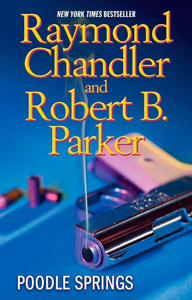
Seven novels showed Philip Marlowe as a serial bachelor who resists marriage like it’s the plague, so at first blush, that should have us scratching our heads over the closing chapter of “Playback” and Raymond Chandler’s four completed chapters of “The Poodle Springs Story.” Marlowe accepts rich socialite Linda Loring’s offer of marriage, and they settle in the blooming desert town of Poodle Springs, Calif., in the fragment that was published in 1962, three years after the author’s death.
This mysterious choice by Chandler is smoothly solved by Robert B. Parker, who writes the final 37 chapters of “Poodle Springs” (1988): By showing Marlowe in a marriage – even one with clear love from both sides — we learn why he can’t be married. He’s married to his detective work. In a nice parallel, the mystery features a celebrity photographer going by two names and married to two women, both oblivious to the situation.
Parker is an obvious yet exciting choice to take the posthumous baton from Chandler. By 1988, he had written 18 novels, 16 of them featuring Spenser, one of many hardboiled sleuths who owe a debt to Marlowe.
“Poodle Springs” (1988)
Authors: Raymond Chandler and Robert B. Parker
Series: Philip Marlowe No. 8
Genre: Hardboiled mystery
Setting: Los Angeles and Poodle Springs, late 1940s
I could point to the tiniest things that indicate this is a Parker novel rather than a Chandler novel. Chandler generally chronicles every moment, whereas Parker sometimes ends chapters on a zinger, leaving the reader to assume the obvious fact that the conversationalists then part ways and move on.
Work-life imbalance
Parker is rather repetitive with the conversations between the newlyweds as Marlowe takes his first case as a Poodle Springs P.I. They both know the marriage won’t last but are delaying the inevitable, amicable divorce.
A section in chapter 33 nicely illustrates the unresolved conflict, when Linda asks Marlowe if he can compromise a bit:
“Depends on what you need me to budge on,” I said. “I can budge on where we live, or who we entertain, or where we go on our honeymoon. But you want me to budge on who I am. What I am. And I can’t. This is what I am, a guy who ends up with dirty pictures in his possession. … And murder and bigamy, and probably a lot worse to come. … It’s the way I make my living. It’s the way I got to be the guy you wanted to marry in the first place.”
In addition to Marlowe’s character, Parker hits on major Chandler motifs. As with previous novels, Marlowe finds multiple corpses, is assaulted by the police and locked up for the night in a cell, is threatened by a client and his henchman, and at the end of the road finds a psychologically damaged woman is the reason for all of this.

While it could be argued that Parker is doing an impression of a Marlowe novel due to these repeated concepts, the novels leading up to this suggest Chandler might’ve repeated himself in this same way. He was already having his protagonist make cracks about the high number of corpses he finds.
Capturing the voice
Even if Parker plays the story developments conservatively, his Marlowe dialog is wonderful: consistently sardonic yet never showy. (“I got an overdue library book, too,” Marlowe says after police detective Bernie Ohls lists charges he could file.) Conversations move naturally in the direction of giving us another shred of information, but we get the sense that 42-year-old Marlowe can’t help his wit at this point.
In one passage, Parker particularly channels Chandler, perhaps inspired by Chandler’s disdain for Golden Age mysteries, as outlined in his essay “The Simple Art of Murder.” Again, Marlowe reacts to Linda’s unrealistic expectations:
“You thought I’d like to grow a thin moustache and drink port and figure out who killed Mrs. Posselthwait’s cousin Sue Sue in Count Boslewick’s castle garden, without getting any bark mulch on my shoes.”
Most of that calls to mind Golden Age detectives, but the moustache makes me think of William Powell in “The Thin Man.” Chandler respected Dashiell Hammett, and for a while Marlowe and Linda banter like Nick and Nora Charles, only with more direct suggestions that they’re having sex when not exchanging bon mots and drinking gimlets. (Still, it’s not too explicit. Parker is cognizant that it’s the late 1940s, not 1988.)
Indeed, both Nick and Marlowe are detectives who marry rich women yet continue their mystery solving. Though both are from the hardboiled school, “The Thin Man” finds Hammett (via Nick) tip-toeing away from that in his last novel. Nick begrudgingly takes cases when they come to him; Marlowe purposely hangs his shingle.
Marlowe can’t be Nick Charles, even when his life situation is identical. Marlowe isn’t wired to treat murder cases flippantly (even if sardonic quips are allowed in the margins). In this most important way, Parker’s “Poodle Springs” stays true to Chandler.
Sleuthing Sunday reviews the works of Agatha Christie, along with other new and old classics of the mystery genre.