
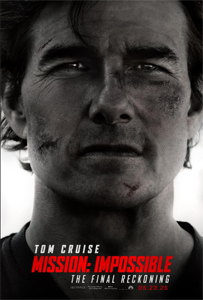
“Mission: Impossible – The Final Reckoning” has one of the most unnecessarily convoluted plots of any tentpole action movie. So much so that this eighth “M:I” film is almost impossible to follow, but not for any good reason. Writer-director Christopher McQuarrie and co-writer Erik Jendresen strain to make this movie big, with many references to previous entries (including a direct tie-in to a past maguffin) and undeniably high stakes: The AI program called The Entity, introduced in 2023’s excellent “Dead Reckoning,” aims to be like Skynet and launch all of the world’s nuclear weapons.
Unlike in the “Terminator” saga, officials – from presidents down to secret agents such as the deified/loathed Ethan Hunt (Tom Cruise) – know about The Entity’s goal in advance. So they simply have to stop it from getting access to the internet, which it would then use to access nukes. (I might have some details of that wrong, but that’s the gist.) Failing that, they could disable the nukes manually. The point is that this is not a sneak attack.
Reckoning with overly complex schemes
The writers perhaps realized this at some point in the process and said “Oh crap, this doesn’t make logical sense,” but they were too far into it. “Final Reckoning” is packed with those “possible flash forward” moments where we are given a visual of what Hunt and his team intend to have happen. It feels like the film’s entire first half is pseudo-ominous exposition.
“Mission: Impossible – The Final Reckoning” (2025)
Director: Christopher McQuarrie
Writers: Erik Jendresen, Christopher McQuarrie
Stars: Tom Cruise, Hayley Atwell, Simon Pegg
This entry bursts at the seams as it struggles to explain the actions of: 1, U.S. government officials, who loathe Hunt to a degree that suggests they never receive full debriefings about his missions; 2, Gabriel (Esai Morales), who desires access to The Entity for nefarious purposes; and 3, Hunt’s team, which is trying to save the world amid all the absurdity.
Classic sci-fi and ultra-present-day themes can be unearthed. If governments talked with each other before settling into a position of total mistrust, maybe disaster could be avoided. If top brass trusted their agents, rather than unnecessarily undercutting them, maybe missions could get accomplished. But how much of this is social commentary and how much is a desperate attempt to wring plot from a mess?
I sense the final act was written first, then McQuarrie and Jendresen worked backward from there, because the ending is “Final Reckoning’s” highlight. The suspense mechanism is the same as “Fallout’s”: Hunt must achieve something while his allies (led by Simon Pegg’s Benji and Hayley Atwell’s Grace) wait for the handoff and then achieve their part to save the day.

The Big Hunt Stunt features a pair of battling biplanes and then battling pilots. It’s visually spectacular, even for a “seen it all before” fan. If Oscars had Best Stunt, it should win. The allies’ job plays like a wink-and-nod at the cliches, with everything going wrong in a scenario where everything must go precisely right. Chuckles are induced.
Final reconnoitering
I like how Grace’s pickpocket skills come into play, and I like the makeup of the team. Hunt has been through enough with these people now that their bond means something. “Dead Reckoning’s” Pom Klementieff (as Paris) and Greg Tarzan Davis (as Degas) don’t need to be here, but both actors have charisma. There’s screen presence up the wazoo in “Final Reckoning” – including “that guy from ‘Severance’ ” Tramell Tillman — but few jump out as a great character.
I’ll remember President Sloane (Angela Bassett) only because of how god-awful she is at her job, although I’m sure the film does not intend that. It intends to show how difficult it is for a president to do the morally right thing when surrounded by advisors screaming the wrong things in her ear. It’s just that the wrong things here are so monumentally dumb, starting with the undercutting of Hunt (clearly their last and best hope) and ending with a staggeringly idiotic proposed action you have to hear to believe.
“Hear” is the key word, because so much of “Final Reckoning” involves talking. Luckily, it looks nice in its dialog-free moments. Before the plane battle, another stellar sequence finds Hunt searching for a maguffin amid a rolling, sunken submarine. The rushing-in water shifts around him, along with dangerous objects, seemingly defying gravity thanks to camera angles. The suspenseful sequence ends with a stylistic copout as the rescue and recovery happen off screen. Compare this to how James Cameron doesn’t allow an escape from the underwater claustrophobia in “The Abyss.”
“Final Reckoning” finally decides to eschew talking and we’re invited to reflect on Hunt’s relationships with these characters and others, such as Luther (Ving Rhames, the only actor other than Cruise to appear in all eight films). It’s a nice moment for the series as a whole, though redundant to the ending of “Ghost Protocol,” still the best entry.
Accept the mission to see “Mission: Impossible — Final Reckoning” for the stunts and characters you like. But otherwise, this outstanding action franchise comes perilously close to self-destructing.