
The Nineties is a fascinating decade in which to find characters who now play differently (sometimes even the opposite) from how they were intended. The most (in)famous example is “Reality Bites” (1994), where the slackers are unironically portrayed as the heroic victims and the responsible people as their oppressors, even though the film never makes its case.
Other oft-cited examples are Keno in “TMNT II” (1991), a fat-shamer of thin girls and impatient martial-arts student who is the cool, relatable human friend of the Turtles; and Enid in “Ghost World” (a 1997 comic made into a 2001 film), who pushes all the squares out of her life until no one is left.
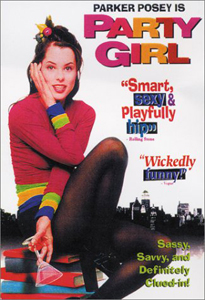
“Party Girl” (1995) is also in that mix, and it’s not as absurd as “Reality Bites,” but this is largely because of the tone created by the titular Mary (naturally smirking Parker Posey). Director/co-writer Daisy von Scherler Mayer creates one of those comedies without jokes or great set pieces, probably by accident, instead seeing her film propped up by the indie queen of the time.

“Party Girl” (1995)
Director: Daisy von Scherler Mayer
Writers: Harry Birckmayer, Daisy von Scherler Mayer, Sheila Gaffney
Stars: Parker Posey, Omar Townsend, Guillermo Diaz
Like a 25-year-old Punky Brewster, Mary – particularly rocking a layered shirt with four primary colors along with jean shorts and leggings – recognizes she has not been working toward a solid future. Her ambitious schemes tend toward organizing illegal parties in abandoned buildings with DJ roommate Leo (Guillermo Diaz). Drugs are barely worth remarking upon in this world; drinking, cigarettes and jail time are neutral or comedic points.
Harboring the standard dose of Gen-X ennui, Mary reads the myth of Sisyphus as a guide to choosing your own mindset; no matter how much things suck, you can choose to be happy. Thirty years later – with inflation plus a trend of filmgoers not forgiving cinematic unreality — this lands with a thud. Sure, Mary lives in a dump, but it looks that way because she’s too lazy to decorate the space. She can afford a loft apartment (big enough for one of her moneymaking parties) in New York City despite not having a steady job. And her path to success is to become a librarian.
Climbing the stacks
As smirking as “Party Girl’s” tone can be, the plot is not intended to be ironic. It’s a straightforward story of someone who struggles to work eight hours in a row, five days a week (at a time when that can get you a decent living), until forcing herself to do so. Mary is not dumb, but she wouldn’t bat an eye if confronted by Lloyd Christmas and Harry Dunne whining about their plights.

She doesn’t have to battle uphill as much as Sisyphus; her head librarian godmother Judy (Sasha von Scherler) gives her a job as a clerk, which Mary can hold as long she doesn’t leave the windows open during a rainstorm. The low stakes are part of why “Party Girl” is rather flat when compared to, say, the same year’s “Empire Records.” In that film, with much wilder plot twists, slackers find the only place they can hold a job and maintain their cred: a music store. (But they still screw it up.) “Party Girl” is comparatively tame in soundtrack and debauchery.
One edgy-in-1995 element is the plethora of gay and cross-dressing (code for trans, perhaps) characters in Mary’s party circles, and even more remarkable is that they aren’t remarked upon. Although Mary enjoys the access to clothes granted by her friendship with fashion designer Derrick (Anthony DeSando), they are genuinely friends, like “My So-Called Life’s” Angela and Rickie.
Also featuring a romance between Mary and Lebanese immigrant Mustafa (Omar Townsend) – a falafel vendor who aspires to be a teacher – “Party Girl” has straightforward motivations compared to the chaos of “Empire Records.” The romantic speedbump, as always, is a misunderstanding, and this is perhaps the most understated one you’ll find in cinema. As far as I can tell, Mustafa announces in English that he has asked Mary out for dinner in Lebanese, and she walks away as if she heard him. But apparently she didn’t? Because then she stands him up (obviously not on purpose) and they are estranged.
I suppose this could be an artifact of this being a low-budget indie at a time when indies were noticeably indie. “Party Girl” could’ve been shot down the street from “Clerks.” It doesn’t have a quarter of the laughs, and appropriately, it’s not a quarter as popular. Yet “Party Girl” and “Parker Posey” were name-dropped a lot in cool-film-geek discussions of the time. The reasons for that have become hazy 30 years later. That said, the passing of time makes it hard to be mean to this tame movie and its likeable pseudo-slacker, even if she doesn’t seem like much of a victim.