
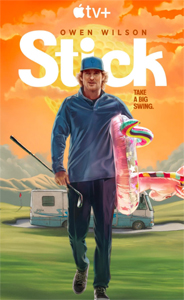
“Stick” (Apple TV Plus) takes old generation-gap and coming-of-age issues and sometimes makes them as fresh as the dew at the morning’s first tee time. At other times, it portrays Gen-Z as by far the most insufferable generation to walk Planet Earth.
But on the other hand, it’s likely for the sake of lessons learned at the end of the day. When will that be, though? Six of Season 1’s first 10 episodes have aired, and “Stick” feels like a stretched-out movie.
A good movie, though. Owen Wilson plays, well, Owen Wilson. Technically, he’s the title character, once-great golfer Pryce Cahill. Wonderful golfer name, even though it sounds kinda Gen-Z. He’s a Gen-X’er, of course, as are his RV traveling companions Mitts (Marc Maron), his former caddy; and Elena (Mariana Trevino). Gen-Z is represented by golf phenom Santi (Peter Dager), the 17-year-old son of Elena; and his caddy/girlfriend Zero (Lilli Kay).
“Stick” Season 1 (2025)
Wednesdays, Apple TV Plus; 10 episodes (six have aired)
Creator: Jason Keller
Stars: Owen Wilson, Peter Dager, Lilli Kay
Pryce is washed up, Wilson isn’t
Jason Keller’s “Stick” follows in the reactionary, feel-good resurgence of “Ted Lasso” (2020-present). Thanks to Wilson, I like this golf series a little more than the soccer one. (The sport isn’t the point, although the golf scenes convincingly make Santi seem like a budding star.)
But I find myself criticizing “Stick” in the margins. On the plus side, we’re hanging out with Wilson and Maron on an extended road trip to beautiful golf courses. Wilson tones down the excessive parts of his schtick, tapping into a perpetual earnestness similar to “Midnight in Paris.” Pryce has been through the wars but still holds onto hope, especially in comparison to Mitts. Maron is a master of bitten-off wisdom.
They are two middle-aged white dudes, as Zero would be quick to point out. The other three main characters represent Diversity, and I’m honestly not sure if they are annoying because the stage is being set for redemption arcs or if the writers’ life perspectives are naturally this irksome.
Zero, a 20-year-old bartender who quits in disgust and begrudgingly (!) takes the $10K (!) caddy job, is the type of character who proudly announces she/they is an anti-capitalist. But she/they doesn’t have the decency to be embarrassed by being impressed that Elena took Pryce for $100K for the right to coach Santi. Hypocrisy is so cool (or cash? Or fire? Or based?).
Zero’s gender-fluidity is frustrating to Pryce and Mitts, who learn the bizarre truth that saying “her” and “their” are both correct on a given day. Santi is, comparatively blandly, half Hispanic (on his mother’s side) and half white American. His father is off screen but still present. His serious coaching tactics drove Santi away from golf before Pryce (with a lot of effort, and risking being accused of stalking a minor) talks him into picking up a club again.

The Pryce of success
“Stick” achieves a light touch via Wilson and Maron but also needs conflict in order to be episodic TV. So we have Santi’s petulant reaction to getting coached by Pryce in their first tournament, and his over-the-top reaction to finding out Pryce paid Zero big bucks to be his caddy. They admit it’s because he’ll listen to Zero, not to Pryce, and he’s unaccountably offended.
Maybe Santi’s mix of confidence on the golf course and self-loathing off it (he wonders if Pryce paid Zero to pretend to like him) will prove interesting. I cynically wonder if Zero is on “Stick” to make Santi seem less annoying by comparison. Elena isn’t all that admirable, either, taking $100K to sell her son (although, granted, he agrees to it, and it’s a financial arrangement that would happen in the real world with underage athletes).
But then there’s this angle: “Stick” makes the three Diverse characters into the most annoying ones. Maybe that’s progress?
Also in that weird middle ground where I’m unsure if “Stick” is exploring moral conundrums or being hypocritical, Zero, an adult, is in a relationship with Santi, a minor. (The actors are 29 and 22, respectively.) It’s considered fine by every character, but would it be if the genders were flipped? And if the answer is no, why is that?
“Stick” stands out in a TV landscape wherein the feel-good dramedy had been left in the dust by post-apocalyptic zombie fiction, quirky murder mysteries and superhero spinoffs. “Ted Lasso” walked so “Stick” could walk faster toward bringing back the dramedy. The core principle of a top-to-bottom likeable cast is being tested. But in scenes like Pryce reflecting to Elena about a life he could’ve had before tragedy struck, I’m happy Wilson is getting a chance to sink the acting equivalent of birdies.