
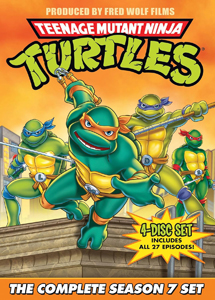
In what seems like a conscious effort after the “European Vacation” sideseason (a.k.a. Season 7, part one), story editor and lead writer David Wise brings “Teenage Mutant Ninja Turtles” back to its highest ebb for CBS’ Season 7 (1993). This batch of 14 episodes – 12 by Wise – is the best since the middle of Season 3.
‘TMNT’ gets darker
A big part of it is the production quality. The background cels are evocative; you might call this the “midnight season.” While CBS had favored nighttime settings, contrasting with syndication’s daytime, now the sky is pitch black, with scenes lit by moonlight. Combined with “TMNT’s” continued cheapness with drawing extras, NYC seems deserted. (This always struck me as incongruous on Saturday mornings.)
The character animation also steps up, with the main characters always “on model,” as the industry saying goes. Newly introduced characters – the Triceratons in “Night of the Dark Turtle” (14), Scumbug and Antrax in “Night of the Rogues” (19), Merdude in “Atlantis Awakes!” (23), and Tokka and Rahzar in “Dirk Savage: Mutant Hunter” (24) — resemble their action figure counterparts. (In appearance, that is. The personality of Rahzar – now speaking like an English gentleman – is an insane choice by Michaelangelo actor Townsend Coleman, topping even Krang performer Pat Fraley’s intellectual-sounding Antrax.)

“Teenage Mutant Ninja Turtles” Season 7, episodes 14-27 (1993)
CBS
Episodes: “Night of the Dark Turtle” (14), “The Starchild” (15), “The Legend of Koji” (16), “Convicts from Dimension X” (17), “White Belt, Black Heart” (18), “Night of the Rogues” (19), “Attack of the Neutrinos” (20), “Escape from the Planet of the Turtleoids” (21), “Revenge of the Fly” (22), “Atlantis Awakes” (23), “Dirk Savage: Mutant Hunter!” (24), “Invasion of the Krangazoids” (25), “Combat Land” (26), “Shredder Triumphant!” (27)
Producer: Fred Wolf
Writers: All by David Wise except 17 (Jack Mendelsohn) and 18 (Jack and Carole Mendelsohn)
A couple new music cues are used early in the batch (though this doesn’t continue), and extra attention is given to some fight scenes, notably in season finale “Shredder Triumphant!” (27). But — while acknowledging that Wise’s writing level doesn’t consistently rise to “great” – this is the best season in a long time thanks to the scripts.
At least three episodes deserve consideration for ranking among the series’ best. Season premiere “Night of the Dark Turtle” is both an answer to the increasing popularity among the target age group of “Batman” (as “The Animated Series” premiered in 1993) and a parody of Batman (Mikey is worried about copyright infringement). Donatello becomes The Dark Turtle; Barry Gordon has a blast with the voice performance and Donnie even intends to drop a limp Shredder to his death before his brothers intervene.

Maybe they wish they hadn’t because Shredder (newly and menacingly voiced by Coleman midway through this season, as James Avery retires from the role) becomes more competent, along with his allies. There’s no special reason for it except better scripting.
From international to interdimensional
Although it’s doubtful that Wise watched the Europe episodes – in “Atlantis Awakes!,” Raph questions whether Atlantis exists even though the Turtles should know it does from “The Lost Queen of Atlantis” (9) – he reverses course on the villains’ increasing idiocy. You might assume the baddies attack European cities because the Turtles keep stopping them in NYC, and the Turtles then travel to Europe to stop them; but no – the bad guys choose the exact locations where the Turtles are vacationing!
In CBS’ Season 7, noting that no one other than the Turtles stops them in NYC — despite a politician taking credit for the crime drop in “Dirk Savage: Mutant Hunter!” — Krang and Shredder devise schemes to distract or dodge the Turtles. Perhaps they have taken note that although NYC features other defenders such as Usagi Yojimbo, Bugman and the cops, they generally leave the streets open to attack.
In “Escape from the Planet of the Turtleoids” (21), Krang makes a power play for the Technodrome only when the Turtles are in outer space (They return in the nick of time). And in “Night of the Rogues,” Shredder recruits seven villains – the aforementioned two new ones plus oldies Leatherhead, the Rat King, Slash, Tempestra and Chrome Dome — to distract the Turtles while he robs a bank. It works for a while except that the Turtles get help from Casey Jones and Zach.
While that is a fan-favorite episode because Wise essentially plays with action figures, a better one is season finale “Shredder Triumphant!” Though he’s not triumphant at the end of the day, he and Krang put the Turtles through their paces even more so than Krang does in “Invasion of the Krangazoids” (25), where he creates six clones of himself who grow full bodies, and “Attack of the Neutrinos” (20), where he brainwashes the Turtles’ three Dimension X friends to attack them.
The fixes there are straightforward – the Krangazoids turn on their master, and the Neutrinos are put back to normal with a whistle – but in “Triumphant!” K&S toss our heroes into Dimension X, where they are enslaved. They stick around to help a revolt in this unusually serious episode from a kids’ perspective. This is a random choice by Wise, but I do love how Irma steps up her game and becomes a worthy fighter. Perhaps this is Wise’s reaction to the missed opportunity in Jack Mendelsohn’s “Convicts from Dimension X” (17), which finds Irma and Vernon locked in a brutal prison. Vernon is a scaredy cat and Irma is useless.
Blasts from the past
Possibly the best episode of the entire series is “The Legend of Koji” (16), a standout for the background imagery of ancient Japan. The Turtles and Splinter go through Shredder’s time machine and meet Splinter’s ancestor, young Hamato Koji. He ends up founding the Foot Clan, and while you might say Shibano-sama (from Season 3’s “Blast from the Past”) founded it, Wise accounts for that in a narrative twist. An unsubstantiated rumor among die-hard “TMNT” fans is that “TMNT III” (1993) was originally going to incorporate the multiverse; the wall hangings featuring “kappa” who look exactly like our heroes could perhaps be explained by the earlier visit by the cartoon quartet.
“White Belt, Black Heart” (18), by Jack and Carole Mendelsohn, would be a standout in a lesser batch, simply because it features Splinter’s sensei, Mogo-San, plus a youth who Splinter trained in the past, Yoku. This might’ve been a chance to flesh out Splinter’s life as Hamato Yoshi in flashbacks, but it all takes place in present day with Mogo-San and Yoku being inexplicably nonplussed by Splinter’s appearance and the fact that he has four adopted mutant Turtle sons.
Now I don’t mean to say Season 7 is an uninterrupted burst of originality, continuity and creativity. Among the mediocre ones: “Revenge of the Fly” (9) is enjoyable in the sense that Baxter-Fly is always entertaining (and now we can add spider to the list of creatures Vernon has been turned into, along with rat and turtle), “Atlantis Awakes” is a generic Atlanteans tale (although it’s funny that Bebop is temporarily their ruler), “Dirk Savage” is a repeat of Season 2’s “Invasion of the Punk Frogs” plot with mutants inexplicably hated by citizens, and “Combat Land” (13) is a straight “Westworld” homage.
Among the weaker entries: “The Starchild” (15) is a boring “E.T.” riff, and “Escape from the Planet of the Turtleoids” is a sequel to Season 5’s “Planet of the Turtleoids” that largely repeats the plot (and brings back Dirtbag and Groundchuck).
But we’re dealing with a low bar here, and I had a smile on my face through much of Season 7, even the weaker episodes. I can tell “TMNT” – or at least Wise – is trying to get this show a little closer to the new standard set by “Batman.” Season 8, the first “red sky season,” will make an even more conscious push for quality, and I’m looking forward to seeing if it can pull it off.