
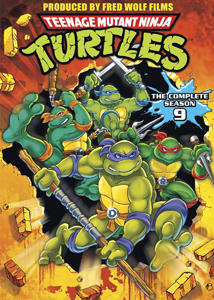
As “Teenage Mutant Ninja Turtles” was dropping in the ratings in the age of “Power Rangers” and “Batman: The Animated Series,” it was stepping up big-time in quality with Season 9 (1995, CBS). Synergy between animation and scripting only blessed “TMNT” in episodes here and there up till this point, but with these eight episodes we get outstanding animation and a smart (and unfortunately timelessly relevant) storyline about a ruler who skillfully tricks the populace.
The show had gotten more serious in Season 8, but it was on the dour side. Season 9 – mostly written by David Wise, although Mark Edens launches the arc — finds the right balance. The Turtles’ expressions are “cartoony” in a good way, reminding me heavily of Archie’s “TMNT Adventures,” particularly Ken Mitchroney’s work. The animators’ use of shadow and light has never been better, and the backgrounds show massive improvement: While the sky still has red in it, it can be starry black when needed; visually, we’re back on Earth.
An Archie influence?
Wise’s writing also seems to draw from Archie: Yes, there is humor (Raph’s quippage game is on point), but there are no comedic B-plots (Krang’s gang and Channel Six are totally absent; April is now an independent reporter – although it’s unclear how she gets her reportage to the populace, as a website is not mentioned). The story is adventure-based, with excellent pacing.

“Teenage Mutant Ninja Turtles” Season 9 (1995)
CBS, 8 episodes
Episodes: “The Unknown Ninja” (1), “Dregg of the Earth” (2), “The Wrath of Medusa” (3), “The New Mutation” (4), “The Showdown” (5), “Split-Second” (6), “Carter, the Enforcer” (7), “Doomquest” (8)
Producer: Fred Wolf
Writers: Mark Edens and Bob Forward (1), Edens and David Wise (2, 3), Wise (4, 5, 6, 7, 8)
Season 9 adds two strong main characters. While Lord Dregg’s schemes – and his rants about the Turtles — are much like Krang’s, the stentorian work of British actor Tony Jay, combined with a voice modulator, gives him heft. In design, he looks a bit like Archie’s Maligna, but rather than leading a roach hive-mind, his strategies are like modern USA populist politics: He tells everyone he’s helping the Earth, and blames problems on the Turtles.
What might’ve seemed blunt in 1995 now plays like politics as usual. One bit of naivete from Wise is that the Turtles can stop Dregg by exposing his plan – capturing his true orders to an underling on tape. Wise didn’t figure Dregg might develop such a cult-of-personality following that the tape would not hurt him. Additionally, it’s convenient that Dregg takes that as a defeat and runs off; in reality, he’d still need other people in power to strip his power. (I suspect this issue will be explored in Season 10, as I see Dregg is still around.)
The second key addition is Carter, introduced in “The Unknown Ninja” (1). He’s the cartoon’s answer to Keno from “TMNT II.” This young man who desires to learn martial arts from Splinter functions as a foil for the Turtles’ personalities to stand out, as each of them reacts to Carter’s behavior. He’s immature at times, but to be fair, in one of the major cases where he’s a pain in the shell, it’s a robot duplicate created by Dregg, in “Carter, the Enforcer” (7).
“TMNT’s” storytelling had been built around plot conveniences whenever necessary for seven seasons (and to a lesser extent, the eighth), and that doesn’t change in Season 9. However, Edens and Wise channel the conveniences into one conceit: that the Turtles and Carter can suddenly and rather randomly hulk out (due to their mutations destabilizing). I should hate that, but I don’t. All “TMNT” fights end in contrivances anyway; might as well end them with the Turtles turning into uber-mutants. Cam Clarke, Barry Gordon, Townsend Coleman and Rob Paulsen do a great job deepening their voices while keeping the personalities intact.
Space and time
Although the Red Sky Seasons don’t have passionate fans among action-figure collectors, one of the best one-off characters is the titular villain of “The Wrath of Medusa” (3), the season’s second-best episode after “Carter, the Enforcer.” The name is unfortunate because she has nothing to do with the Medusa myth, but Carol Katz’s vibrant voice work combines with good animation and action to give the team one of their best female opponents.
Another worthy villain pairs with a clever plot in “Split-Second” (6). It’s tempting to call him The Clock King, as “TMNT” edges awfully close to “Batman” here, but he’s named Chronos, and his clock- and timing-based scheme is in revenge for a past encounter with the Turtles. While it’s a shame this encounter is not from an actual past episode, it still broadens the world nicely.
Speaking of time and space, the gang travels to the distant future of 2015 in “Carter, the Enforcer” to see the apocalypse caused by Dregg’s rule, and Donnie dispatches Medusa into a space-time warp similar to the dispatching of Titanus last season. Various adventures take place off Earth, including “The Showdown” (5), a lesser version of Archie’s Stump Asteroid story that features one of the most made-to-hate supporting characters, Carter’s wannabe tough-guy enemy Jet McCabe.
Even in that relatively weak episode, Season 9’s scope is appreciated. Granted, there are no moments of non-New Yorkers reacting to Dregg, but it’s easy enough to imagine that happening off screen. Unlike in Season 8, we see enough New Yorkers (including the Channel Nine station manager who rejects April’s tape revealing Dregg’s evil, as he says she could’ve faked it) that Wise’s story substance has caught up with the animation style.
And the animation is better than in Season 8, where there’s an uptick in money spent per episode but the action and pacing are a tad stiff. “TMNT” is lively and fun in Season 9. In 1995, few (including me, I admit) had stuck around to appreciate it. Better late than never for Wise and company, and better late than never for the fans to find “TMNT” ’87 at its best.