
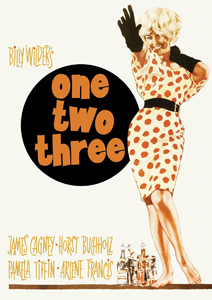
“One, Two, Three” (1961) is a good showcase of what writers Billy Wilder and I.A.L. Diamond can do with quick-hitting language. Though it is stagier and stodgier than exchanges of barbs we’ve seen in movies since then, it was a standout at the time, with most of the cast able to pull off witty exchanges in a natural way.
It’s a rompish farce, but not for the sake of brainless silliness; instead, it’s for the sake of saying lots of things about universal human behavior and the daily life of people living in West and East Berlin – particularly those moving between the halves of the city.
Wilder, who also directs, gives us a sense of immediacy by placing us in the summer of 1961, when all eyes are on Washington … because Roger Maris has knocked a couple more homers against the Senators. We jump to Berlin, but our focus remains on an American: Coca-Cola’s executive for Germany, C.R. MacNamara (James Cagney, game for the fast talking).
“One, Two, Three” (1961)
Director: Billy Wilder
Writers: Billy Wilder, I.A.L. Diamond (screenplay); Ferenc Molnár (play)
Stars: James Cagney, Horst Buchholz, Pamela Tiffin
Human absurdity transcends borders
Wilder and Diamond often employ half entendres, delighting in dodging the censors by creating a code with audiences. For example, MacNamara refers to his trysts with zesty German secretary Fräulein Ingeborg (Lilo Pulver) as “German lessons,” with particular emphasis on learning about umlauts.
After events – which to the writers’ credit are plausible within the plot’s insanity – find Ingeborg wearing only a slip, MacNamara suggests: “You better put something on. Your goose pimples are showing.” “That’s nothing. You should see my sister,” Ingeborg says.
The title “One, Two, Three” refers to the mechanical precision of German workers who retain Nazi-era discipline (though they dodge admitting they were members of the Nazi party), particularly office manager Schlemmer (Hanns Lothar), who has to borrow Ingeborg’s dress at one point.
This could be a great double feature with “Ninotchka” (written by Wilder) in that both films poke fun at Eastern socialist philosophies and Western concepts of corporatism (called “capitalism,” since movies always fail to make the distinction).
“One, Two, Three” is the less subtle of the two, but it’s also completely a comedy. About 75 percent of the dialog is laugh lines, with the other 25 percent devoted to rapidly moving the plot along. The sad aspect of MacNamara cheating on his wife (Arlene Francis) is barely relevant.
Love is blind — and deaf and dumb … and funny
Technically, it’s a romance, too, but that romance is between two delightfully absurd characters: Scarlett Hazeltine (Pamela Tiffin), sexpot Southern daughter of the Coca-Cola boss, and Otto Ludwig Piffl (Horst Buchholz), a hardline Russian Communist. Every line from Otto reflects his staunch belief in the Party; he openly admits he puts Party before love, but there’s no chance of the love-blinded Scarlett being turned off.

Although there are no realistic stakes, “One, Two, Three” is not exactly a relaxing viewing experience. At one point, Otto – mislabeled as an American spy – is tortured by East German officials playing “Polkadot Bikini” on repeat. It’s an early Sixties reference that turns out timeless because one, the song is still annoying, and two, you can imagine a current novelty hit in there.
“Sabre Dance” is the film’s dominant song, and you’ll be sick of that one, too (although it’s a perfect match for this movie’s energy). Amusingly, since it’s played in an East German club when MacNamara pretends he’ll trade his sexy secretary for access to Russian markets, Ingeborg hums “Sabre Dance” in the next scene.
I come away exhausted yet impressed with the clever, censor-dodging dialog and, to a lesser extent, the way in which the actors deliver it. (Considering that none of the cast specializes in this type of comedy, they’re very good.)
In “One, Two, Three,” as in 1959’s “Some Like It Hot,” Wilder understands the value of brisk pacing. Follow up an absurd image – for instance, a poorly made Russian car falling apart piece by piece and then crashing (but everyone walking away, although one is wearing the door) – by smash-cutting to the next scene. It’s strange that he’d forget this lesson later with the slogging “Kiss Me, Stupid” and “Fortune Cookie,” but he knew it in 1961.
Wilder Wednesdays looks at the catalog of legendary writer-director Billy Wilder.