
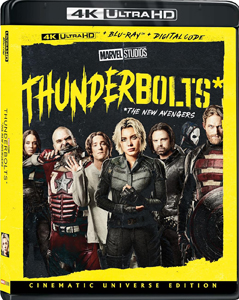
The Marvel Cinematic Universe rediscovers the heady times of about a decade ago with “Thunderbolts,” a story of six decidedly rough-around-the-edges anti-superheroes-turned-real-superheroes that goes down smooth. Befitting the theme of this 36th MCU film, it’s a team effort (and what a monumental career leap for director Jake Schreier). But if there was any hint that this level of quality was coming, it’s that writer Eric Pearson had penned solid work such as “Thor: Ragnarok” and “Black Widow.”
The latter is not an elite entry, but the banter between Widow operative Yelena (Florence Pugh) and her father — the aged Russian answer to Captain America, Alexei Shostakov (David Harbour) — is a highlight. That continues in “Thunderbolts,” which — like the lesser 35th entry, “Captain America: Brave New World” — effectively juggles multiple points of view.
Yeah, but they’re really depressed
The depressed Yelena is the initial audience surrogate, but experimental supersoldier patient Bob (Lewis Pullman), a former meth addict, competes for that mantle. And like in “BNW,” the villain’s POV is thoroughly analyzed; here it is Valentina Allegra de Fontaine (Julia Louis-Dreyfuss), a military industrialist who is also the director of the CIA. She has divested her corporate interests in word but not deed. Through politics and secret assassinations – including assassinations of the assassins by each other — she aims to become unimpeachable.
“Thunderbolts” (2025)
Director: Jake Schreier
Writers: Eric Pearson (screenplay, story), Joanna Calo (story)
Stars: Florence Pugh, Sebastian Stan, Julia Louis-Dreyfus
It’d be too simple to call this new team of ex-assassins a rougher, more grounded 2020s answer to the Avengers of the 2010s. The original sextet all had issues, after all. But the thing about this sextet – Yelena, Alexei, Bob, Bucky/Winter Soldier (Sebastian Stan), John Walker (Wyatt Russell) and Ava Starr (Hannah John-Kamen) – is that they really have issues.
Though the heroes always look rough, Pearson’s screenplay is sharpened to a fine point of themes about depression, loneliness, trust-building and political power. “Thunderbolts” knows when to add comedy and how to cue a mood via Son Lux’s versatile score. I’m simply describing slick Disney filmmaking, I suppose, but when we see stumbles such as … well, every recent entry not overseen by Ryan Reynolds or James Gunn … we’re reminded that this is not easy to do. We were spoiled last decade.
Additionally, Pearson – who got his start overseeing TV’s “Agent Carter” – incorporates threads from the Disney Plus TV shows without making us need to watch them. (Yet he almost inspires me to watch them, to learn more details.)
We find the Thunderbolts endearing when they have to team up to escape de Fontaine’s death trap. While the strategy is for the four of them (Alexei and Bucky join later) to climb back-to-back, arm-in-arm up a circular shaft, Pearson’s smart strategy here is to use comedy that also gives us information. Yelena asks if anyone can fly. Nope. “We all just punch and shoot?”
I don’t know what the escape route is for this problem, but MCU films are almost always loaded with exposition. “Thunderbolts” is unable to drop the exposition, but Pearson never makes it dry. It’s always blended with witty lines and action. At every point, I know what I need to know, yet I don’t know how the story will end. Pearson falsely telegraphs directions for key characters, then reverses course in ways that make emotional sense.
Sharp wit makes world-building go down smooth (Spoilers)
(SPOILERS FOLLOW.)
When “Thunderbolts” could go a cliched route of Bob embracing his de Fontaine-stamped role as The Sentry, with powers greater than a God, the film instead explores Bob’s inner thought processes. Why should he answer to de Fontaine?
And then there’s the question of whether Bob is emotionally equipped to wield such power. Here, “Thunderbolts” takes us into one of the best astral-plane sequences I’ve seen in a superhero film. The stakes in the final act are as high as when Thanos aimed to wipe out half the galaxy’s population. Yet they remain personal and grounded. The literal void of an astral plane of what Yelena calls “shame rooms” (again, exposition softened by easy wit) plays as a metaphor for the void within a mentally ill person.
These New Avengers are not out of reach like the Old Avengers; they are the common man (even if some have superpowers, notably Eva Starr/Ghost, whose skill is similar to “X-Men’s” Shadowcat).
And their problems are of the 2020s: It’s not as simple as a government official stamping them as the New Avengers. They’re not cool and slick. They might not even have legal copyright status to be the Avengers. Pearson, with Disney’s approval (to its credit), goes meta in a montage of clippings showing that the fictional public does not fully embrace them. Likewise, if the real moviegoing public doesn’t want this sextet to be the Avengers, Disney can pull back. It’s like a collective “choose your own adventure.”
But great filmmaking sells; it seems people like this movie and this team. The MCU is not pushing utopian hope on us; it’s reflecting reality even more so than “BNW,” which intended to be grounded but ended with the president turning into a Hulk and – even more surprising – showing humanity. Will de Fontaine soon occupy a prison cell alongside ex-President Ross? Well, do we live in a real world where Trump, Biden, Obama, Fauci, Netanyahu, etc., will pay a legal price? No, but that doesn’t mean there aren’t workarounds; “Thunderbolts” is a celebration not of utopian hope but of practical hope. Hashtag “Yes, my Avengers.”