
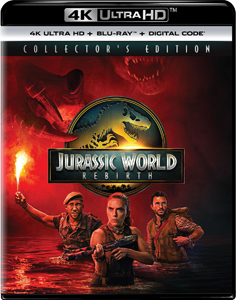
The seventh “Jurassic” movie is for some reason called “Jurassic World: Rebirth,” but colloquially I suppose people will call it “the 2025 one” or “the Gareth Edwards one.” It also marks the return of writer David Koepp, who had departed after the first two films. In those cases, he adhered to the themes and story beats of Michael Crichton’s novels. But now he gets to focus on cinematic scares and thrills, appealingly lowering (or at least under-hyping) the worldwide stakes.
Some might roll their eyes at the sub-Crichtonian theme and video-game-esque plot: By acquiring blood samples from three living beasts – a mosasaur in water, a titanosaur on land and a quetzalcoatlus in air – scientists can make a major step toward curing heart disease. (The way they get these samples is itself a delight of technological ingenuity.) Millions-seeking mercenaries and Pollyanna-missionaries team up on the quest to what I think is the third InGen island from the “Camp Cretaceous” animated series, although “Rebirth” is almost aggressively uninterested in “Jurassic” mythology details.
Some might notice the influence of Edwards, who launched the American “Godzilla” franchise in 2014, in the vibrancy. The film luxuriates in Malaysia and Thailand as stand-ins for a Central American island, and either the shots are enhanced by special effects or I didn’t realize we had such prehistoric-looking jungles on Earth. Cinematographer John Mathieson nicely works in fogs and colors, similar to the “Godzilla/Kong” films.
“Jurassic World: Rebirth” (2025)
Director: Gareth Edwards
Writer: David Koepp
Stars: Scarlett Johansson, Mahershala Ali, Jonathan Bailey
But the big reason “Rebirth” is on par with the Crichton-drawn films is that the dinos come to life; we believe the whole “red in tooth and claw” ecosystem. The special effects are far more professional than the American “Godzilla” franchise’s increasingly cheap efforts. We feel the smallness of the humans because so many shots crisply include both them and the dinosaurs.
Luxuriating in prehistory
A particularly naturalistic shot features a T-rex ominously rolling around while napping in the weeds. Nearby, Teresa (Luna Blaise), one of a family of rescued civilians thrown into this terror, tries to acquire a raft from a shed without being noisy.
Edwards favors B-monster-movie adventure over horror framing, but a sense of danger permeates “Rebirth.” While I didn’t necessarily believe the good, likeable characters would bite the dust, I feared for the side characters and villains. “Rebirth” moves beyond the recent trend in franchises like this one and “Scream” where everyone must (implausibly) survive.
For the first time in a while, a “Jurassic” film need not serve character legacies, so it simply casts good actors. Scarlett Johansson and Mahershala Ali (joining Chris Pratt with MCU-“Jurassic” doubles) provide star power as the principled mercs, but I notice their professional skills more. I knew less about the other actors, but they fill out the roster by appealingly side-stepping stereotypes. Jonathan Bailey plays a nerd but dodges the scaredy-cat jokiness; he’s reasonably brave. Rupert Friend plays the money-grubbing scientist, but he doesn’t twirl a mustache.

Meanwhile, a group of four, led by patriarch Manuel Garcia-Rulfo, crosses mosasaur territory in a midsize sailboat. Teresa’s boyfriend is the lazy Xavier (David Iacono), but when the film leans into the arc of him proving himself in survival situations, Xavier will have none of it. Koepp doesn’t totally avoid tropes, but he resists leaning into them.
The youngest, Bella (Audrina Miranda), adopts a baby ceratopsian and names it Dolores, and in the old days that might’ve been for the sake of selling toys and stuffed animals, but I don’t think that applies in 2025. The baby serves as canary in the coal mine; when it’s scared, predators are near.
Renewed sense of danger
“Rebirth” achieves consistent danger by emphasizing the bigness of the world (even though this is just one island, it might as well be Pangaea) and the smallness of humans. One way it does this is by taking time to breathe. The mosasaur portion plays like “Jaws” with its emphasis on characters and build-up while viewers know a monster lurks. Composer Alexandre Desplat is too understated, but I like how he uses callbacks to John Williams’ motifs without bludgeoning us.
This is a world where death can be escaped if you’re small enough, but it can also strike instantly. A great scene finds Xavier taking a piss and – except for the fact that stealthy raptors aren’t apex predators – he’d be dead before he knew it. The moment sets up the terrifying nature of the quetzalcoatlus.
“Rebirth” might lack dino-hype (compared to “Jurassic World’s” I-rex and “Fallen Kingdom’s” indoraptor) but it serves up a nice mix of new scientific discoveries (the notably long tails on the peaceful titanosauruses) and H.R. Giger-esque creature design. An ugly mutant beast, called a D-rex in signage at the InGen lab, bookends the film with two classic horror sequences. Distortus rex is its full name, two seconds of research tells me.
“Rebirth” doesn’t move the franchise’s story forward much. And thematically, the idea of open-sourcing science is wonderful, but Koepp has little idea how it could happen for real. Edwards’ sensibilities bring “Jurassic” back to B-movie storytelling traditions, combining that with elite modern effects and characters whose unimportance on the world stage of dino-politics is their appeal.
“Jurassic World: Rebirth’s” various steps backward combine into an invigorating step forward.