
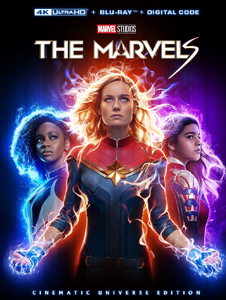
The Marvel Cinematic Universe has achieved a weird semi-success, semi-failure with Captain Marvel (Brie Larson), introduced in “Captain Marvel” (2019) and getting her second showcase in “The Marvels” (2023), where she teams with Monica Rambeau (Teyonah Parris) and teen Kamala Khan/Ms. Marvel (Iman Vellani). (Commercially, the trio of characters seems to be a failure, as the film lost money – unheard of for the MCU – and “Ms. Marvel” doesn’t appear to be getting a Season 2. But we’re speaking in critical terms for this review.)
The long-lived Captain Marvel (a.k.a. Carol Danvers) doesn’t totally know her own backstory, as she’s plagued by dreams and visions. But that’s not an excuse for keeping a viewer so in the dark in “The Marvels,” directed and co-written by Nia DaCosta, who did decent work writing “Candyman 4.”
(SPOILERS FOLLOW, although you might actually want to read this section to understand the plot better.)
An absolutely crucial plot point for “The Marvels” is that Carol destroyed an artificial intelligence that was ruling the Kree homeworld; while this was intended as a good act, it sent the world on a path to destruction that somehow included the depowering of its sun. This is revealed off-handedly midway through the film by Dar-Benn (Zawe Ashton), the Kree leader who hates everyone, but particularly Carol, whom she calls The Annihilator.

“The Marvels” (2023)
Director: Nia DaCosta
Writers: Nia DaCosta, Megan McDonnell, Elissa Karasik
Stars: Brie Larson, Teyonah Parris, Iman Vellani
Carol’s part in the Kree’s problems is not shown in “Captain Marvel” nor in any of the TV series, nor in a tie-in comic or book. The web can only tell me the event happened between “Captain Marvel” and “The Marvels.” Dar-Benn’s offhand mention, accompanied by a brief visual of Carol blowing up the AI building, is the only reason we know about it.
(END OF SPOILERS.)
The Marvelous Ms. Marvels
This is inexplicably bad plot writing. But on the flip side, the character writing is good, even bordering on delightful. The MCU’s 33rd film brings together three superpowered women: Captain Marvel, brooding on her spaceship an occasionally checking in with Nick Fury (Samuel L. Jackson); Monica, who also works with Fury since being resurrected from the Blip, but who has not yet reconnected with her surrogate aunt Carol due to hard feelings from Carol leaving when Monica was a kid; and Ms. Marvel, a New Jersey teen who hero-worships the famous Captain Marvel, who has a comic-book line in addition to being an actual hero.
The way they meet is so clever that it’s stunning it comes from the same team of writers who bungle the explanation for why the villain loathes Carol. The trio’s light-based powers are linked (due to mumbo-jumbo, which I’ll allow), so when any two of them activate their powers simultaneously, they swap positions in space and time.
This allows for entertaining, well-choreographed sequences of the trio popping up in each others’ spaces while doing various things: Carol is fighting the Kree, who are encroaching on their sworn enemies the Skrulls; Monica is repairing a space station; and Kamala is in her room, sketching herself in a team-up with Captain Marvel. (Indeed, she named herself after the elder superhero.)
Eventually, they get together in the same time and space, and it’s a blast to see them practice turning their swapping abilities into a positive force. Additional moments of whimsy come from a visit to a planet where everyone communicates via singing, and where Carol is in a political marriage with a friend and ally; and from an evacuation of a space station that relies on herding Flerken, which – continuing from the amusing revelation in “Captain Marvel” – look exactly like Earth cats but “eat” people with their tentacles and spit them out later, undamaged.
A smile-worthy running gag taps into the odd oversight that Monica does not have a superhero name. Throughout their time together, the bubbly Kamala tries to think one up for her. Not quite as brilliant as Norm MacDonald’s Mr. Fantastic skit, but nonetheless funny.
Flying to the big screen
Although completists already knew Kamala from TV’s “Ms. Marvel” (2022) and the grown-up Monica from “WandaVision” (2021), those who haven’t watched the TV shows won’t be lost in terms of character development. We can appreciate matters in shorthand: Ms. Marvel is the Spider-Man to Captain Marvel’s Iron Man, except with a helicopter mom, dad and adult brother; and Monica resents Captain Marvel for exiting her life in the 1990s. (As a superpowered being, Carol ages very slowly.)
“The Marvels” has to be appreciated for its playful rhythms and interplay, vibrant one-off ideas such as the song-and-dance culture, and the high production values. The gee-wiz sci-fi looks pretty good throughout, although it’s interesting that many scenes are in deep space and we had been told the three women use “light” powers. All three flirt with being “overly” powered in comic-book terms, but I never got a sense that this mission is too easy. The younger two are learning how to use their powers (Kamala can create solid forms, and Monica can fly), and all three are learning teamwork.
The motivations of Dar-Benn and why she wants the maguffin – Kamala’s gauntlet that’s a twin of her own – are broadly understood: She hates Carol’s guts and the gauntlet will give her extra powers. If you want any details beyond that, well, I’d actually say don’t bother thinking too hard about it.
(SPOILERS FOLLOW.)
At the end, Captain Marvel settles the whole issue by using her powers to restore the Kree’s sun. She could’ve done this at any point over the 30 years of the Kree’s suffering under a dying sun, but simply didn’t think of it. Monica thinks of it, and then Carol says she’s never tried such a thing. But when she tries it, she achieves it with no problem. The entire plot of the film need not have happened. To be fair, many things in life happen because of people not thinking of a way to stop it from happening; it’s just an unusually soft-edged plotting choice.
(END OF SPOILERS.)
Blurring your brain to the indecipherable plot and inexplicable underplaying of the hero-villain conflict doesn’t hurt “The Marvels” as much as it should. Its brainless entertainment value remains high. But unfortunately the flaws mean “The Marvels” can’t ascend beyond the midrange in the MCU, which has established a high bar.