
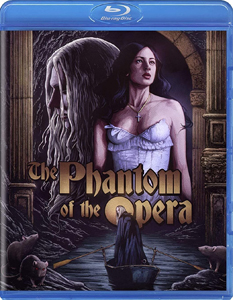
In my Dario Argento reviews up to this point in his filmography, I’ve given at least a mild recommendation to everything except 1990’s “Black Cat” (half of the “Two Evil Eyes” diptych), a Poe adaptation. “The Phantom of the Opera” (1998), adapting the 1909 novel by Gaston Leroux, is another step in the case that Argento should stick to original works.
Not the best version to start with
One of (according to Wikipedia) 43 screen adaptations of “Phantom,” this version stands out by mixing the gothic classiness of Leroux’s 19th century-set tragic romance with giallo-style gore; it’s pretty much guaranteed to displease fans of both camps.
It’s not totally without merit. Ennio Morricone’s score, if you were to listen to it separately, would seem to be from a wonderful epic. Cinematographer Ronnie Taylor shows off Italy’s Pertosa Caves, which serve as the Phantom’s (Julian Sands) vast stomping grounds beneath the opera hall (also lasciviously lensed).

“The Phantom of the Opera” (1998)
Director: Dario Argento
Writers: Gérard Brach, Dario Argento (screenplay); Gaston Leroux (novel)
Stars: Julian Sands, Asia Argento, Andrea Di Stefano
Asia Argento, as Christine – opera understudy and lover of the Phantom – gets fine treatment from Taylor as well, and she’s pretty good at this project-expressions-to-the-back-row acting. Had she been old enough, she likely would’ve had the lead role in “Opera” (1987), the far superior of Argento’s two operatic riffs.
Viewers new to Argento’s style will be taken aback by the fact that the on-set Italian is poorly ADR’d in Italian and then subtitled into English. The story is simple enough that the clunkiness doesn’t add confusion, although Christine’s behavior teeter-totters, even accounting for the “women are crazy” stereotype. She’s all about the sensual Phantom while she keeps hapless suitor Raoul (Andrea Di Stefano) on hand; to be fair, she says Raoul is like the brother she never had. But sometimes she hates the Phantom’s guts and calls Raoul “my love.”
Technically, this is due to the Phantom’s vampire-like ability to hold her in his thrall, but it’s not communicated all that well by the filmmaking; the unleashing of his powers happens invisibly, and we don’t know how he achieved the powers. In backstory, the Phantom is the Penguin from “Batman Returns” except raised by rats. He even refers to himself as a rat at one point.
A thing about rats
Argento aims to make this version stand out by upping the gross-out factors, both in terms of gore and human behavior. It’s hinted that the Phantom has a sexual connection with the rats (in addition to his familial bond); luckily this is a rare moment that cuts away rather than showing everything. An employee of the opera house is openly a pedophile, plying terrorized child ballet students with chocolate and “playfully” chasing them around.

And in a tangential plot that tries to force the movie into a comedic mode (with Morricone trying to help), two anti-Phantom bums build a magical steampunk lawnmower-type vehicle to mow down rats in the tunnels. The lead opera singer, Nadia Rinaldi’s Carlotta, is also saddled with a pseudo-comic thread wherein the Phantom tries to scare her off.
“Phantom” is too schlocky to really be sickening, blending unconvincing practical effects with bad compositing and CGI that didn’t pass muster even at the time. Granted, schlock is very much part of giallo, but it doesn’t play as well in this storyline because there’s no weird mystery: The Phantom is openly the antagonist.
So instead there’s simply weird gore and weird behavior, and it gets old after a while. The romance (or romance-via-thrall? It’s hard to tell) is the superior portion of the movie, simply because Asia Argento is an objectified beauty and Sands has charisma.
This movie is an experiment in mixing oil and water, and it’s interesting as far as that goes. I can’t say Argento is unengaged in terms of style, but I do miss his original storytelling. Even if that’s not his strong suit, his original plots keep us engaged and guessing; “Phantom of the Opera” is more likely to have us checking our watches.