
Noah Hawley (“Fargo”) is one of the few writer-directors working with pop-culture franchises who actively resists ’memberberries. When watching “Legion,” I had to actively remind myself it’s part of the “X-Men” saga.
Recognizably ‘Alien’
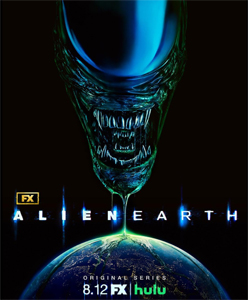
But “Alien: Earth” (Tuesdays, FX and Hulu) is more recognizably an “Alien” series – in fact, the saga’s first-ever TV series – and its retro-futurism is in lockstep with last year’s “Alien: Romulus,” an entertaining film that some criticized for being oversaturated with ’memberberries in the dialog and the use of Ian Holm’s likeness for a synthetic model.
That movie takes place just after “Alien” (1979), and “Earth” takes place just before. Hawley starts off episode one by showing the crew of the Maginot, very similar to the Nostromo’s. Except instead of delivering supplies and being diverted into specimen collection by the Company (known in the lore as Weyland-Yutani), the Maginot specifically collects specimens. Among them, a xenomorph.
“Alien: Earth” (2025)
Tuesdays, FX and Hulu (two episodes have aired)
Showrunner: Noah Hawley
Stars: Sydney Chandler, Alex Lawther, Timothy Olyphant
I wonder if it was a late, studio-mandated decision to emphasize this “Alien” visual connection off the bat with the ship interiors, cryopods, communal meal and crew members bitching about the Company. It’s not Hawley’s usual bent to drive home narrative connections, and we’ll soon see that the Maginot crew – aside from the resident synthetic, Morrow (Babou Ceesay) – is fodder, not the main cast. Hawley is interested in a whole ’nother big idea, communicated via flashbacks amid the Prodigy corporation’s search-and-rescue mission of the Maginot’s 9/11-esque wreckage.
Being a TV show, “Earth” is an indulgent theme and character piece like “Legion.” In 2025, we’re asking what exactly will AI look like? In the show’s 2120, that question has become thoroughly corporate. It’s like the VHS-vs.-Beta battle, but the issue is the precise nature of the singularity – how humans and technology will merge. One possibility is synthetics (Ash, Bishop, Call, etc.); we know from the films that they win out.
A hybrid position
Another product is hybrids – human psyches transplanted into synthetic bodies. This tech is in its earliest stages in “Earth,” developed by trillionaire genius Boy Kavalier (the Timothee Chalamet-esque Samuel Blenkin). Our main character is the first transference subject, Wendy (Sydney Chandler, a dead ringer for Linda Cardellini and a delightful actress in her own right).
Only children, whose brains are more flexible, can undergo the transfer process, so our main group is a half-dozen sick kids transferred into healthy adult artificial bodies. It’s a bit of “Legion,” a bit of “The Midnight Club,” and a lot of fun for the actors. Wendy tells a “secret” to her hybrid friend: Her brother, Joe (Alex Lawther), is a medic (“a type of doctor,” she explains) on the search-and-rescue mission. (Joe’s plea to Prodigy to be released from his contract mirrors the plea of Cailee Spaeny’s Rain in “Romulus.” In both cases, no such luck.)

The friend then blurts it out to Joe when they find him: Wendy, though she looks different now, is his sister. The children-as-adults are a great way to dodge cliched scenes, move the story along and have some laughs while also allowing a fresh angle into the question of what’s human and what’s artificial.
Sure, we get the “You’re not human” finger-wagging by the hybrids’ handler, Kirsh (Timothy Olyphant, half-charming, half-slimy), the classic scientist for whom knowledge vastly trumps empathy. But it is reasonably fresh. “Romulus” found an emotional angle with adoptive human and synthetic siblings (and, crucially, two good actors to play it out), but Hawley intends to go quite a bit deeper, as we’d want a TV series to do.
To sharply contrast the hybrids, Morrow is completely cold. The xeno-on-the-loose shipboard attack has been seen before, but not totally from the perspective of the all-business synthetic who not only lets a crew member get slaughtered outside his computer-room door, but who desires it to happen. A living witness would be a complication.
Not just about the alien, but not without the alien
Don’t worry, though, the alien in this “Alien” TV show is front and center by episode two. Hawley (who writes both hours) and second-episode director Dana Gonzalez particularly like Scott’s late-film shot of the xenomorph hiding amid the techno-wall and unspooling behind Ripley. Gonzalez also makes sure to emphasize wide shots so we know it’s a man in a suit playing this xenomorph.
Is it as scary as “Alien”? No, how could it be? But it’s grisly and threatening, on par with all the sequels save the unreachable masterpiece “Aliens.”
“Earth” nonetheless offers something we hadn’t seen before. The Maginot crashes into a large building that seems to be a multipurpose conapt like in a PKD novel, featuring a high-end fashion store as well as party rooms where people escape into the past. Had “Earth” been envisioned in the 1980s, this likely would’ve been a retro-futuristic shopping center, but 2025 writers know malls largely don’t exist now, and likely will not in 100 years. The set designers do impressive work melding what passes for an urban center in 2120 with a dripping, utilitarian spacecraft.
It’s hard to do something new with this franchise, and “Earth” does hemorrhage some disgusting wonder just because we’ve already seen the gross science of “Prometheus,” “Covenant” and “Romulus.” That said, it’s not nothing when a bug like the ear-crawler from “Star Trek II” escapes from the Maginot’s lab, attacks hapless Prodigy soldiers and goes through its own life cycle at an incredible rate.
An amusing line when the innocent hybrids come upon the aftermath: “Is that blood?” (Practically the entire room is painted with viscera.) The aliens have come to Earth, and this efficient, sterile, emotionless 2120 is soon slathered with enough organic material to make H.R. Giger squirm in his grave and aggressive infusions of empathy and personality via the hybrids’ innocent minds.
Welcome to Earth, again
Though it’s the saga’s most overt clash between unhinged nature and careful corporate planning, this is not the first time aliens have been on our fair planet, thus putting “Earth” in a weird position.
In 1992, fans thought for sure the xenos would come to Earth in “Alien 3” – the teaser trailer purposely misled them to that conclusion – but it didn’t happen. Logically, if xenos were discovered in “Alien,” then they would interact with wider society for the first time after that.
But then in 2004, “Alien vs. Predator” revealed aliens were on Earth at the time of ancient Egypt, and in “Requiem” they were in Colorado in 2007. OK, so throw out the “AvP” films (I’ve often read that they “don’t count”).
Ridley Scott himself – if there is an overseer of the franchise, it would have to be the “Alien” director, who is also a producer on “Earth” – nonetheless agreed that humans were linked with the aliens before the Nostromo’s discovery, as revealed in 2012’s “Prometheus.” Created via the Engineers’ magical and weird experimentation, the creatures firmly resemble the aliens we know in 2017’s “Covenant,” still set before “Alien.”
The hybridization of corporations and governments
We’re in this odd situation wherein the first story of aliens-on-Earth that “counts” takes place before the Nostromo truckers’ shocking discoveries in “Alien” – shocking even to synthetic Ash, who is most closely linked to the Company’s bigwigs.
There isn’t widespread knowledge of the creatures amid humanity; but there is institutional knowledge – and by institution, I mean the Weyland-Yutani Corporation. (And I suppose some grunts, but maybe they don’t talk much, or their talk is shut down behind the scenes.)
One more bit of continuity that’s shaky but still allowable. Earth has four major corporatist oligarchies. Weyland-Yutani is one of them. Prodigy is a smaller one, on the rise. By the time of “Aliens,” corporations and governments have split apart again, although W-Y and the Colonial Marines work closely together.
That’s the difference between a future-gazing 1986 idea and a future-gazing 2025 idea. But, awkwardly, the 2025 story takes place before the 1986 story. Not a plot hole, but also not the smoothest way to tell a story.
“Alien: Earth” tries to be smooth, tries to be complex, and mostly succeeds. I sense some strain, but it’s patched over by the likability of Chandler, the charisma of Olyphant and the careful world-building wherein Hawley is aware of nitpicky fans and the established aesthetics of “Alien” and “Romulus.” It’s as big-brained as “Legion,” but crucially, it has more heart. That the heart is synthetic is a technicality.