
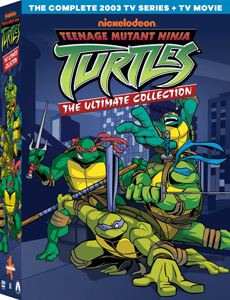
“Teenage Mutant Ninja Turtles” (2003) Seasons 1-4 are “TMNT” done right, and Season 5 (2008) is “TMNT” done so wrong that its biggest upside is it makes me appreciate how great the first four seasons are. One of the cool things about the Turtles is that they can easily move into any genre: street-level martial arts, space opera, rural horror, weird science, dreamscapes …
And – cue record scratch – magical fantasy. This is my least favorite genre, but even considering that bias, Season 5 is hard to watch because it’s a shallow representation of the form, loosely copying “Avatar: The Last Airbender” with smidgens of “Lord of the Rings,” “Harry Potter” and zombie lore. The plotting is bad, with writers (some new, some returning) throwing in new magical abilities on whims.
The Turtles take an ocean vessel through the sky to a mystical version of Japan, which – while vibrantly colorful – disconnects the viewer from any stakes since we don’t know how or why or where this place exists. Each Turtle learns a superpower – for example, Donatello can create a “cleaving wind” — and earns a magical weapon from the Ninja Tribunal; they develop glowing stripes in the colors of their masks when unleashing the power.

“Teenage Mutant Ninja Turtles” Season 5 (“The Lost Season”) (2008)
Fox, 12 episodes
Producer: Lloyd Goldfine
Director: Roy Burdine
Writers: Christopher Yost (1, 4, 6, 11, 12), Joseph Kelly (2, 5, 10), Danny Fingeroth (3, 7), Matthew Drdek (8), Roland Gonzalez (9)
All together now
The Turtles’ place at the center of the action is challenged because four additional human acolytes are also training. And when the action returns to NYC – a nice relief – they have the superheroes of the Justice Force to help them out. The camera does keep its focus on the Turtles and Splinter – even as the bad guys (Karai’s Foot Clan, Hun’s Purple Dragons and Bishop’s Earth Protection Force) join them — but it often strains.
In the abstract, the new villain – the Original Shredder – is a good one. Scottie Ray continues to do an epic Shredder voice, and dark choral music swirls around him. You can’t go far wrong by using some form of the Shredder as the villain, although convolutions are required to explain this one. The Shredder who was dispatched in Season 3 was Ch’rell, the one evil Utrom. We now learn Ch’rell simply stole Shredder’s identity for the sake of being intimidating.
This Original Shredder – a.k.a. Demon Shredder, a.k.a. Tengu Shredder – is the body of the human Oroku Saki combined with a mystical demon. The Ninja Tribunal has been guarding the sarcophagus against the Foot Mystics’ aims of using magic to resurrect the demon. Even as the Tribunal successfully powers up the Turtles and the four human acolytes, it also botches its guarding of the sarcophagus. Midway through the 12-episode season, the O.G. Shredder and the Foot Mystics float through NYC like Zod and his henchpeople in “Superman II.”

This sequence – in “New World Order, Part 1” (7) – is one of many that relies on things conveniently happening … or not happening, in this case. Even though we’re reminded in “Membership Drive” (6) that the Justice Force presides over NYC – and has in fact added previously solo superheroes Nobody, Raptarr and Nano – they are not on hand to fight the O.G. Shredder.
Vaguely, it’s suggested that Shredder has put some sort of shield over the city as he goes on his destructive spree, so that might explain it. Then again, it might not, because Season 5 is full of unclear plotting.
Huge stakes … and yet no stakes
In another example, the four human acolytes are killed in “Beginning of the End” (5), the conclusion of the training arc in magical Japan. I know no one is really dead in fantasy storytelling, and cartoons don’t usually show corpses, but one of them is crushed by a giant boulder while saving Donatello; another is eaten by a dragon. In “Enter the Dragons, Part 1” (11), the acolytes pop up in NYC, totally fine, mentioning a few bruises and scratches (which they don’t have anymore).
Other examples: Karai has the ability to absorb Shredder’s power as a containment vessel; she learns this via meditating off screen. This power comes simply because she has falsely taken on the moniker and costume of the Shredder. And the Foot Clan’s Dr. Chaplin is devising a magic-tech hybrid weapon off screen. These both might’ve made for decent side episodes.
Instead, Season 5 has only two of those; they are the two best because things slow down and the stories can be character-based. In Christopher Yost’s “Membership Drive,” Mikey seeks to join the Justice Force as the Turtle Titan; rather than being another training/quest story, we at least get the tale of the possessed Nano.
The season’s standout is Roland Gonzalez’s “Fathers and Sons” (9), a flashback story of Splinter and the four toddler Turtles traveling to Japan so Splinter can spread his Master Yoshi’s ashes and the Ancient One (Yoshi’s master) can mourn with them. The young Turtles are super cute, and the voice work (by the adult actors) is surprisingly good.
Of the series’ three flashback episodes to the Turtles’ younger days, this is the standout because it illustrates how Splinter is unambiguously their father. In every incarnation of “TMNT,” he is their father figure and respected sensei, and certainly they are a loving family. But Splinter has all the frustrations of being a single parent to four rambunctious kids here.
Style utterly dominates substance
The other 10 episodes are like an endless trailer for an epic superhero showdown. Any given frame has a rainbow of colors, yet the storytelling and even the anime-influenced action sequences lack flow. Most of the episode breaks hit with a threatening one-liner or menacing approach or a revelation of a new power by the Demon Shredder.
Splinter’s arc of fearing for his sons’ lives is illustrated by a recurring dream of Demon Shredder on a fiery horse mowing the Turtles down. This is redundant. The fact that this magical evil being, whose powers know no bounds, intends to destroy the world – combined with the fact that the Turtles are on the front line of defense – is plenty reason for Splinter to be scared. When living a nightmare, an individual should be less likely to have nightmares.
Some might say Season 5 is a nightmare to watch. It aired in 2008 – after 2006’s Season 6 (a.k.a. “Fast Forward”) – and therefore has the moniker “The Lost Season.” Some might say it should’ve stayed lost. I won’t go that far; these dozen episodes have some value. I’ve heard the cartoon “Rise of the TMNT” loosely remakes the Demon Shredder story. From a scholarly perspective, it’s neat to see the last major Shredder arc Peter Laird wanted to tell before selling “TMNT.”
There should be something compelling here about everyone – good guys and bad guys – teaming up against a greater threat. Unfortunately, too often in “TMNT” Season 5, I’m thinking about a story that could’ve been instead of what’s thrown at the screen.