
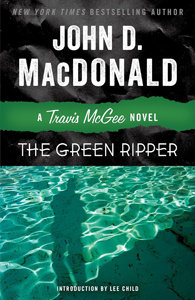
John D. MacDonald challenges the definition of what a mystery can be in “The Green Ripper” (1979), his 18th Travis McGee novel. It starts as the deepest of impenetrable mysteries, with a strong emotional motivation for our hero, then turns into a “Rambo”-esque action movie. Not a bad thing, and the book certainly is prescient about shadowy operations on the sides of both good and evil, but I can see why some mystery fans might blanch.
The first couple chapters are excellent, as MacDonald makes us feel the depth of the bond between Travis and Gretel. Even though he goes through at least one relationship per novel, this one feels special. Then there’s a twist. (SPOILERS FOLLOW.)
Green with … a different emotion (Spoilers)
The plot teeter-totters into revenge as Gretel is murdered by a high-tech poison dart launched by … someone. McGee’s economist and former government agent friend Meyer, who lives a few houseboats down the row, theories that a terrorist cult has killed Gretel because she recognized a cult member on her employer’s property.

“The Green Ripper” (1979)
Author: John D. MacDonald
Series: Travis McGee No. 18
Genres: Hardboiled mystery, action
Setting: Florida, California forest, 1979
By the end of “The Green Ripper” (a child’s-misunderstanding play on “the Grim Reaper”), Meyer has been proven exactly right. MacDonald sometimes writes twist-laden, puzzle-solving mysteries, but not this time. Here, he dives into the horror of one’s worst imaginings being proven true. However, the book isn’t over-the-top in its setup.
Once Travis goes undercover to infiltrate the terror cell in the California northwoods, it’s a starkly informative portrayal of how such cells operate and how their members think. They aim to kill innocent people because it gets attention and forces government reprisal. The response is likely to go too far, thus creating more revolutionaries. All part of a big plan.
Ultimately, the terror group is indeed the killers, as Meyer surmised. And it would seem to be disappointing that McGee never finds out precisely who killed Gretel. We aren’t even led to think there’s much possibility of this, and after a while we don’t even feel it matters. Because MacDonald is building on his wider point about how terrorism can have success, it’s fitting that the murder is never solved, and justice delivered, in a specific sense. “The Green Ripper” isn’t traditionally satisfying, but it feels right.
Ironically, McGee’s vengeance in the style of John Wayne (the author references the Western star several times) is the most over-the-top part. This is solid writing of action in the woods shortly after the success of David Morell’s “First Blood.” But, chillingly, it’s clear MacDonald is tapping into real life with his portrayal of the terror cell and branching into cinematic fantasy tradition with how McGee overthrows them.
(END OF SPOILERS.)
Cell-ing his point of view
“The Green Ripper” allows a platform for MacDonald’s politics, as he portrays black-book American agents as noble figures and believes they are essential for what he sees as a balance between freedom and safety. He believes reasonably porous borders fit with freedom but an off-the-books investigative state is necessary for safety.
This thoughtful traditionalism went against the grain on the heels of 1970s neo-noir conspiracy films. It would’ve been interesting to see what MacDonald thought of the post-9/11 extremes had he lived into the new century.
Another political oddity is that Meyer is very on-point about the corporatist/oligarchical aims of Western governments, yet his boat is named after John Maynard Keynes, an economist who believed in significant governmental control of the economy.
This doesn’t quite line up, but then again, “The Green Ripper” isn’t what one might expect. Writing in a formulaic genre, MacDonald brazenly eschews formula. It’s a love story and a revenge tale with insight into how a person might deliberately split their personality in order to (attempt to) stay sane.
It would seemingly be too intimidating to go to these dark places as we wonder if MacDonald somehow forgot he’s a mystery writer. It calls to mind Robert Galbraith’s “The Running Grave,” except without escapes into other POVs. But we can escape the undercover mission faster in “The Green Ripper” due to a tight page count of 237. And, as the McGee novels are always in the first person, we’re with Travis the whole way. We wouldn’t want any other companion.
Sleuthing Sunday reviews the works of Agatha Christie, along with other new and old classics of the mystery genre.