
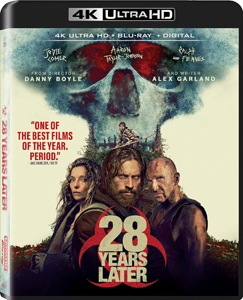
“28 Days Later” (2002) director Danny Boyle and writer Alex Garland – after both skipping “28 Weeks Later” (2007) – reteam for “28 Years Later.” It comes five years early based on the math, and thank goodness, because this is a spectacular-looking, deeply emotional zombie film. Not resting on the laurels of the previous two popular films, it would be an artistic standout even if this was an all-new universe.
Because so much time has passed, it is an all-new cast. The marketing team doesn’t want you to know this, but 14-year-old Alfie Williams is the star. He plays 12-year-old Spike, and gives a child horror-film performance up there with Haley Joel Osment in “The Sixth Sense.”
In an about-face from his overly complex sci-fi films such as “Annihilation,” Garland crafts a simple yet engrossing story. On an island off the larger island of Britain (or what was known as Britain before The Infected took it over), a village has lived in peace and subsistence. But they haven’t let their guard down.
“28 Years Later” (2025)
Director: Danny Boyle
Writer: Alex Garland
Stars: Alfie Williams, Jodie Comer, Aaron Taylor-Johnson
An infectious coming-of-age journey
Viewers of “The Walking Dead” will be familiar with the structure: A small community is safely walled in but they venture out sometimes, for supplies or other reasons. One of the reasons in “28 Years Later” is to raise vigilant defenders via hunting practice against The Infected. Spike goes on his first outing with his dad, Jamie (Aaron Taylor-Johnson).
We absorb information at the same rate as young Spike, an effective trick for getting us to sympathize with him. There are slow, fat Infected; hunting them is about as dangerous as hunting deer. But there are also fast zombies – this franchise re-invigorated the style – and packs of those are led by Alphas. The Alpha in this film looks like Jason Momoa from Hell, played by a nude Chi Lewis-Parry. (All of this film’s zombies are naked, a nice — if disgusting — distinguishing feature compared to other sagas.)
The mainland is accessible via a land bridge exposed at low tide, a neat concept also used in the TV show “The Third Day” (2020). In one particular action sequence on the soggy land bridge, Boyle defines what this movie is: a moving art piece.

A gorgeous starfield, unpolluted by artificial light, fills 90 percent of the wide screen. Various overhead angles further illustrate Spike’s and Jamie’s relative smallness. The score by Young Fathers complements the cinematography by Anthony Dod Mantle, never intruding but taking the reins at the right moments.
The first two films were products of the Aughts, so they featured shaky hi-def cam for the zombie kills – allowed in these films since they pioneered it, but it’s uncomfortable to praise the style since it led to other action films that are now unwatchable. “28 Years Later” continues with this style in a good way, highlighting the kill shots and the misses partly to look cool and partly to communicate that it’s Spike’s growing skill set that we should focus on.
Bigger budget doesn’t gloss over the grossness
“Days” was low-budget, and “Weeks” was mid-budget. “Years” is bigger budget, but Boyle avoids the trap of making a slicker yet boring film. It’s just as nasty and dirty as the first two. Yet this is a special horror film that – while horrific and gross – is emotional and spiritual. Boyle is not remotely interested in cheap jump scares; the film’s surprise is that the focus is always more human and grounded than you’d assume.
The primary way these survivors protect themselves is maintaining a wide field of vision of their surroundings. If taking a break on a trek, they do so in the middle of an open field with clear sight lines. Boyle and Mantle frame everything with wide honesty, and we quickly trust them, and then likewise trust Garland’s story and character building.
Taylor-Johnson’s Jamie is an imperfect but grounded father, Jodie Comer plays a sick yet loving mother, and Edvin Ryding and especially Ralph Fiennes come in as key supporting players on Spike’s mainland journey. Everyone is unpredictably human, even if this is an archetypal coming-of-age journey. Fiennes is especially moving as hermit Dr. Kelson, whose beliefs about life, love and death are totally valid, but he’s an outcast essentially for being honest about these issues. On the island, many people cling to pre-apocalypse conventions.
It’s a mild shame that “28 Years Later” ends in the style of a “Walking Dead” season, teasing the next mini-society we’ll encounter. It undercuts this film’s status as a think piece and switches its focus to world-building, perhaps what some viewers came for. “28 Years Later’s” quality is so high that I bet most viewers will be won over by Spike’s journey, and ironically they might resent the gear-switch a little.
Someone in power decided the blunt sequel-baiting to next year’s “28 Years Later: The Bone Temple” is crucial, so that’s what we get. They didn’t realize the softer hook of us liking and rooting for Spike had long since been set.