
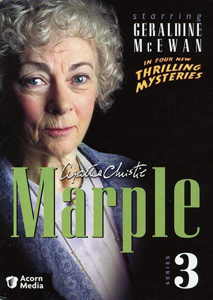
I should be careful about making judgments based on a small sample size. “Marple” Season 2 inserts Jane Marple (Geraldine McEwan) into two of Agatha Christie’s non-Marple stories, and it is jarring. But then in Season 3 (2007-09, ITV, A&E), she enters two more non-Marple stories quite smoothly.
Come to think of it, Marple is very much an outside observer in her first novel, “Murder at the Vicarage” (where the vicar, in fact, is the narrator). Christie meant to surprise readers at the time with how observant Marple is. Although the trick couldn’t be pulled off twice, the notion of Marple hanging out on the periphery and noticing people’s psychologies plays well in Season 3’s “Ordeal by Innocence” and “Towards Zero.”
Ironically, the two other episodes are rewritten from the novels much more. Again, I should be careful about snap judgments. My gut feeling is that it’s disrespectful to Christie, but on the other hand, her midrange work can be improved upon, especially when the needs of the screen are taken into account. In one of these cases, the storytelling is indeed punched up; in the other case … well, the changes are interesting.

“Agatha Christie’s Marple” Season 3 (2007-09)
ITV, A&E; four episodes
Directors: Dan Zeff (1), Moira Armstrong (2), David Grindley (3), Nicolas Winding Refn (3, 4)
Writers: Tom MacRae (1), Stewart Harcourt (2), Kevin Elyot (3), Stephen Churchett (4)
Stars: Geraldine McEwan, Richard E. Grant, Martine McCutcheon
Here are my rankings of the four Season 3 episodes that mark the farewell for McEwan’s portrayal of the sleuth (Julia McKenzie takes over for Seasons 4-6):
1. “Ordeal by Innocence” (episode 2, written by Stewart Harcourt)
Harcourt and director Moira Armstrong achieve a Shakespearean gravitas in their presentation of how the innocent suffer when a murder case is not solved. Whereas Christie merely raised the fascinating issue, this episode illuminates a direct conundrum: Is it best to bury the fact that the condemned man was not actually guilty? Should survivors’ peace of mind rank ahead of the wrongful denigration of someone’s name? The weightily reflective presentation reminds me of “Five Little Pigs,” the best Poirot episode.
This is all combined with an excellent mystery, boosted by sharp characters all around. Particularly good is Calgary (Julian Rhind-Tutt), who is not merely the plot device (he belatedly comes forth with the executed man’s alibi) but he gets beefed up with a humorously flustered personality. Also look for “Star Wars’ ” Denis Lawson as the buried-in-his-work patriarch. Like Marple in the shadows, we enjoy observing these folks.
Novel: “Ordeal by Innocence” (1958)
2. “Nemesis” (4, Stephen Churchett)
Churchett takes the novel’s plot outline, characters and premise but does his own thing, mostly effectively, crafting a fitting final installment of the McEwan “Marples.” The plot is like “And Then There Were None,” as the late, off-screen Jason Rafiel arranges for everyone associated with his son’s tenuous legal situation to be together, with Marple at the center. He assumes she will solve it. (Readers know Rafiel knows Marple from “A Caribbean Mystery,” which hadn’t been adapted at this point in this series. So that’s weird. But it doesn’t matter much.)

The plot twists are detectable if viewers schooled in the Golden Age know to look for changed identities, amnesia, secrets from the past, and misdirection in the presentation of a key clue. Churchett stretches a tad too far with a woman who accepts a different man as being her husband after his war injuries. Then again, Christie did something even more absurd in “Murder in Mesopotamia.”
Again we have evil nuns like in the “Poirot” adaptation of “Appointment with Death” (among the worst written of that series), but generally I’m fine with the wilder characterizations, including Michael Rafiel (Dan Stevens) being turned into a German WWII pilot. The TV show’s re-characterizing of Jane’s nephew Raymond West (Richard E. Grant) might be particularly controversial: Though he’s still a famous author, he’s now a principled womanizer rather than a married man. But he makes for a colorful sounding board for Marple.
Novel: “Nemesis” (1971)
3. “Towards Zero” (3, Kevin Elyot)
Strong casting enhances a good novel that doesn’t totally distinguish itself from better ones. It boasts a good mystery about a deformity in a suspect that a man (who is killed due to this recognition) would recognize, similar to “A Caribbean Mystery.” And it cleverly reverses “Death on the Nile” with two people pretending to like (rather than hate) each other.
It’s also not often that a person frames themselves. This is one of the convolutions (another is a time-oriented false alibi that Dorothy Sayers would love) that keeps the events short of plausible. Also, some weird smash edits undercut the gorgeous seaside setting.
On the other hand, Saffron Burrows (“Deep Blue Sea”) nicely sets the tone as a sad, pretty woman, and Julian Sands is also suitably melancholy. Marple’s addition is not intrusive to the story’s flow, but as the laying out of clues is not particularly strong, I’m not sure how exactly she puts the pieces together.
Novel: “Towards Zero” (1944)
4. “At Bertram’s Hotel” (1, Tom MacRae)
The novel has two dozen significant characters, so it’s bizarre that the episode creates a new one: hotel maid Jane Cooper. But she turns out to be the highlight, since she’s played by “Love Actually’s” Martine McCutcheon, who has great comic timing. The maid’s relationship with the detective adds a cute element.
The book is about how things stay the same at that downtown London hotel, but MacRae explores how things change. Fitting for “Marple” I suppose. The story resists a viewer/reader getting into it, a problem also found in the book and the “Miss Marple” adaptation, because almost 100 percent of the characters are ciphers. We can’t connect with them. So while the hotel is lavish and holds a place in Jane Marple’s heart, it remains a foreign setting to the viewer.
Novel: “At Bertram’s Hotel” (1965)