
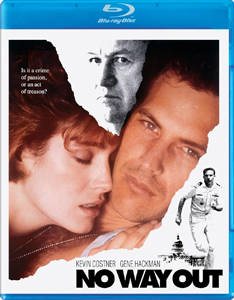
When “No Way Out” came out in 1987, moviegoers found it fascinating to see what computers could do (and how they could be manipulated) in a crime investigation. Today, it’s fascinating to see what computers did in a 1987 crime investigation. It’s one of those suspense thrillers that became outdated and forgotten, and now is appealing for being a historical snapshot.
Fugitive on the inside
Robert Garland, working from Kenneth Fearing’s 1946 novel “The Big Clock,” writes some parts of the screenplay with convenience rather than plausibility in mind. Minor tidbits of information could trip up a suspect, yet big sections of the Pentagon itself have no security guards or cameras. A parody might find someone simply typing “(So and so) did it” into the computer to complete the frame job.
But even with the unflashy direction by Roger Donaldson (“Species”), “No Way Out” holds one’s attention. It leisurely moves toward its main thrust: Naval lieutenant Tom Farrell (Kevin Costner) is suspected of a murder he didn’t do. Political handler Scott Pritchard (Will Patton) isn’t precisely framing Tom, but he’ll do anything to protect Secretary of Defense David Brice (Gene Hackman).

“No Way Out” (1987)
Director: Roger Donaldson
Writers: Robert Garland (story, screenplay), Kenneth Fearing (novel)
Stars: Kevin Costner, Gene Hackman, Sean Young
Before that, “No Way Out” is a classier-than-Skinemax sexy romance featuring Tom and Sean Young’s Susan Atwell. Since her job – and a well-paying one at that — is to be Brice’s arm candy, it seems Brice and Tom could do a timeshare, but emotionally it doesn’t work that way. Soon-to-break-out Costner and seems-like-she-should-break-out Young – showing more zest than in “Blade Runner,” as she’s not a robot — have sizzling chemistry.
Then the story changes to crime solving and cover-up, with Tom in the middle of it, though he doesn’t want to be. He’s a Crichtonian version of The Fugitive, sweating it out while the CIA’s top computer man, wheelchair-bound Sam (a pre-“Law & Order” George Dzundza), sifts through evidence.
The unusual amount of emphasis on data searches, probably Donaldson making sure viewers can follow it, now perfectly illustrates how long things used to take. Especially fun is one screen in the agency’s data center showing a pixel-by-pixel reconstruction of a blurry photo of Tom; this functions as a ticking clock.
Gray areas for the white hats and black hats
“No Way Out” wouldn’t be made the same way today (maybe we can make a comparison if another adaptation comes along; the book was also adapted in 1948 and 1976), and not only because of the computer stuff. The fact that Brice hesitates before approving Scott’s cover-up scheme now plays as a throwback, either an example of a writer’s naivete or an attempt to be kind to governmental back-room ops.
It’s interesting to watch Patton’s subtle turn as a homosexual, something that mattered in 1987 and now is trivial. The idea that Susan has value beyond being “the Atwell woman” seems to be pushing an envelope for the era.
A case could be made that Patton and Young give the most interesting performances, but the star power of Costner and Hackman can’t be denied. Costner – usually wearing a white uniform — is understated, but that makes sense: Brice’s team recruits Tom as a lobbyist for submarine funding (again, a throwback to the notion that spending wouldn’t be automatically rubber-stamped) because he’s a perfectly generic hero. The movie’s events challenge Tom to become an actual one.
Hackman – usually wearing a black suit — also gets moral gray areas to play in, but I wonder if he was paid by the hour. The film loses something when Brice is out of the picture, presumably brooding in his office, even though Patton is intensely watchable as the scheme’s smiling, slimy front man.
Even a little Hackman elevates mid-range thrillers. “No Way Out” is no exception, but just as the game gets away from Brice, this isn’t really Hackman’s show, and therefore not among the top selections in his catalog. Those diving deeper will enjoy it for more reasons than Hackman. It’s a quaint yet quintessential slice of 1980s grime-hewn glitz.