
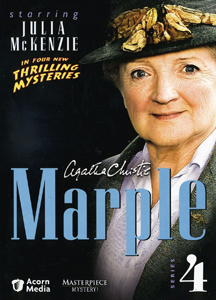
It’s generally thought that “Poirot” nailed the TV casting with David Suchet whereas “Miss Marple”/”Marple” struggled by bouncing between Joan Hickson, Geraldine McEwan and Julia McKenzie. But as I move into the McKenzie batch, it’s evident that all three Marple actresses are outstanding, in different ways.
There’s no sense of continuity whatsoever in the handoff from McEwan to McKenzie from Season 3 to Season 4 (2009) of “Marple,” even though this is ostensibly all the same series. “Nemesis,” chronologically the last Marple book, was a bow-out for the sly McEwan; now the nine-years-younger McKenzie plays the sleuth with more energy and emotion. I went with the flow.
It’s smart to start the McKenzie era with “A Pocket Full of Rye,” both because it’s a strong, traditional mystery and because Marple feels righteous indignation that her former maid, the overlooked Gladys (Rose Heiney), has been murdered. Because we share her sense of injustice, we accept the new Marple.

“Agatha Christie’s Marple” Season 4 (2009)
ITV, A&E, four episodes
Writers: Kevin Elyot (1), Stephen Churchett (2), Paul Rutman (3), Patrick Barlow (4)
Directors: Charlie Palmer (1), Hettie Macdonald (2), Andy Wilson (3), Nicholas Renton
Stars: Julia McKenzie, Benedict Cumberbatch, Brian Cox
Then, unfortunately, we get into the weaker aspect of this series: When Marple intrudes on adaptations of non-Marple books (“Murder is Easy” and “Why Didn’t They Ask Evans?”), it’s obvious even if someone isn’t a Christie scholar. She spies and lurks around scenes, something that probably seems OK in a teleplay but is weird on screen, because Christie’s Marple doesn’t behave this way.
Those two episodes have their high points – including the series’ always-classy settings, wardrobes and casting – and are still easily worth watching. But playing armchair showrunner decades later, I would’ve renamed the show “Agatha Christie’s Marple and Other Mysteries” and had Marple bookend the non-Marple stories with narration while knitting in her armchair, an approach that would be a nod to “The Tuesday Club Murders.”
Here are my rankings of the four Season 4 episodes where we welcome McKenzie to the club as the sixth screen Marple (and third in a TV series):
1. “A Pocket Full of Rye” (episode 1, written by Kevin Elyot)
As with the novel, it’s hard to keep the characters straight due to everyone being Mr., Mrs. or Miss Fortescue, but it’s still engrossing. This is also a notable mystery wherein the most obvious suspect is the killer all along, which — for those distracted by perusing deeper layers — actually comes as a surprise.
McKenzie’s Marple is more assertive as she directly offers to help Inspector Neele (Matthew Macfadyen) because she has a personal connection. Her former maid, Gladys, is one of the victims of a string of killings, and – even more tragic – she’s killed only for the sake of fitting with a distracting nursery rhyme. That’s not to say McKenzie can’t also do dark British humor. When someone asks if Gladys was pretty, Marple immediately says “Oh, no, not at all.”

Novel: “A Pocket Full of Rye” (1953)
2. “They Do It with Mirrors” (3, Paul Rutman)
This one has a great setting wherein the traditional manor house full of suspects is on the same grounds as a men’s criminal reform school, wherein the students catcall Gina (Emma Griffiths Malin), who loves the attention. Sexpot Gina has a low-key rivalry with her sister, the mousy Millie (Sarah Smart); it’s one of several good inter-character dynamics. Another is that of patriarch Lewis Serrocold (Brian Cox) and secretary Edgar (Tom Payne).
This is one of those novels wherein I say “That’s fine on the page, but how will they pull it off on screen?” because the murderer’s trickery is achieved via voice mimicry. Director Andy Wilson and his crew decide to present it in straightforward fashion, and the brazenness is almost admirable.
Novel: “They Do It with Mirrors” (1952)
3. “Why Didn’t They Ask Evans?” (4, Patrick Barlow)
In every adaptation of this novel, the appeal is not the mystery (I can never remember why they didn’t ask Evans) but rather the cuteness of Frankie and Bobby, 20-something former childhood playmates who gradually realize what the audience does: that they’d make a good couple. This version boasts Georgia Tennant as headstrong Frankie and Sean Biggerstaff as more-reluctant Bobby.
It initially makes sense that Marple – a longtime friend of Bobby’s family – horns in on the case when she notices this innocent lark for the amateur sleuths could become dangerous. She poses as Frankie’s governess to get invited to the increasingly (and rather inexplicably) crowded house of suspects and victims.
With a cast including Rafe Spall, Natalie Dormer, Samantha Bond and “that guy” character actors Warren Clarke and Mark Williams, “Evans” holds one’s attention. But it’s unfortunate that Marple steals the mystery-solving spotlight that should belong to Frankie and Bobby, and – as often is the case in adaptations where Marple is artificially added – it’s unclear how Marple is able to put the pieces together.
Novel: “Why Didn’t They Ask Evans?” (1934)
4. “Murder is Easy” (2, Stephen Churchett)
This is the most obvious non-Marple to turn into a “Marple,” as one might want to replace Miss Fullerton – the woman who suspects a string of village deaths are murders rather than coincidental accidents – with Marple. Churchett instead replaces retired police detective Luke Fitzwilliam with Marple in that train-car opening, then has Marple be a mentor to the official detective on the scene.
We’re off and running, but the problem is that Churchett believes (correctly) that the case must then become more complicated in order for Marple to not solve it faster than the book’s sleuth. It becomes so complex that it’s laughably unclear how Marple figures it out.
The summation gathering is so insane – including incest, abortion and psychopathy — that you can’t turn away. A sympathetic turn by Shirley Henderson (Moaning Myrtle in “Harry Potter”) as Honoria stands out among a cast so loaded that Benedict Cumberbatch’s Luke is lost in the shuffle. The uniquely high-voiced Henderson (who played Agatha Christie herself in “See How They Run”) was in her 40s when playing Honoria, but perpetually seems 29. That’s part of why the love octagon here is hard to keep straight based on ages.
Novel: “Murder is Easy” (1939)
Sleuthing Sunday reviews the works of Agatha Christie, along with other new and old classics of the mystery genre.