
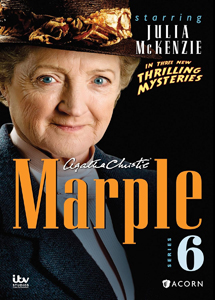
“Agatha Christie’s Marple” wraps its run with a three-episode Season 6 (2013, ITV, A&E) featuring the last remaining novel to be adapted, a smart mashup of two short stories and an adaptation of one of Christie’s best novels. While I do have some quibbles, I generally found them to be wonderful fun to watch.
As a whole, I enjoyed this 23-episode journey. Julia McKenzie (who tallies 11 episodes total) is a warmer, more vulnerable version of Marple than Joan Hickson and Geraldine McEwan, who exude more of the sly, eye-twinkling “Nemesis” or “Dark Marple” aspect of the sleuth. Although McKenzie’s turn is more of the stereotype of an old but spry woman solving manor mysteries, she easily fits into the wider definition of who Marple can be.
The showrunners do a smart job selecting which stories fit McEwan and which fit McKenzie, leading to the odd yet appropriate situation wherein McKenzie’s “Caribbean Mystery” leads into McEwan’s “Nemesis” (linked by the character of Rafiel), despite them being filmed out of order. (This was also the case on Hickson’s “Miss Marple.” I wonder if the expense of location shooting made the production team hesitate.)
“Agatha Christie’s Marple” Season 6 (2013)
ITV, A&E; three episodes
Directors: Charlie Palmer (1), Sarah Harding (2), David Moore (3)
Writers: Charlie Higson (1), Tim Whitnall (2), Kevin Elyot (3)
Stars: Julia McKenzie, Antony Sher, Tom Hughes
Here are my rankings of Season 6, McKenzie’s final bow as Miss Marple:
1. “Endless Night” (episode 3, written by Kevin Elyot)
As fans of the novel know, this is an internal story, narrated by Mike Rogers (Tom Hughes), so adjustments are needed to translate it to the screen. The 1972 movie brilliantly pulls it off, whereas “Marple” takes a blunt approach, simply using Miss Marple as an observer (who even coincidentally vacations to the same place as the newlyweds!). One could also quibble that Marple’s radar for a person’s decency is miscalibrated to an uncharacteristic degree; that said, it is a convenient shorthand for the villain’s trickery.
On the other hand, I adore the novel, and the episode gets the emotions and characters absolutely right, led by Hughes’ perfect turn as someone with complex psychological wiring. Faithful to the novel except for Marple’s intrusions, “Endless Night” is a delight to watch for those who know the story, and I’m guessing it is an effective shocker for those newly acquainted with it.
Novel: “Endless Night” (1967)
2. “A Caribbean Mystery” (1, Charlie Higson)
While Joan Hickson’s version remains definitive, this is an enjoyable take, with South Africa beautifully standing in for the titular location. Donald Pleasence’s gruff Jason Rafiel from the 1989 version matches with the novel, but I also enjoy Antony Sher’s alternate interpretation of a smart, workaholic industrialist who has no time for politeness, but nonetheless forges a friendship with Marple based on mutual respect.
As with “Endless Night,” this story’s denouement is memorable enough that there are no surprises for Christie readers, and I find it amusing how much the killer is telegraphed via the performance. But I feel it’s a strong enough mystery, with enough red herrings, that newcomers will enjoy it.
I’m guessing it’s controversial among fans, but I’m fine with Ian Fleming being one of the hotel guests, and with James Bond being the botany expert — and Fleming scribbling in his notebook upon hearing “Bond, James Bond” in a “George Lucas in Love” type of gag. It’s especially fair game since Christie named a character James Bond before Fleming did, in “The Rajah’s Emerald” (1926, collected in “The Golden Ball and Other Stories”). And besides, the writers are allowed a little fun.
Novel: “A Caribbean Mystery” (1964)
3. “Greenshaw’s Folly” (2, Tim Whitnall)
Whitnall improves upon the short story by sidestepping Christie’s false identity trick that doesn’t hold up to scrutiny. (At some point, Louisa would realize there are two distinct people claiming the same identity, and the ruse would collapse.) The episode nicely embellishes Miss Greenshaw (Fiona Shaw) into an eccentric, kind-hearted friend to orphans, something that adds heart to her hiring of Louisa (Kimberley Nixon) for the typist job. More of the grandmotherly TV Marple comes through via her chats with Louisa’s precocious young son.
The episode expertly portrays Christie’s complex staged killing involving multiple costumes, temporarily faked identities, locked rooms and the construction of false alibis based on timing. Whitnall also smoothly works in the amusing language-based clue at the heart of a shorter story, “The Thumb Mark of St. Peter” (from “The Tuesday Club Murders”). Had “Marple” continued, I would’ve been game for more mashups of short stories if done as well as this one.
Short story: “Double Sin and Other Stories” (1961)