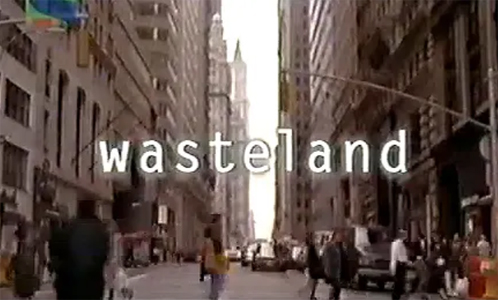
It’s a testament to the stacked nature of the Fall 1999 TV schedule that I canceled “Wasteland” after one episode. (ABC would then cancel it after three, with 10 unaired until a 2001 airing on the obscure ShowNext channel.) Although I disliked it, it nagged at me that I should give it another chance, which I was able to finally do thanks to it becoming available via … ahem … a certain unofficial source.
The show marked Kevin Williamson’s jump from teen drama to 20-something drama after launching “Dawson’s Creek” and writing “Scream,” “The Faculty” and “Teaching Mrs. Tingle,” all set in high school. In 1999, the pilot episode seemed crass and desperate for attention, with the “DC” characters’ self-absorption more grating when coming from characters who constantly announce that they are 26.
Though I still don’t think it’s elite TV – as with all Williamson shows, it drops off when he stops writing (after two episodes in this case) – it has aged gracefully thanks to nostalgia and a couple identity politics issues that make the show an interesting artifact. (Appropriate, since Marisa Coughlan’s Dawnie speaks of anthropological artifacts such as a poetry book from her first relationship.) Surprisingly, Williamson’s trademark pop-culture references don’t lock “Wasteland” – chronicling a half-dozen friends in New York City — in 1999; there are barely any to be found.
“Wasteland” (1999-2001)
13 episodes, ABC, ShowNext
Creator: Kevin Williamson
Stars: Sasha Alexander, Marisa Coughlan, Rebecca Gayheart
Williamson’s bluntly spoken edge helps launch the premise, namely via Dawnie being obsessed with her virgin status. Then it settles into being a soap opera. Certainly it’s better than your typical daytime “stories,” but it does have that melodramatic back-and-forth structure wherein people can cut someone out of their life in one episode and be tight with them again in the next. That’s what Dawnie does to Ty (Brad Rowe), her first love who had screwed up their high school relationship by wanting to move faster than she did.
The central theme, as outlined in perpetual degree-grabber Dawnie’s dissertation, is The Second Coming of Age. The idea (rightly or wrongly) is that, unlike previous generations, when Gen X’ers graduated from high school, they didn’t smoothly transition to adulthood. Instead, they encounter a second set of hurdles. This idea would be improved upon with Gen Y characters in “Wonderfalls” (2004) and “quarterlife” (2007).
20-something wasteland
In 1999, “Wasteland” felt much less polished than “DC” to me. There might’ve been some truth to this, as Williamson had an extremely busy 1998-99. Possibly it was not as much of a passion project as “DC,” despite again being semi-autobiographical.
Consider his description of the show in 1998, as outlined to Creative Screenwriting magazine and recounted in Andy Mangels’ “From Scream to Dawson’s Creek” (2000): “‘Wasteland’ is about a group of kids who all went to college together and they’ve sort of all wound up in Los Angeles (changed to New York) together. Their past and their present is sort of shaping their future. They all sort of had weird relationships back in college, and now their relationships continue here, 10 years later. It’s sort of my version of ‘Melrose Place.’ It’s a lot of fun. Very risky, sort of out there.”
That’s a lot of “sort ofs.” To be fair, Dawnie herself struggles to get a handle on her paper. And Williamson was in his mid-30s at the time, so just as he remembered his teen years, he also remembered his 20s. But after he writes the first two episodes, “Wasteland” gets in a cycle of “who’s dating whom” relationship drama.
Though the staff isn’t filled with big names (but make note of “Once and Again’s” Maggie Friedman and “Lost’s” Damon Lindelof), the stories do have a certain wit. The directors – helped by nightlife establishing shots and some rain and snow – find a slapstick rhythm to make the familiar beats palatable; for example, when Russ (Dan Montgomery Jr.) needs to recruit all his friends to go along with him pretending to be straight for the sake of a magazine interview. Immediacy and realism are attempted via the emphasis on the Thanksgiving, Christmas and New Year’s holidays, although annoyingly, everyone thinks 2000 marks a new millennium. (To be fair, math is hard, and that’s how real people were at the end of 1999.)
The characters are defined by one or two core issues, which isn’t realistic but it’s a fair way to craft a TV show that aims to make universal, rather than personal, points. “Wasteland” is elevated by a strong (and impossibly beautiful — that’s TV for ya) cast. But as the episodes tick along, we get dangerously close to everyone being an issue more so than a person. Their stagnation does fit with the theme, granted.
From Dawson to Dawnie
In addition to Dawnie with perpetual analytical life (making her the “Dawson”), we have two other “stuck” characters. Ty’s behavior has matured but he’s still stuck on first girlfriend Dawnie, who has moved on. Vandy (Eddie Mills) dreams of a record contract and is content to be a bartender; that stagnant career choice drives off high school sweetheart Sam (Rebecca Gayheart).
And we have three who are doing well professionally but not relationship-wise. Sam works from the bottom up toward a great career in the district attorney’s office, and she hits it off with boss Vince (“Cupid’s” Jeffrey D. Sams), but inter-office romance is a no-no. Jesse (Sasha Alexander) achieves quick success in PR but struggles to land a steady boyfriend due to her abrasive personality. And Russ is a daytime soap star but he is gay and in the closet.
The two time-capsule issues are Russ being gay and, rather surprisingly, Vince being black. The characterization of Russ walks a tightrope. A viewer might say “We don’t care that you’re gay, but your obsession with it is grating.” However, that’s a little mean. Russ isn’t naturally self-centered; society truly does make him sensitive about this issue. Yes, by 1999 (one year after the first TV kiss between gay men, featuring Kerr Smith’s Jack on “DC”) he could likely be openly gay and not hurt his career – but it’s still a risk.
It’s weirder that the press materials (quoted in the Mangels book) note that Vince and Sam are in an “interracial” relationship. In a “racism once removed” thread, the DA warns Vince that – although he’s not racist – his friend who is the father of Sam might not look kindly on this relationship. (Vince can’t legally be fired for the relationship, but his boss can make him miserable enough to quit.)
In 2025, by contrast, sexual orientation and race would be consciously represented in a cast’s demographics, but no storylines based on being gay or black would spring forth. The point, rightly or wrongly, would be to show that we’re all essentially the same.
Acting their age
Although there’s a certain sameness to each episode’s beats, I enjoyed my experience of watching “Wasteland” due to the actors. Coughlan is delightful, with a face-based acting style similar to Katie Holmes, just without the ability to brood. Gayheart surprised me, particularly with a gag in the opening episodes where Sam has a natural North Carolina twang but must get rid of it for the sake of being “professional.” Alexander’s seriousness would later translate to Gretchen on “DC.”
Rowe has a Val Kilmer quality, Mills is a classic Nineties “slacker” (softened by the fact that his extreme-slacker roommate, Gothic Bill, never leaves the couch), Sams is suave, and ironically Montgomery seems like a daytime soap star. “Parks and Rec’s” Adam Scott is initially the mysterious Coffee Boy whom Jesse is “sort of” dating, but once he’s integrated into the cast, he’s simply a self-absorbed wannabe writer.
That journey from the excitement of something new to boring (if comforting) familiarity (and what actor more fits than mold now than Scott?) mirrors “Wasteland” and a lot of Williamson’s projects. He has a tendency to launch things with a legitimate bang then hand off the reins. (After overseeing “DC” Season 1, he writes only two more episodes; his contributions to “Scream” have been off-and-on.)
Though he is one of the core voices of his generation, and chunks of his work are masterful, the initial originality often gets sanded off. Obviously, it’s because he hands off the reins, but it also should be noted that he chooses to hand off the reins. “Wasteland” never lives up to the ennui-laden evocativeness of its title, instead becoming an unusually well-acted soap opera, mirroring “DC.” ABC abandoned the project, but Williamson sort of did too.
This blog post is part of a series about great short-lived TV shows that haven’t been released on DVD or digital or streaming services, and are rarely – if ever — shown in syndication. While some of these shows can be found somewhere on the Internet, fans of great TV want to see them get a proper release. If you’re one of those fans, your best bets are to vote for the show at TVonDVD.com or to request information from Amazon.com in the event the show gets released. This will let the copyright holder know of your interest.