
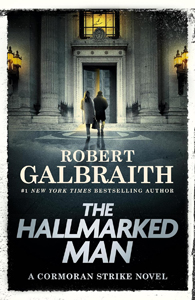
J.K. Rowling (under the pen name Robert Galbraith) continues to push the boundary of how involved a mystery novel can be with “The Hallmarked Man” (September, hardcover), her eighth Cormoran Strike entry. It clears the 900-page mark, and while three Strike books are longer, this one is so complex that I feel the figurative weight. (As for literal heft, a tip of the hat to the book’s physical construction. The pages are thin and the weight reasonable.)
It’s a lot – but at least it’s a lot of good stuff
I must note that I was never bored while reading “Hallmarked”; that’s a testament to Rowling’s prose skill. The story is aggressively linear, but also plays like a bunch of well-written shorter stories that we rotate among, along with private investigators Strike and Robin Ellacott.
A man going by the fake name William Wright has been murdered and his body mutilated (no hands for fingerprinting) in the basement vault of a London silver shop. Rowling goes for a closed-room mystery – some fun is had with surveillance footage from outdated cameras — and tries to limit the number of possible victims. The detectives consider five people from the UK’s missing-persons rolls, although Strike at one point gives lip service to the idea that it’s someone who has slipped through the cracks.

“The Hallmarked Man” (2025)
Author: Robert Galbraith (J.K. Rowling)
Series: Cormoran Strike No. 8
Genres: Mystery, romance
Setting: 2017, London and surrounding areas
They need to identify the killer, too, of course. But identifying the victim is “Hallmarked’s” emotional thrust, and it provides a twist compared to “Career of Evil,” where S&R sort among three potential killers. Though four of the candidates must be red herrings, Strike and Robin spend tons of time on them. These side trips aren’t incidental, because Rowling either tells tragic tales about the possibly dead man or explores England’s political games.
For example, if the victim is Dick de Lion, a desperate young porn actor, the killer might be the corrupt official who is lobbying for PIs to be heavily regulated. Then he can continue to influence the police on cases and not have to spread his bribes and threats so thin.
A mix of sharp and cursory analyses
Rowling’s smartness about the dirty ways of the world mostly hits but sometimes gets lazy in this entry wherein the Strike series surpasses “Harry Potter” in book count. Robin – aggressively stalked by henchmen of one of the suspects — doesn’t have a gun, because that’s illegal in the UK. She uses pepper spray, which is also technically illegal, but the police give her leeway if she’s the target. Robin is matter-of-fact about this civil-liberties violation, which makes me wonder if the author is fine with the law. If nothing else, I suppose it’s a peek into London street life.

This has the most story branches of any Strike book, and as such, it’s not the most thematically laser-focused. The author touches upon 21st century gender roles (it’s tough for women, but sometimes it’s tough for men, too), the secret society of Freemasons (with a fair pro and con analysis), and terrorism (with a quick acknowledgement of how imperialism might hold some blame, but it’s silly to bring that up because it’s the specific acts of heroic protection by soldiers that matter).
“Hallmarked’s” broad theme is that life and work are complex as hell. For each of the potential IDs of the corpse, witnesses and suspects and even a potentially related cold case branch off. On top of that, the agency has two other cases – simpler yet time-consuming. As with all of the Strike books, we see how a detective agency truly operates; cases overlap, rather than lining up one by one. And cases must be taken for money, not only for intrigue.
But I would’ve appreciated more fictional license here. If I had my druthers, the existence of other cases – and the four other employees working on them – would be acknowledged, but we wouldn’t shift focus to them. Even though I admit the sexy and annoying Kim Cochran is quite entertaining.
If only an omniscient narrator existed IRL
The core mystery is more than enough, but it provides merely 50 percent of the novel’s emotional thrust. The other half comes from the “will they or won’t they” between Strike and Robin. Rowling is an omniscient narrator who is happy to jump back and forth.
She uses these partners-turned-friends-turned-potential-lovers partly to explore gender roles and how the detectives navigate them. Strike believes the bad guys are targeting rape victim Robin, believing she’s the agency’s weak link. He struggles to make it clear that he doesn’t believe she is weak, but the fact that they believe it puts her in danger. In a parallel, Robin is cautious about mentioning that she notices Strike is struggling with pain relating to his prosthetic leg, aware that he doesn’t want to be seen as having a weakness.
The Galbraith series has always flirted with the romance genre, but it’s undeniable in “Hallmarked.” Strike strategizes about how to tell Robin he loves her, but hesitates as he mulls evidence that she doesn’t like him in that way. Then we cut to Robin thinking about how she needs to make herself appreciate boyfriend Murphy because, although her feelings for Strike annoyingly crop up, evidence suggests he’s just not that into her.
An inordinate amount of words are devoted to these games of inner theorizing and self-deception, and I can see some readers finding it super cute, and others being nauseated. Undeniably, it all rings true. This is how humans think when it comes to love, even if they are grounded about other issues. Since there’s no such thing in real life as an omniscient narrator, S&R can’t interview such a person to give them the full picture.
The reader needs a murder board
While I know Strike and Robin better than they know themselves, “Hallmarked” could’ve helped me out with a dramatis personae for the next several dozen characters on the roster, or a sketch of the office murder board.
Even though Rowling vibrantly writes personalities and speech styles (phonetically, no matter how extreme the accent or impediment), the sheer volume of characters is overwhelming. In one of their notes-comparing lunches, Strike asks Robin to refresh his memory of who she’s talking about. I would’ve liked Rowling to use more tricks like this.
“The Hallmarked Man” isn’t overwritten in terms of wordiness. Any given paragraph efficiently achieves its aims. The 127 chapters average four to five pages, so I never got bogged down. On the other hand, cut out a victim candidate, cut out a source from each thread, cut out details of the agency’s other cases, and you have a tighter but just-as-good novel.
As an author obsessed with detail and complexity (to her credit), Rowling should be careful going forward. But there’s little danger of me not following her forward to the ninth book.