
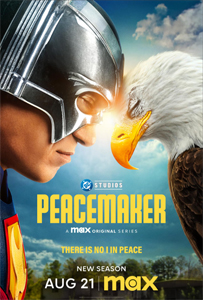
James Gunn is improving the quality of DC’s storytelling from within the Warner Bros. machine, ironically by telling an epic story about former government agents raging against their machine. In a time when one might fear all superhero stories have been told, Gunn is telling hyper-relevant – but also funny and emotional – tales. The DC Universe officially started with summer’s “Superman,” but Gunn continues it in “Peacemaker” Season 2 (HBO Max) with even more unhinged passion, writing all eight episodes and directing three.
Though I never doubted Gunn’s ability to make fun movies and TV episodes, with “Peacemaker” I’m not merely curious – or morbidly curious, as with the latter entries in the DC Extended Universe – I’m excited about each new wrinkle. This is largely because of an ability many first noticed with “Guardians of the Galaxy”: bringing oddballs together into a makeshift family.
That’s an old trick – Joss Whedon mastered it with “Buffy,” “Angel” and “Firefly” – but what makes Gunn distinct is there’s no line of oddness he won’t wade into, no corner he won’t write himself into and challenge himself to get out. Chris/Peacemaker (John Cena, now challenging Dave Bautista as the best of the wrestlers-turned-actors) is literally a bad guy in “The Suicide Squad,” and now he’s convincingly a good guy. Adrian/Vigilante (Freddie Stroma) has killed so many people in his assassin job that it’s darkly comical, but he’s endearing in his obsession with manta ray facts.
“Peacemaker” Season 2 (2025)
HBO Max, eight episodes
Showrunner: James Gunn
Stars: John Cena, Jennifer Holland, Danielle Brooks
Kidding around, but not always
Among the makeshift family known as the 11th Street Kids, the most normal is Adebayo (Danielle Brooks), who not long ago would’ve been the ultimate outsider for being black, gay and heavyset. But Gunn nudges us into a richer world of personality, neurotype and life-experience diversity, like with techie John Economos (Steve Agee, one of those delightful actors who seems like a non-actor, but in a good way), who is anxious and awkward the minute he takes a step away from his desk.
With Harcourt (Jennifer Holland), we have the “rage issues” cliché incongruously pasted onto a slight woman (who nonetheless can convincingly kick ass). And in a triumph of CGI, we have Chris’ pet Eagley, who frustratingly often acts like a wild bird but comes through in the clutch.
“Peacemaker’s” character creation is rich enough to make the show watchable on its own, but for the plot Gunn taps into the relevant question of whether government agents (the entire 11th Street group works — or formerly worked — in black ops) can change things from the inside. And if they conclude they can’t, do they have any chance on the outside?

The MCU also explored this concept in 2025 with “Thunderbolts,” but the DCU might have an edge because it has put its trust in Gunn whereas the MCU has morphed into a boardroom approach. A decade ago, the MCU had the strong storytelling leadership of Kevin Feige, and Gunn is fast becoming DC’s answer.
With “Peacemaker,” Gunn has made it clear that the DCU is not a hard reset but rather a continuation/soft reboot of the DCEU, and he demonstrates how this is logically possible due to the multiverse. Chris has moved into his late father’s house, which contains a doorway to a room full of other doorways.
A page from PKD: Alternate dimensions
For the good guys, these are pathways to personal stories. Chris gets a chance to reconnect with his “dad” and “brother” and gets a second chance with “Harcourt.” He loves Earth 2 enough to move there permanently. (SPOILERS FOLLOW.) Then in a well-earned twist that borrows from PKD’s “The Man in the High Castle,” we learn that Earth 2 is the Nazi States of America when the residents begin chasing Adebayo because she’s “a Black.” By this point, Cena has shaped Chris into someone believably narrow-focused enough to miss that he’s in Nazi World but we know it’s not because he himself is a Nazi. And besides, as Judomaster (Nhut Le) notes, Earth 1 isn’t all that great to minorities of any stripe either.
Furthering the PKD connections with a “Crack in Space” lift, the season ends with Chris dumped into Sanctuary. ARGUS (the black ops agency) leader Rick Flagg Sr. (Frank Grillo) makes Chris the first prisoner to be dumped onto this interdimensional Australia as revenge for Chris killing his son (Joel Kinnaman) back in “The Suicide Squad.” (END OF SPOILERS.)
“Peacemaker” sometimes uses violence as a shortcut to put our sympathies in the intended place, such as when Flagg Sr. beats the crap out of Chris under the flimsy guise of an interrogation. Gunn also uses a montage in this way. Agents are sent as first explorers through various doorways, and if some are killed, well, those are valuable data points. The deaths are interspersed with Flagg and his underlings celebrating their progress.
But meanwhile, Gunn will spend just as much screentime on a jokey scene such as Economos trying to distract ARGUS personnel while Harcourt looks up Chris’ location on another computer. These unorthodox pacing choices are invariably the right call.
“Peacemaker” builds fresh stories atop a foundation of the familiar, catering the show to people who are aware of 2025 backward-reaching politics and who have gone through the superhero boom’s ups and downs. As Season 2’s theme song – Foxy Shazam’s “Oh Lord” (2010) – states, “There will always be a wrong to your right.” Gunn might be saying superhero shows will always be here. Might as well make them relevant, entertaining and – in an antidote to reality – not overly serious.