
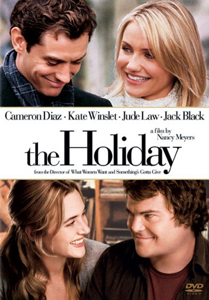
“The Holiday” (2006) has a large gap between screenplay quality and overall movie quality. It would be an interesting experiment for someone to read the flat screenplay first, then watch the sparkling final product. That’s not really a fair criticism, though, because Nancy Meyers is both the writer and director and she likely pictured in advance suave A-listers performing all the lines, along with the staging, lighting and score.
This Christmastime four-hander is impossibly cute, with almost every broad behavior – and many specific actions – of the quartet being supremely unlikely in the real world. It’s a fake movie, but there’s no fake-out; you won’t be whiplashed between fantasy and reality.
Kate Winslet’s Iris lives not only in a quaint English village, but her specific house looks like in belongs in a ceramic display. When Cameron Diaz’s Amanda moves in as part of their L.A.-for-U.K. two-week swap, she finds walls full of books, and even a totally unfazed dog (perhaps the biggest fantasy element). It’s cozy in the way of pure fiction, and now she just needs the perfect man to break her out of her loneliness. Enter Jude Law’s Graham.
“The Holiday” (2006)
Director: Nancy Meyers
Writer: Nancy Meyers
Stars: Kate Winslet, Cameron Diaz, Jude Law, Jack Black
When you get to the A-list, it’s a good idea to check off your wish list a Meyers rom-com; if it’s set around the holidays, all the better. You can do serious acting later, but first lock in something timeless. For Jack Black, it’s somewhat the opposite. The antics-driven character actor proves he can unleash leading-man charm as Miles, who befriends Iris; it’s all about confidence.
Suave and successful
In “The Holiday,” the men always say the right thing; if it’s borderline, they recover with the next line. And the women are allowed to be quirky, but not to the point that their appeal is in danger. And consider these perfect jobs (with all four being totally steady in them; if they were to leave, it would leave their companies devastated) that allow them to focus on romance:
- Iris is the lead copy editor at the London Telegraph (at a time when newspapers were healthy).
- Amanda is a prized movie-trailer editor.
- Graham is a successful book editor, from a family of such.
- Miles is a talented and deeply knowledgeable film composer.
Perfect escapism is the point of “The Holiday,” so although I might sound snarky, I’m not being critical. This movie does exactly what it intends to do. Unless the viewer is simply in the wrong mood, they’ll have a smile pasted on their face in the first half, and the momentum will carry them rest of the way.
Separating it from great rom-coms, though, it could use more layers. It almost has them, but they are garnishes rather than core points. Amanda has quick daydreams about her life in the form of movie trailers, with the familiar baritone of Hal Douglas as the narrator. It’s amusing when accompanied by Diaz’s expressive face. In the action-romance trailer that represents Amanda’s editing skill, we get a couple fun cameos.
Since Meyers has Black, she lets him riff in a (now nostalgic) Blockbuster, grabbing selections for Iris and humming the movie scores. This is Black dialed up to 5; hey, you can’t keep him totally contained. “The Holiday” is a love letter to Tinseltown all around, especially when you throw in Iris’ friendship with new neighbor Arthur (Eli Wallach), a retired Oscar-winning screenwriter who notices if someone delivers a movie-caliber line IRL.
Daydream believer
“The Holiday” includes a couple of daydream-type impossibilities. Amanda and Graham are both so irresistibly attractive that they have sex within minutes of meeting, like they are forces of nature. The guy who always took Iris for granted, colleague Jasper (Rufus Sewell), finally notices what he’s missing now that she’s gone.
I wish the screenplay was more surprising. Although it eschews the “big misunderstanding” trope, instead making everyone’s conflicts deep-seated and relatable (if glitzier than ours), you can predict the broad narrative and even individual scenes. When characters don’t have major flaws, and when their minor flaws (drinking, womanizing) turn out to be one-offs or exaggerations, you can bet a devastating ending won’t be coming.
On the other hand, “The Holiday” features smart observations. If someone doesn’t show interest in three years, move on if you can. Going across the globe to escape the person might not be likely, but since Iris has the opportunity, good for her for taking it.
The betterment of your situation isn’t guaranteed to happen, especially if you do nothing (Iris crawls back under the covers as a reaction to multiple bad turns), but if you do a little something, you have a chance.
Or don’t even think that deeply about it, just kick back and enjoy. “The Holiday” is here for you like a cozy English hearth or a version of Hollywood with the filth scraped off and repolished.