
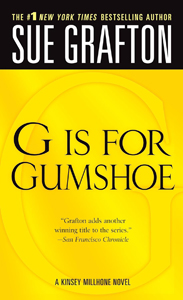
Sue Grafton overlaps two high concepts in “G is for Gumshoe” (1990) but under-develops one of them, leading to a fizzle of an ending. In one thread, Kinsey is pursued by a hitman due to her help in arresting a man off-page between books. In the other, the job of tracking down a missing elderly woman warms up a cold case from decades earlier in a riff on Agatha Christie’s “By the Pricking of My Thumbs.”
Kinsey – whose rebuilt garage apartment now has a bedroom loft — is into her second year of filing these reports for us, thus making it 1983 for those scoring at home. Although Kinsey is – by the author’s admission – a cooler version of Grafton, the P.I.’s total inability to deal with the hitman smacks more of how an author or an accountant or a grocery clerk might deal with such a situation in real life. She’s in over her head.
Although Kinsey continues in a lineage from Marlowe, in “G” she is the target and Dietz, a P.I. from Las Vegas who is a friend of a friend, is the Marlowean knight. Grafton unequivocally paints Dietz as a square-jawed good dude. Grafton engages in a fantasy wherein Kinsey’s loneliness and practical worries are magically cured by a perfect guy. He even quits smoking, without issue. Did Grafton’s editors drop a hint that bodice-rippers were outselling her?

“G is for Gumshoe” (1990)
Author: Sue Grafton
Series: Kinsey Millhone No. 7
Genre: Hardboiled mystery
Setting: 1983, Santa Teresa, Calif., and Salton Sea area
‘G’ is for gun sights
While it wouldn’t be impossible to gender-flip this story (a veteran female P.I. teaches a novice male P.I. how to exercise caution and self-protection), it’s hard to not notice Kinsey ceding her status and becoming the spunky second fiddle, like a 1930s Hitchcock heroine.
Which isn’t to say our narrator’s personality has changed. Grafton’s self-deprecation-by-proxy continues: “If I were asked to rate my looks on a scale of one to ten, I wouldn’t.” And, after describing an appealing woman: “In her presence, I felt as dainty and feminine as a side of beef. When I opened my mouth, I was worried I would moo.”
Becoming the junior partner is a surprising turn for Kinsey, but I’ll grant that even heroines need help. The plot thread thoroughly goes into the art of dodging and hitting back at a hitman, including smart gun and bullet choices. Messinger is a scary yet unlikely villain, professional enough to take the job but wacko enough to toy with his target for fun. And Dietz conveniently allows Kinsey to still do her detective job on this other case, although he’s always glued to her side.
As for that other case: It’s merely serviceable when it could’ve been a juicy story of digging up not merely old crimes, but creepy old crimes. How Kinsey learns information about the family of the elderly woman (and the middle-aged daughter who hires her) is procedurally enjoyable, including library microfiche perusal. When the (literal and/or figurative) buried bodies see the light of day, though, a reader wants answers, and Grafton – via Kinsey – almost literally says she’s not interested in details; she’ll leave that to the police.

Maybe that’s fair play. The presence of the old puzzle isn’t going to suddenly transform Kinsey from the Marlowe tradition into Tuppence Beresford. But at least give me some creepy details in an epilog. At its high points, “G is for Gumshoe” is a daring one-off change of pace, but at its worst, more like gum on your shoe.
Sleuthing Sunday reviews the works of Agatha Christie, along with other new and old classics of the mystery genre.