
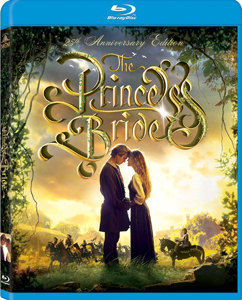
Some have suggested Rob Reiner had the greatest five-film run of all time with “Stand by Me,” “The Princess Bride,” “When Harry Met Sally,” “Misery” and “A Few Good Men” from 1986-92. This is debatable, as many five-film runs match it. But it’s hard to find another such stretch that covers five genres – in this case, coming-of-age, storybook adventure, romance, horror and court drama.
A storybook story
I’m guessing the one most people went to upon his tragic death last year was “The Princess Bride” (1987). Describing the plot, it doesn’t sound like a particularly standout work of fantasy, but it’s crafted as if by someone who wants to do each genre as best he can.
Working from William Goldman’s own adaptation of his 1973 book, Reiner blends the 1980s tech of matte paintings, compositing and creature effects with unspoiled backcountry Ireland and England to create the storybook-land. Liltingly moving compositions by Dire Straits’ Mark Knopfler carry us through a sometimes-comedic fantasy drenched in emotional truth.
“The Princess Bride” (1987)
Director: Rob Reiner
Writer: William Goldman
Stars: Cary Elwes, Mandy Patinkin, Robin Wright
In what would be labeled “manipulative” in a less-assured film, the framing mechanism finds a grandfather (Peter Falk) reading this book to his initially skeptical grandson (Fred Savage), who longs for fights and monsters but is won over by the love story. Kids and adults can get into “Princess Bride.”
Thinking back on it, everyone who dies is a pure villain, everyone who is merely knocked out is a semi-villain, and all the good guys live happily ever after, even if their wounds suggest they shouldn’t. The movie has a dark edge for kids, with the R.O.U.S. (Rodent of Unusual Size) being simultaneously scary, obviously a puppet, and a tragic figure because Westley must kill it. Suggestions of Westley being tortured further darken the picture, although the light spin of suction cups “draining his life” keep it safe.
Westley actor Cary Elwes – between this and “Robin Hood: Men in Tights” (1993) – seemed like an A-list star to all young viewers of the time. Maybe he would’ve been except for a convergence of typecasting and being typecast in period-piece comedy-adventures, in which years can go by without a new one.
A classic … as he wishes
Robin Wright is the titular Buttercup, and she and Elwes have chemistry to knock you off your couch. Examined too closely, this is an unearned romance. The grandfather narrates that she realizes Westley’s statements of “As you wish” mean “I love you,” and she’s won over. We believe Falk’s voice, the youthful beauty of Elwes and Wright and the chords of Knopfler. “Princess Bride” grabs us and says “Let’s go for a ride,” and winks at us if we deign to say “Romance isn’t this easy.”
After the establishment of Westley-Buttercup, the movie is critic-proof (not that it has many critics). It might be nice if Buttercup did more to chip in. She almost knocks the R.O.U.S. on the head, but mostly she can’t help her own cause; every action scene must reinforce Westley’s heroism. It might be nice to have a final swordfight between Westley and Prince Humperdinck (Chris Sarandon), but the prince is a coward so he surrenders.

While the theme is love (of the storybook purity that requires no clashes beyond the brief misunderstanding before Buttercup realizes the mask hides her beau), the film is also a touching story of friendship when we double back to Inigo Montoya (Mandy Patinkin) and Fezzik (Andre the Giant). Westley had let them both live, as this is the type of world where a hero can safely knock out enemies he doesn’t want to kill. Thus he acquires two allies he couldn’t do without.
Though Goldman’s framework is recycled gold, Reiner knows how to polish it to a gleam. Buttercup jumps from a window into the arms of Fezzik, and it’s not just a logistical moment; it’s a chance to linger on her pure white dress against a deep black night sky.
There’s less to this epic adventure than I remembered (it’s amazing how brief the end credits are, truncating the Oscar-nominated “Storybook Love” by Willy DeVille), but I see how the director made less into more by finding filmmaking beauty whenever he can. There’s no particular reason why “The Princess Bride” should be great … other than the fact that Reiner wishes it to be.