
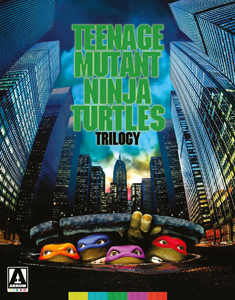
I’ve often heard great family movie screenplays complimented with “Both a child and an adult can like it,” but I don’t usually agree. One exception is “Teenage Mutant Ninja Turtles” (1990), and my bias is likely explained by the fact that I first saw it age 11 and I still love it at age 47 even if I try not to. I did some anecdotal research by screening the 35th anniversary Blu-ray for my friend Todd, who — despite being 12 in 1990 — had not seen the film. At age 48, he liked it.
My suspicion is confirmed that writers Todd W. Langen and Bobby Herbeck did indeed hit a sweet spot of penning dialog that connects with both children and adults. More specifically, they wrote lines that adults understand and kids enjoy (without understanding the full meaning) because their favorite characters are saying the lines.
The fact that they connect for a home run is especially impressive because they got so few at-bats. Langen has two movie credits and two TV series credits. “TMNT” is Herbeck’s only film credit to go with three TV credits.

“Teenage Mutant Ninja Turtles” (1990)
Director: Steve Barron
Writers: Bobby Herbeck (story, screenplay), Todd W. Langen (screenplay)
Stars: Judith Hoag, Elias Koteas, Corey Feldman
Although Herbeck also has the story credit (wherein he masterfully reassembles key parts of Eastman and Laird’s first 20-odd issues), Langen’s name is mentioned more often among “TMNT” fans and scholars.
This is perhaps because he is also the solo writer on “TMNT II: The Secret of the Ooze.” On the sequel, he writes some gems (“Wax on …” “Mouth off.” And my favorite: “Yeah, a little too Raph.”) But nothing there is at the level of “TMNT” 1990, which at times becomes Mametian in the way lines are simultaneously clever and absurdly naturalistic. Here are my favorite pieces of dialog from “TMNT” ’90.
“A Jose Canseco bat? Tell me … you didn’t pay money for this.”
Though the Raph-Casey fight comes from the “Raphael” one-shot (1985), the dialog is new. The Bash Brothers had led the A’s to the title in 1989, and Canseco was popular with teens. I used to think it weird that Raph is criticizing Casey for buying a cool product. Some have suggested Raph is a Yankees fan and dislikes the A’s. Some have interpreted Raph as suggesting Casey stole the bat, but that doesn’t fit: The enemies-turned-friends do immediately recognize each other as being opposed to theft.
Now I read it as Raph simply trash talking. He would criticize whatever model of bat Casey wields. Casey’s comeback after hitting Raph with another bat seems to acknowledge it’s not the best bat ever: “It was a two-for-one sale, pal.” Earlier in the fight, Casey calls Raph “Bogey,” a reference to Raph’s Bogart-style film-noir trenchcoat, but kids can just think it’s a funny name to call him.
“Gosh, it’s kind of like ‘Moonlighting,’ isn’t it?”
Here the writers hang a lampshade on the cliched (but very entertaining) nature of April and Casey bickering as a form of courtship. Donatello makes an on-the-nose reference to the 1985-89 TV series where this is the theme, so smart kids can probably figure it out (as I did, helped by the fact that my mom watched “Moonlighting”).
If not, it’s at least fun when Donnie (voiced by Corey Feldman) delivers this scene-closer. Today, the “Moonlighting” reference is a perfect time capsule. Obscure enough to be clever; but with Bruce Willis rising to the A-list (something already happening in 1990), most adult viewers will get it.
“You’re a claustrophobic.”
This exchange is the most Mametian, as Donnie suggests that Casey is afraid of enclosed areas. The nature of Casey’s character (street-smart but not a master of vocabulary) — along with “claustrophobic’s” rhythmic similarity to “homophobic,” which then calls to mind “homosexual” – allows us to quickly understand that he thinks Donnie is accusing him of something more culturally uncomfortable (in 1990).
It’s clinched, and made funnier, when Casey says “I’ve never even looked at another guy.” Also, Feldman’s snickers and the animators’ facial expressions for Donatello are top-shelf here.
“Question: Do you like penicillin on your pizza?”
This is the line that took me the longest to grasp. As a kid, I got it backward. I thought perhaps a bottle of penicillin had spilled on Danny’s leftover pizza, and Don and Mikey are enthused to eat it anyway, because they are hungry, it’s pizza, and they are animals.
Now I realize this is wrong. The Turtles eat like humans (Mikey listing his favorite toppings as “flies, stink bugs” is a joke). Now that I know penicillin – though most commonly thought of as a pain drug – is a type of mold, I realize Donnie has spotted mold on the pizza. The animators’ work here is misleading, as Don appears playful rather than crushed. But as an adult, I realize Don lowers the pizza to the ground and he and Mikey hum a funeral dirge for it. (Raph is later eating an apple, so apparently they acquire food before the final battle.)
“Oops!”
The edgiest moment comes in the denouement. Casey doesn’t really have an arc: He’s so violence-prone when we meet him that Raph tells him to dial it back. It’s more like viewers have an arc of getting to know him. Although he makes fun of Raph for being ugly, bald and green, that’s trash talk. Rather than being a bigot, Casey has an ingrained sense of decency and respect for all good beings. While it takes him a moment to absorb seeing a giant rat, he’s not repulsed. His lecture about “family” is taken in by even the toughest Foot Club members.
However, someone has to finish off the Shredder (never mind the sequel, which creates a logic hole) in order for the plot to be resolved, and Casey’s the only one who can do it. The Turtles can’t become killers. Casey can sit out the next movie and we can let this incident fade.
Honorable mentions
“Yes, friends, the new Turbo Ginsu. It dices, it slices … and yet makes French fries in three different … Whoops!” – Though the parody of infomercials might be lost on kids, it doesn’t matter because they are into the screwball comedy of the pizza slice landing on Splinter’s head.
“Looked like sort of a big turtle, in a trenchcoat. You’re going to LaGuardia, right?” – Just another day in NYC.
“Eleventh and Bleecker?” (Sniffs.) “Nope. This is only Ninth Street. Get it?” – I actually don’t get this one, unless it’s just a broad joke about how the Turtles are so at home in the sewers that they can navigate by specific sewage smells. Maybe there’s nothing to get.
“I am your father. … We have a new enemy. …” – It’s an open but rarely discussed secret that all incarnations of “TMNT” riff from “Star Wars.” In Shredder’s speech, the writers repurpose a Vader and an Emperor line. Later, Splinter contacts the Turtles via the Force, and because the groundwork is in place, we accept it.
“Ah, good, leftovers!” – Perfect for use at several lunchtimes per week.
On some Tuesdays, RFMC looks back at a “TMNT” movie, TV show or comic book. Click here to visit our “TMNT” Zone.