
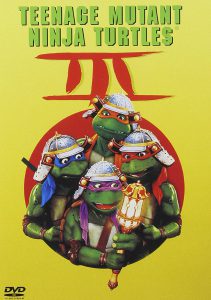
“Teenage Mutant Ninja Turtles III” (1993) is correctly the most maligned of the trilogy. In retrospect, the handoff from Jim Henson’s Creature Shop to All Effects Company (part of the budget trim from $25 million to $21 million, compared to “TMNT II”) meant it could never succeed. However, it came close to having the most sneakily clever story among the three films.
The theoretical bid to create a “TMNT” multiverse across the movies, the Mirage comics and the cartoon fizzled so badly that there’s no clear evidence who (if anyone) was guiding the idea. It’s tempting to credit Peter Laird, since he later shepherded “TMNT’s” Multiverse: He co-wrote “Tales of the TMNT” Vol. 2 Issue 52 (2008), in which Archie’s Cudley the Cowlick meets the Mirage Turtles, and the TV movie “Turtles Forever” (2009), in which the 1987 and 2003 animated Turtles cross over.
Nonetheless, there are enough stark similarities between three distinct “TMNT” sagas in 1992-93, plus a fourth in 2004, that it’s hard to chalk it up to coincidence. It might be as simple as “the Turtles go to ancient Japan to explore their roots” being in the air at Mirage Studios. But it might represent a genuine truncated attempt at a cool use of the multiverse nearly 30 years before the idea went mainstream in “Spider-Man: No Way Home” and “The Flash.” (And even those multiverses stay within the medium of film.)

“Teenage Mutant Ninja Turtles III” (1993)
Director: Stuart Gillard
Writer: Stuart Gillard
Stars: Elias Koteas, Paige Turco, Stuart Wilson
Mirage comics: “Masks” (April-May 1992)
Michael Dooney’s “Masks” Part I (Issue 46) and Part II (Issue 47) mark first instance of the Turtles time-traveling to ancient Japan. Their friend Hattori (from Issue 9, “The Passing”) is troubled by visions. Renet, with her Sands of Time Scepter, shows up by appointment (from her perspective) to shepherd the Turtles to 1373.
Our heroes battle Oraga’s evil warriors on behalf of the Gosei samurai. Among the former group is troubled henchman Chote, who would become the short-packed 1994 action figure Shogun Shoate (mint on card, look to spend $1,000). He’s an anthropomorphic lizard, something that hints at a Utrom/TCRI or “Usagi Yojimbo” connection, but Dooney does not explain it.
While he impatiently waits for the Gosei clan to OK a move against Oraga, Raphael trains young warriors. In a final-page irony, these samurai form the Foot Clan.
Movie: “Teenage Mutant Ninja Turtles III” (March 1993)
Writer-director Stuart Gillard reveals in the commentary track for the 35th anniversary Blu-ray of the “TMNT” trilogy (2025) that he was hired by Golden Harvest to make the third movie, but he’d need Eastman & Laird to approve his pitch. Remarkably, he says he made his pitches in early 1991, around the time “TMNT II” was a theatrical hit. E&L approved Gillard’s samurai idea, and presumably their conversations led to the inclusion of what visually and functionally is Renet’s Time Scepter.
On the commentary track, Gillard makes no mention of Dooney’s story. So although it seems like he would’ve been writing his theatrical riff on “Masks,” his idea apparently predates the comic by a year. In their intro to “Masks, Part I,” E&L note that Dooney is a big fan of “The Seven Samurai” and had been reading a lot of “Usagi Yojimbo” lately. So it seems safe to say Gillard’s pitch did not influence Dooney.
Movie and comic fans have seen this before: Movies have to be simpler. April buys the scepter for Splinter at an antique shop, thinking it looks cool. Due to mass displacement, 1993 April swaps spots with 1603 Kenshin (note the similarity to “Kenji,” a key character in “The Passing”), son of bedraggled Lord Norinaga (similar to “Oraga”). Gillard set his story in 1593 (an even 400 years in the past), but it was moved to 1603 for the finished film and he doesn’t know why.
Then the Turtles swap spots with four of Norinaga’s honor guard. In addition to the Time Scepter, another design link to “Masks” is the guardsmen’s face protection, then worn by the Turtles.
The biggest “what the heck” element is the scroll that shows four “kappa” (tortoise-like creatures in Japanese mythology) who look exactly like the TMNT, from centuries in the past. In the commentary, Gillard says he wanted to introduce some mythology. However, the film does not expound on how or why the Turtles entered into Japanese legend before their first journey there, and Gillard does not say what he had in mind — if anything. The link between Whit and Casey (both played by Elias Koteas) is random, so perhaps the Turtles pre-existence in the legend is likewise a vague notion that never coalesced into a full story.
1987 cartoon: “The Legend of Koji” (December 1993)
Writer David Wise is likely riffing on “TMNT III” in the third installments of CBS’ Season 7, one of the series’ very best episodes. But given the advance production time for a cartoon, maybe he is riffing only on “Masks.” Shredder acquires a Time Portal and its ruby power source. He travels to 1583 and the Turtles and Splinter follow him.
Splinter’s ancestor Hamato Koji (“I don’t see the resemblance,” Koji deadpans) teams up with the rat sensei and his Turtles, while Shredder usurps the throne of his ancestor, Oroku Sansho. Koji is the name of a modern-day descendant of Oraga in “The Passing,” so it’s quite possible Wise is giving a nod to Mirage.
Though the characters from “TMNT III” would’ve been merely 20 years younger in 1583, no connection is made. The two universes don’t interact.
2003 cartoon: “Secret Origins” (2004)
In Season 2, episodes 6-8, writers Eric Luke, Michael Ryan and Marty Isenberg (overseen by Laird) send the Turtles to 10th century Japan. It happens via a Utrom virtual-reality device, a way to give the Turtles a vibrant history lesson. But it somehow functions like reality and the Turtles fight Shredder (actually the evil Utrom Ch’rell) and his Foot Clan.
As such, the 2003 toon’s Foot Clan exists two centuries before its creation in the Mirage timeline and four centuries before its founding in the 1987 toon. The Sword of Tengu plays a part, which is worth mentioning because the Japanese warriors in “Masks” call the Turtles “tengu.” Since a tengu is a supernatural being in Japanese folklore, this is likely a coincidence rather than a reference.
Was a multiverse intended?
These four sagas’ tales of the Turtles’ jaunts to ancient Japan feature remarkable internal continuity. “Masks” builds on “The Passing,” plus the time-hopping rivalry between goatlike warlord Savanti Romero and time mistress Renet that starts in Issue 8.
“The Legend of Koji” references Season 3’s “Blast from the Past” – and though Wise retcons his own mythology that Shibano-Sama founded the Foot Clan, it’s a smart retcon: Kenji uses the deceased Shibano’s teachings as the clan’s foundation. “Secret Origins” delves into the complex backstory of the Utroms and the evil Shredder/Ch’rell who springs from them.
But the only indication of a multiverse – of external continuity — is the scroll in “TMNT III.” Gillard says in his commentary that he just wanted to throw some mythology in there. Nothing bigger, nothing specific, was planned by him or Eastman & Laird or Dooney.
Were multiple “TMNT” universes to cross over, we would need a branching point. For instance, the 1373 of “Masks” and the 1373 of “TMNT III” could be one and the same, then later they branch off. I can imagine Renet or Donatello explaining this in a couple panels, or a half-page of a screenplay, albeit wordily.
Unfortunately, the answer to “Who are the Turtles on the scroll?” remains “We don’t know.” The Turtles have traveled to ancient Japan so many times that it could qualify as a favorite vacation spot, but – aside from seeing that scroll — they’ve never run into themselves. As experts in the dangers of time-travel paradoxes could tell us, though, that’s probably a good thing.
On some Tuesdays, RFMC looks back at a “TMNT” movie, TV show or comic book. Click here to visit our “TMNT” Zone.