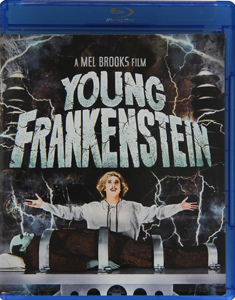
I can imagine writer-star Gene Wilder and writer-director Mel Brooks watching “Frankenstein” (1931) and inserting jokes, a la the “Airplane!” (1980) writers when watching “Zero Hour!” It’s a winning premise … if their fun translates to the audience. It does.
However, “Young Frankenstein” (1974) does not pioneer gag-a-minute comedy like “Airplane!” would later do. It probably could have, but Wilder and Brooks do something that’s less laugh-packed and more multi-layered. They craft a pastiche sequel that riffs on James Whale’s film (one of 400-plus adaptations of Mary Shelley’s 1818 novel). And, although it is set in the 1970s, they shoot in the black-and-white style of the 1930s with sets designed to look great in that format.
When American professor Frederick Frankenstein (Wilder) visits the Transylvania castle willed to him by his grandfather, he is stepping into the 1930s, stylistically speaking. Wilder and Brooks remake the O.G. while simultaneously respecting it, laughing at it and commenting on it.
“Young Frankenstein” (1974)
Director: Mel Brooks
Writers: Gene Wilder, Mel Brooks; based on the novel by Mary Shelley
Stars: Gene Wilder, Teri Garr, Peter Boyle
Cleverly, Frederick’s views on animating dead tissue to create a Monster (Peter Boyle) are the opposite of grandfather Victor’s, but Wilder’s performance can be similar. Frederick is not a wildly experimenting scientist but rather the exact opposite: a raving skeptic. He calls his grandpa a “cuckoo” and has taken on the pronunciation “Frahn-ken-STEEN.” He’s a new kind of mad scientist.
I had remembered “Young Frankenstein” being slow, and that memory is accurate, but on this rewatch I sense that Brooks is mimicking 1930s pacing. His legacy sequel is not boring, though. Between belly laughs, I enjoy looking at the production design and relishing the most recent bit of humor.
Worthy of a yummy sound
The film often observes the ridiculous human condition, wherein one can be a professional and live on respected grounds and have three employees … yet be surrounded by absurdity. Most famous is that the horses whinny every time someone says “Frau Blucher,” even if it is whispered. I’m partial to the misunderstandings of the Monster’s moan, particularly when it’s mistaken for a “yummy sound.”
The sequence where Gene Hackman, as a lonely and kindly blind man, interacts with the mute Monster is delightful in that way where we anticipate every gag (he ladles soup onto the Monster’s lap) yet enjoy it because we’re in lockstep with the joke.
A borderline moment: The running gag about sex is premised on the Monster essentially raping Frederick’s fiancé, Elizabeth (Madeline Kahn), until she likes him. But I think most viewers will react with “That’s unfortunate” rather than being so offended they’re taken out of the film. By this point, we’re so into all the ridiculousness that we’re not only fine with Frederick cheating on Elizabeth, but we want him to end up with lab assistant Inga (Teri Garr).
Not a mean-spirited film, “Young Frankenstein” manages to have Igor (big-eyed Marty Feldman) be the butt of the joke yet also in on the joke. The biggest laughs come from the smallest moments, like Frederick trying to communicate to Inga and Igor via charades while being choked by the Monster. The bits that fall a little flat – like Frederick and the Monster performing “Puttin’ on the Ritz” – are over fast enough that we don’t dwell.
Wilder and Brooks share their creation with the world, and rather than being terrified, I applaud them for it.
For Mel Brooks’ 100th birthday year, RFMC is looking back at his catalog on some Mondays.