
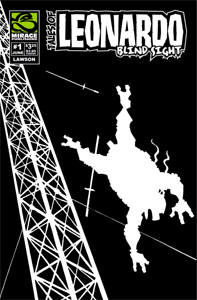
Not many people cite Leonardo as their favorite Teenage Mutant Ninja Turtle (including me; I’m a Donatello guy), but when Mirage does a batch of comics featuring each Turtle, he wins. The “Leonardo” one-shot “What Goes Around … Comes Around” (1986) is of course a classic that inspired the rooftop battle sequence of “TMNT” 1990 (where Raph takes his place). And when Mirage did a four-issue series for each of the brothers in the Aughts, Leo again wins the day with “Tales of Leonardo: Blind Sight” (2006).
Writer-artist Jim Lawson and we the reader spend “Blind Sight” in Leo’s head as he struggles with the classic question of his purpose in life. Is he merely a weapon? If he tosses his swords away, is anything left?
He initially asks himself these existential questions in “Tales of the TMNT” Issue 5 (“Blind Faith”), when a Foot soldier, whom Leo had blinded in a previous unchronicled fight, uses poisoned shuriken to likewise blind Leo. His blindness narrows his focus and self-perception.

“Tales of Leonardo: Blind Sight” (2006)
Mirage, four-issue series
Writer: Jim Lawson
Art: Jim Lawson
He’s skilled enough to seemingly do well against the Foot soldier (who has had a long time to adjust to his condition), but Lawson raises intriguing questions of whether Leo can trust his remaining senses, and therefore his own self. It starts at the end of “Blind Faith,” when Leo accidentally kills a homeless man. Shades of “Buffy’s” Faith, who does not care, but Leonardo’s curse is that he cares – maybe too much?
A dream of a miniseries
For an internal journey, “Blind Sight” is gripping. Even though we can guess some sequences are dreams — and indeed some are clearly stated as being visions, like when Splinter gives him a special tea — they are poignant. Issue 1 asks: What would happen to his brothers if he were dead?
Another highlight – although I wouldn’t want every issue to look like this (and indeed Lawson gives us reprieves) — is the art. It’s drawn in silhouette. Leo and other characters and objects – plus the words — are white; the backgrounds are black. Amazingly, there is not a single panel where I couldn’t tell what was happening, and only a few where I had to spend time on it. The story and fight scenes flow like any good “TMNT” story. Rather than losing something by “seeing” that Leo is blind, we enter his reality – not just sensory, but also psychological.
Lawson presents this vibe well, so as Issues 2-4 become a weirder spiritual journey — touching on forests and ancient Japanese culture (calling to mind the guest era of Volume 1) — I was geared for the ride. He doesn’t match the striking highs of “Blind Faith” and Issue 1 – which also includes a remarkable example of public investigators actually doing a flawless job of probing Leo’s death and the possibility of more mutants. (That’s one of the tipoffs that it’s a dream sequence.)

But the understated questions remain present as Leo’s trek gets weirder in the ancient Japan dream-world. Interestingly, Lawson is not probing “What is it like to be the leader of four brothers, who Splinter has put his trust in?” He isn’t interested in exploring the pressure Leo might feel, as is the case in – for example – the “TMNT” ’87 episode “Take Me to Your Leader.”
It’s like Leo is past crises of confidence and on to a pure crisis of self-worth as a sentient being rather than as a tool. In “Blind Sight,” Leo must become confident not in his skills, but rather in the value of his existence.
On some Tuesdays, RFMC looks back at a “TMNT” movie, TV show or comic book. Click here to visit our “TMNT” Zone.