
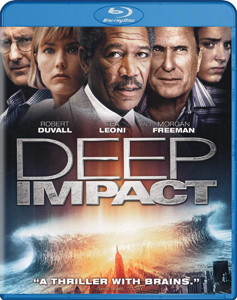
Exposition is the blessing and the curse of “Deep Impact” (1998), a superbly acted, deeply emotional and relatively mellow end-of-humanity movie about a comet headed toward Earth. Communicating the logistics to the audience is a bane of natural disaster films, but director Mimi Leder and the writing duo of Bruce Joel Rubin and Michael Tolkin find a smart workaround.
The last voices we hear
The primary expositors are also the main characters, and everything they say is natural dialog that would be said. Tea Leoni plays MSNBC reporter Jenny Lerner, who rises to become what Walter Cronkite was for the moon landings. (Appropriately, TV’s “The Morning Show” is Leder’s latest project.) Morgan Freeman is the president; his words and wordless moments are equally thoughtful. Robert Duvall is grandfatherly astronaut Spurgeon “Fish” Tanner. All are comforting voices at the (possible) end of the world.
I would’ve liked more of cute teenage lovebirds Elijah Wood and Leelee Sobieski. “Deep Impact” opens with them discovering the comet during a nighttime astronomy field trip. But, as we bounce between the narratives in large chunks, we don’t get a lot more of them in detail. Their conflict-free love story is a stand-in for audiences to paste themselves onto. We think about who we’d like to be with in our final moments.

“Deep Impact” (1998)
Director: Mimi Leder
Writers: Bruce Joel Rubin, Michael Tolkin
Stars: Robert Duvall, Téa Leoni, Elijah Wood
Though it gradually builds tension with the kids’ discovery and Jenny’s “All the President’s Men” Lite reporting, “Deep Impact” ultimately has more questions than answers. On the emotional side: Will we approach our end with dignity, or embarrass ourselves trying to save our own skin? On the logistical side: How will the world’s leaders act if this situation arises?
In this story, the USA government – in a behind-the-scenes, black-book operation – builds a shelter in Missouri’s caves, chooses 200,000 people of key professions and announces it will select 800,000 additional citizens via lottery. It makes extra-congressional decisions such as legal discrimination: No one 50 and over will be eligible for the lottery.
“Deep Impact” is arguably statist propaganda, in that we get the voices of the president, a major media network and a government-funded space program, plus a kid hero from a public school. It presents unintended meta-commentary about the state’s selection of winners and losers: “Artists” are among the 200K pre-approved. But it’s not flag-waving propaganda; oddly, there are fewer flags here than in “Armageddon,” where the private sector provides the heroes. It’s more like comfort food. It’s up to each of us to decide if we trust the government; this film makes us feel OK if we choose to do so.
Big questions, but we might not like the answers
However, it’s not Pollyanna at the world’s end. The bureaucracy makes mistakes, including one that leads to a devastating family scene. Sobieski is so good at this type of acting that it almost breaks my heart that she didn’t quite achieve the A-list. When some characters make it to Missouri’s “Ark,” it has an ominous vibe like they are in for two years of totally controlled military life before the dust clears and they’re allowed to go topside. Is that a life worth living? Or would it be better to see the gorgeous comet as the last thing you do?

Dozens of actors get chances to shine in given scenes. But Duvall is a standout with how Fish directs the space mission. The actor makes fascinating choices like saying “It’s OK” in a calming voice while an astronaut is pleading that they save his colleague, which is impossible due to limited fuel. It’s not OK, but we get Fish’s leadership approach, and also absorb the fuel info.
But in the big picture, “Deep Impact” misfires with exposition, papering over things it’s not telling us. Why is there only one spaceship after two years of preparation? Why is the amount of nukes out of whack with the amount of fuel? There might be reasons for these things, but Rubin and Tolkin don’t work them into the story.
The paper they use for the papering-over is admittedly distracting. The movie is filled with heart-wrenching small moments, like Spurgeon reading “Moby Dick” to a young crew member. Life gets simpler when it’s about to end.
Like the fuel-to-nuke percentage, maybe “Deep Impact” doesn’t get the ratio of information to action to special effects to sentimentality perfect. With a scope this grand, it must make choices of what to show us. What it does show us rings true.