
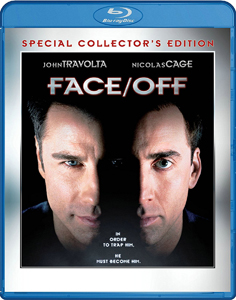
“Face/Off” (1997) is on the short list of great body-swap movies. Fans say they love John Travolta acting like Nicolas Cage and Cage acting like Travolta. But ironically, because it’s one of Travolta’s best films and one of Cage’s best films – and because both have come to be known for going over-the-top – the mimicry aspect is almost lost to time. If someone wants to do a deep study of the actors’ pre-1997 catalogs, they’ll likely appreciate subtle things they are doing here, but luckily, it’s still a great film if that angle is taken away.
Writers Mike Werb (“The Mask”) and Michael Colleary rely on that unwritten rule wherein we’ll allow one insane thing – in this case the wackadoo-sci-fi face-swapping – as long as the rest of the film plays fair. It does, and it’s quite emotional.
Stuck behind their masks
As good guy Sean Archer (originally Travolta, but mostly Cage) cries in his throw-away-the-key cell, we feel his despair. Meanwhile, we see how Castor Troy (originally Cage, but mostly Travolta) delights in a fresh opportunity to be the “good guy” and get kudos for defusing a terrorist bomb (that he is secretly responsible for).

“Face/Off” (1997)
Director: John Woo
Writers: Mike Werb, Michael Colleary
Stars: John Travolta, Nicolas Cage, Joan Allen
Interestingly, in a rare body-swap story that equals this one — the magical swap of Slayers in “Buffy” Season 4 — the villain’s comedic playfulness while getting to be the hero is more memorable than the hero’s despair (although ultimately Faith does change by being in someone else’s shoes).
But in “Face/Off,” Cage (as the hero) gives the project-to-the-back-row performance while Travolta’s (as the villain) is subtly creepy. Some of it comes from the mere suggestion of how Castor is eyeing Sean’s wife (Joan Allen) and scantily clad teenage daughter (Dominique Swain). Swain’s Jamie makes the theme blunt: She’s exploring her identity through different looks, as teenagers are wont to do. On the flip side, we’re invited to think about how looks don’t matter via Castor’s 5-year-old son Adam. He looks like the villains (his mom, played by Gina Gershon, isn’t a good person either), but that doesn’t mean he must grow up to be one.
A delicious irony is that adults Troy and Archer are extremely set in their ways – one a fun-loving assassin, one a workaholic FBI man – and they are obsessed with being who they are. (Ironically, more healthily in the villain’s case.) But simply by being viewed different (due to their new faces), their well-honed senses of self totally collapse. Even looking in a mirror, they lose their minds because their self-view gets shattered.
Trading faces
One of director John Woo’s best stop-and-take-a-breath moments amid the (top-shelf) action finds each of them looking in a mirror, knowing their enemy is behind it. It seems like they shoot “themselves” because they now hate “themselves.” Earlier in the film, neither pulls the trigger in the same situation with their true faces.

“Face/Off” makes a convincing case that a breakdown of one’s identity is what would really happen if they traded faces. Our sense of self is linked to our physical senses, one of which is sight. Other senses come into play both for their inner perception and for others’ perception of them.
The sci-fi tech also switches Castor’s and Sean’s voices (sound) and their bodies (touch). Smell and taste might be less relevant, but the voice-modulator test phrase (and perhaps the film’s most famous line) is “I could eat a peach for hours.” Archer, when hanging out with Troy’s goons, is exposed to new “tastes” of drugs, alcohol and easy women. This exacerbates his psychological vertigo.
Woo is an action guy, and Cage and Travolta aren’t the go-to guys for subtlety, yet “Face/Off” is more memorable as a psychological drama than as an actioner. The film is deftly structured: We always know what’s going on, even though body-swap stories can get tricky with all the “Who knows who is who, and how and when?” But an unspoken through-line adds additional tension. The secret surgical team has all been killed, so will Archer get to switch back to his original appearance?
Even if the face-offing is temporary, we (and Archer, and even Troy to a degree) fear it’s permanent. This horrific thought gives the film substance. Though fans riff about theoretical sequels and remakes, “Face/Off” is protected in part because its rare achievement of psychological depth in an absurdly premised action thriller might be unmatchable.