
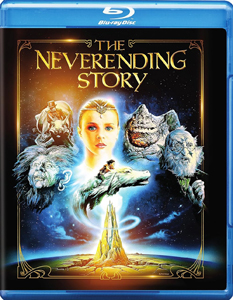
“The NeverEnding Story” (1984) is an ideal film to teach young kids about the power of following your dreams, and it retains a smidgen of magic for adults. I wasn’t drawn into it the way a kid would be, but I appreciate its technical beauty and the way it connects with kids. I love “The Princess Bride” (1987), so I’m not totally immune to the fantasy genre, but this one goes a bit far down the nerd hole for my taste.
Though Wolfgang Petersen directs his first English-language film here, adapting it from the German children’s book by Michael Ende, the messages are so universal that nothing gets lost in translation. Its fairy-tale structure is common: A real-world kid – with issues such as bullies and a deceased mom — gets sucked into a fantasy world.
This also happens in “Labyrinth” (1986), but it’s not merely a structural aspect here, it’s part of the magic. As he’s reading the book, Bastian (Barret Oliver) gradually is amazed to find out he’s part of the story. On the surface, this screenplay by Petersen and Herman Weigel is propaganda for reading, because it celebrates that a kid skips math class, sneaks into the school’s attic and reads this book he has taken without permission. It’s like the movie version of those READ posters.
“The NeverEnding Story” (1984)
Director: Wolfgang Petersen
Writers: Wolfgang Petersen, Herman Weigel (screenplay); Michael Ende (novel)
Stars: Noah Hathaway, Barret Oliver, Tami Stronach
If one thinks about it for a moment, though, this propaganda is in the form of a movie, so it’s openly encouraging imagination via movies (and via at least the tool of TV, since this was a VHS rental staple). And while the bookstore owner (Thomas Hill) criticizes video games, Bastian learns he’s part of the adventure, and the closest parallel to being a participant in a fantasy world is video games.
The film accidentally acknowledges real-world beauty when the rear-projected landscapes are clearly from Earth. But on the whole, “NeverEnding Story” presents real life and imagination as being in conflict when Bastian’s well-meaning dad (Gerald McRaney) encourages him to “start keeping both feet on the ground,” “stop daydreaming” and “start facing your problems.”
It’s OK to be lost
As a sign I’m watching “NeverEnding Story” through the lens of McRaney’s character, I thought about how he must be worried about his son who has not come home from school. The movie never addresses this; it’s clearly on the side of the kid, the side of being lost and taking an unorthodox path to finding yourself. I like that it takes one IRL detour though: payback of bullies.
The actual fantasy world — before it gets lazy with the later rear-projections — is so dream-like it borders on sleep-inducing (although the film has the decency to only be 102 minutes). Granted, you can unearth parallels and metaphors.
A giant turtle – standing in for beaten-down adults — is so old she doesn’t care a lick about giving hero Atreyu (Noah Hathaway) any help. The fantasy world – unfortunately given the name Fantasia (same as an older Disney movie) – is under threat from The Nothing, a roiling dark cloud that could be a metaphor for nuclear Armageddon. The Bog of Despair is a neat concept, but we don’t grasp why Atreyu’s horse is so sad.
The racing snail and giant rock creature provide “gee-wiz” but little else, and the Empress (Tami Stronach) is functionally The Princess from a video game, albeit one with a message about the importance of following one’s dreams. And she stands for imperialism, which isn’t great, but I suppose that element is a given for fairy tales.
The friendship between Atreyu and giant dog-dragon Falkor is cute, and pretty matte paintings combined with pretty music pluck at a viewer’s imagination. I’m too far gone for it to work on me, but not so disconnected I can’t see how “NeverEnding Story” delivers a hopeful message to children.