
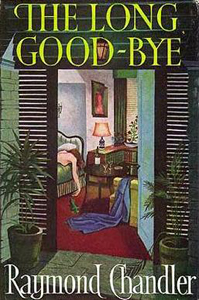
Raymond Chandler makes what seems like a conscious reaction to “The Little Sister” (1949) – where everyone is mean and/or manipulative – in “The Long Goodbye” (1953). He starts his sixth novel with Philip Marlowe actually making a friend, Terry Lennox, and continues into the question of whether the sleuth truly can have friends.
Too bad Anne’s not around anymore
Additionally, Chandler explores whether Marlowe could have a healthy relationship with a woman. The answer is a decided no in regards to the book’s three main female characters, who are all bug-nuts insane.
In his final encounter with Mrs. Linda Loring, the least crazy one, they are conversing in his living room and she throws her drink in his face, then says she doesn’t know why she did that. It’s like Chandler is writing a parody of the “all women are crazy” trope and seeing how far he can push it before people realize he’s jerking their chain.
“The Long Goodbye” (1953)
Author: Raymond Chandler
Series: Philip Marlowe No. 6
Setting: 1953, Los Angeles
Chandler wrote a down-to-earth woman, policeman’s daughter Anne Riordan, back in “Farewell, My Lovely,” but she hasn’t appeared since and I’m starting to wonder if he wrote her by accident.
None of this is to say the male characters – other than Marlowe – are normal and rational. Terry calls on his friend to drive him to Mexico because he may or may not have murdered his wife. For one, he isn’t sure; and two, he can’t tell Marlowe anything without making him an accessory after the fact.
Chandler has always been interested in the nuances of the law and how a P.I. might navigate them, and also the morality (or lack thereof) of the law and how police officers go about their jobs. This is his most aggressive novel yet in that area.
A respectful disagreement
Continuing the theme of generally less-nasty relationships (although, don’t worry, Marlowe gets the snot beat out of him by cops and mob goons), Marlowe shares begrudging respect with policeman Bernie Ohls, a rare above-board cop in Chandler’s Los Angeles. A telling conversation contrasts Marlowe’s live-and-let-live attitude with Ohls’ mainstream idea that the law should attempt to eradicate unsavory elements of society. Marlowe mocks Ohls’ POV in chapter 48:
“If a guy loses his pay check at a crap table, stop gambling. If he gets drunk, stop liquor. If he kills somebody in a car crash, stop making automobiles. If he gets pinched with a girl in a hotel room, stop sexual intercourse. If he falls downstairs, stop building houses.”
While this might be a more civil book than the previous entries, that’s not to say Marlowe hits it off with everyone. The alcoholic author Roger Wade aims to hire Marlowe – knowing of his good treatment of friend Terry — as essentially a babysitter for him, to quash any homicidal or suicidal outbursts. Marlowe declines, correctly noting that no one can watch someone 24/7; during any breaks, a clever person would know that’s the time to go on the binge of violence.
But circumstance keeps Marlowe in Wade’s circle (and that of his smoking hot, and nutso, wife). In this segment, “The Long Goodbye” is a fair, stark portrayal of Wade’s alcoholism, and this is one of the possible meanings for the title. If Wade can’t recover, he’s on a slow path to killing himself, one that’s always in danger of being sped up.
Wade’s other trait is he’s a best-selling author. Whenever an author writes an author character, it’s tempting to find clues that it’s the author’s surrogate (for example, Ariadne Oliver being a stand-in for Agatha Christie), but Wade resists that categorization. Wade is not a mystery genre author; he writes popular literary fiction. However, he thinks it’s trash, and so do most critics.
A cruel world, but one with choices
This doesn’t reflect Chandler, a craftsman who aimed to do good work, who saw genre fiction as being as legitimate as straight fiction, who was well-reviewed, and who did not crank out material for the sake of cranking it out. Despite his outsized impact, he only wrote seven novels, compared with – for example – Christie’s 66 (which is not to say Christie cranked out drivel by any means, although Chandler might’ve disagreed with me).
Indeed, as is the case in most of his work, “The Long Goodbye” is a traditional literary exercise; it’s merely couched in genre. This novel in particular is a thesis statement on Marlowe – although not a final statement, as the character is only 42 years old and there’s one more full book to come, plus another that was halted due to Chandler’s death.
Not only is “The Long Goodbye” (379 pages over 53 chapters) not cranked out or forced into existence for the sake of a sale, it almost resists ending. Standing in stark contrast to the blunt hardboiled ending of “The Lady in the Lake,” this one has 50 more pages after the wrap-up of the Wade case. (At that point, the Lennox case has also officially wrapped, with only Marlowe unsatisfied.) Chandler’s prose is as crisp and to-the-point as always; the main reason for the length is that two related cases are thoroughly probed. That said, I admit this is a very long “Goodbye.”
In the coda of this novel that’s 50-100 percent longer than Chandler’s average, Marlowe is straight-up offered a different type of life – marriage to Linda (who proposes to him, in an interesting gender-role switch), money from Terry (who is so rich he could lose a $5,000 bill between the couch cushions and not miss it) – and he declines.
Life is cruel and unfair, we’re reminded even in this relatively kinder and gentler Chandler novel. But it still does offer choices (albeit not always lovely ones). Marlowe has to be who he is because that’s who he is. Thus his archetypal knightly portrayal continues, but with so many of his decisions hinging on his care for people, “The Long Goodbye” humanizes Marlowe more than ever.
Sleuthing Sunday reviews the works of Agatha Christie, along with other new and old classics of the mystery genre.