
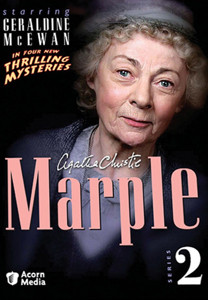
“Agatha Christie’s Marple” Season 2 (2006) starts with the same high standards as Season 1, with “Sleeping Murder” and the best episode so far, “The Moving Finger.” Then it makes the controversial and ill-advised decision to add Miss Marple (Geraldine McEwan) into non-Marple novels, leading to the disappointing “By the Pricking of My Thumbs” and “The Sittaford Mystery.”
Christie consciously and deliberately chose which mysteries would feature Poirot, Marple or one-off amateurs (often a guy and girl who might be a love match). Although she is known for puzzle mysteries (solvable by readers based on the clues presented), she also continued the Holmesian tradition wherein we enjoy watching the sleuth solve the puzzle. That, along with rewrites necessitated to get Marple into the narrative, is why those episodes face an uphill battle.
Considering that out of the 20 Marple short stories, 18 were left unadapted by the end of “Marple’s” 23-episode run, it’s even more of a head-scratcher why non-Marple novels were bastardized into episodes. The dropoff from the pure “Marple” adaptations is undeniable.

“Agatha Christie’s Marple” Season 2 (2006)
ITV, A&E; four episodes
Directors: Edward Hall (1), Tom Shankland (2), Peter Medak (3), Paul Unwin (4)
Writers: Stephen Churchett (1, 4), Kevin Elyot (2), Stewart Harcourt (3)
Stars: Geraldine McEwan, James D’Arcy, Greta Scacchi
Here are my rankings of Season 2’s four episodes:
1. “The Moving Finger” (episode 2, written by Kevin Elyot)
One of the weaker “Miss Marples” turns into the elite “Marple” so far as Elyot captures the way the gossip from poison-pen letters can fracture a village. And director Tom Shankland oversees a particularly beautiful-looking episode with a vibe of budding spring romance as Jerry (the charismatic James D’Arcy) recuperates from a motorcycle crash.
While the gossip element is timeless, on the other hand (or on the other finger), this is a great romance as spunky 20-year-old Megan (Talulah Riley, who is also great in the elite “Poirot,” “Five Little Pigs”) gradually emerges as a potential love match for unfocused Jerry. He’s initially distracted by stunning nanny Elsie (Kelly Brook), but one of those kisses-gone-wrong like between Cordelia and Wesley in “Buffy” Season 3 quashes that. Granted, love is treated without much complexity here, but that’s part of the old-world appeal.
Novel: “The Moving Finger” (1943)
2. “Sleeping Murder” (1, Stephen Churchett)
Again, a romance – albeit of the slow-burn, sneaky variety – is the big hook. Here it’s between Gwenda (Sophia Myles), almost supernaturally drawn back to purchase her childhood home, and Hugh (Aidan McArdle), a sharp nebbish assigned by Gwenda’s out-of-country fiancé to look after her.

The flashbacks to a small-town theater troupe muddle things a bit but also provide a bevy of colorful characters and potential motives. Though not part of Christie’s text, the theatrical element livens the proceedings and fits with the nostalgic theme. Particularly strong performances come from Sarah Parish as Eve, the multi-talented act who can’t get any passes due to wearing glasses, and Phil Davis as Dr. Kennedy, a psychiatrist with his own twisted secret.
Novel: “Sleeping Murder” (1976)
3. “By the Pricking of My Thumbs” (3, Stewart Harcourt)
The casting of Anthony Andrews as Tommy and Greta Scacchi as Tuppence isn’t bad; the opening scene shows their comfortable spousal banter, their primary appeal from the books (of which “Thumbs” is their fourth). From that point forward, they are a little off, as Tommy is more of a brash government official than I’d expect and Tuppence has the new trait of being an alcoholic.
They are split up through most of the adventure, as Marple takes over Tommy’s role in the search for a house in a painting which might feature a child’s corpse bricked up behind a fireplace, as per the mumblings of the late Mrs. Lancaster (June Whitfield). Since Marple also perhaps encountered this old lady in the novel version of “Sleeping Murder,” there is a certain sense to adding Marple here. Harcourt and director Peter Medak nicely enhance the book’s fairy-tale horror flavor, but the scrambling of the book’s cast and characterizations makes this a slight misfire.
Novel: “By the Pricking of My Thumbs” (1968)
4. “The Sittaford Mystery” (4, Churchett)
I was confused for most of the runtime about where characters are located, even though Christie took pains to make it clear who is in the Sittaford house atop the 2-mile rise and who is in the Exhampton hotel below amid a snowstorm. Former James Bond Timothy Dalton adds charisma as the eventual victim amid a convoluted parade of suspects, future star Carey Mulligan is pretty, and director Paul Unwin captures the winter setting, albeit in the artificial way of fake snow.
I recall the team-up of amateur sleuths Emily and Charles – and the slight possibility of a love match, though it’s hampered by Emily being engaged – being the novel’s highlight. Here, Zoe Telford and Ian Hallard do indeed have the spotlight, but cuteness is exchanged for an edge that’s ultimately unappealing. Emily is less likable at the start and (due to a rewrite of Christie’s work) Charles is less likable at the end. Marple is in the episode, but barely, which is more distracting. The only reason it takes her a while to solve this one is the wait for information.
Novel: “The Sittaford Mystery” (1931)
Sleuthing Sunday reviews the works of Agatha Christie, along with other new and old classics of the mystery genre.