
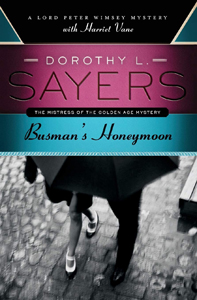
For an author who believed strongly in the rules of murder mysteries (in a nutshell, playing fair with the reader and being true to reality), Dorothy L. Sayers sure dodged the genre a lot. “Busman’s Honeymoon” (1937), the last of the four books featuring both Lord Peter Wimsey and Harriet Vane, is roughly 40 percent mystery and 60 percent relationship drama.
A honey of a mystery
In chronicling the first few days of Wimsey’s and Vane’s marriage – which (significantly for modern readers) are also their first few days of living together – Sayers doesn’t have much to say that’s surprising. All of their worries about how to behave now that they have a spouse to consider seem like exactly what would happen. “Honeymoon” accidentally is evidence for the adage that happy couples are uninteresting.
Sayers aims for a sense of whimsey over the incongruity of a relaxing honeymoon (at their newly purchased country house) mixing with a murder mystery, and she mostly achieves it – not so much through singing prose, but rather through the awkwardness of the situation. Wimsey is an unofficial yet totally dedicated sleuth, and when a corpse is found in the basement of his own house, he can’t exactly leave it all to the police detectives.

“Busman’s Honeymoon” (1937)
Author: Dorothy L. Sayers
Genres: Mystery, romance
Series: Lord Peter Wimsey novel No. 11 (fourth with Harriet Vane)
Setting: 1930s, rural England
Characterization of Peter and Harriet is entirely about avocation-marriage balance (and butler Bunter’s changing role with an additional master to serve). Aside from a brief passage where Harriet confirms to a journalist that, yes, she will continue her mystery-author career now that she’s married and rich, Sayers forgets that Harriet has this job.
After Peter saves Harriet from a wrongful conviction in “Strong Poison,” they work as a team to solve a case in “Have His Carcase.” “Gaudy Night” then finds Harriet working alone, since her colleagues at her alma mater assume her authorial skills translate to detective skills; the experienced Peter then takes the solution across the finish line.
Harriet hardly contributes at all in “Honeymoon.” Peter is extremely helpful to the police, always fretting that he’s ignoring his wife. Sayers finally includes striking characterization in a long epilog. She touches upon Peter’s shell-shock from the war, and sort of ties that in to his dilemma about how – when he solves a case – he is condemning the perpetrator to death.
A great week for village gossip
The mystery is good, although it takes nearly 100 pages to get to the corpse; a reader might assume this is purely the story of a honeymoon and colorful country folk. “Honeymoon” has much stronger characterization for the players than is found in “Gaudy Night,” where Sayers struggles to distinguish the teachers.

It’s fun to meet the personnel who take care of the house (the housekeeper and the gardener, whom Peter and Harriet intend to keep on), plus various hangers-on, such as the neighbor, the vicar, the niece of the house seller, the chimney sweep, furniture movers and policemen. The chaos of changing home ownership in a small village increases only slightly once the body is found.
Though the logistics of the murder have to do with space, weight, time and other mathematics – and though the book includes no graphics – it’s compelling enough, largely because of the strong personalities and potential motives, as no one liked the borderline criminal, bad-tempered victim.
Reading “Honeymoon” is a sometimes-thrilling, sometimes-tiring alternation of magnetic stretches and slogs. I prefer Agatha Christie’s relationship-sleuthing mixes (an adventure followed by an engagement on the last page) to those of Sayers, although I acknowledge the latter is far more grounded. And although Sayers invented Vane before Christie invented Ariadne Oliver, Christie ultimately gives a superior portrayal of a mystery author drawn, over her head, into real mysteries.
Completing the Vane-Wimsey quadrilogy is not a dire assignment, but “Gaudy Night” and “Busman’s Honeymoon” are less of a treat than the first two books. In this final entry, Sayers becomes more smitten with Peter and Harriet than they are with each other, so the mysteries – while fairly clued, plausible and engaging – play second fiddle.
Sleuthing Sunday reviews the works of Agatha Christie, along with other new and old classics of the mystery genre.