
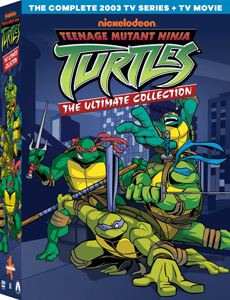
I owe an apology to “Teenage Mutant Ninja Turtles” (2003-09, Fox). It landed at a precise time when I wasn’t into kiddie versions of all-ages properties, I thought the theme song sounded dumb, I thought the Turtles’ lack of pupils looked horrible, and any connection to Mirage was of the watered-down ripoff variety. I reflexively said “Not my TMNT!” and would’ve added a hashtag but Twitter didn’t start until 2006.
After finally watching the 26 episodes of Season 1 (2003), I realize this show – while not absolutely perfect – kicks a substantial amount of butt and is on a path to becoming what I’d judge as the best universe outside of Turtles Prime (the Mirage comics).
Laird’s crowning (non-Eastman) achievement
According to “TMNT: The Ultimate Visual History” (2014) by Andrew Farago, Peter Laird felt good about selling “TMNT” to Viacom after this series ended. He felt he had achieved the definitive cartoon version of the Turtles, and got the nagging disappointment of the 1987 toon out of his system. I can see why.

“Teenage Mutant Ninja Turtles” Season 1 (2003)
Fox, 26 episodes
Producer: Lloyd Goldfine
Director: Chuck Patton
Writers: Michael Ryan (1, 4, 9, 10, 11, 12, 16, 21, 23); Marty Isenberg (2, 6, 7, 8, 19, 20, 21, 22); Eric Luke (3, 5, 13, 14, 15, 17, 18, 24); Greg Johnson (13, 14, 15, 25, 26); Kevin Eastman, Peter Laird, Jim Lawson (source material)
Although both are rated 7.9 on IMDb, “TMNT03” is substantially better than “TMNT87” in three key categories: action (combining Kevin Eastman’s layouts with anime’s dynamic balance of angles, speed, reality and fantasy, under the direction of Chuck Patton), narrative coherence (the Mirage beats combined with adjustments for a less choppy flow) and music (instead of a small library of themes, each episode is fully scored).
If you want lightness and comedy, “TMNT87” is the way to go, and you get better designs of the eyes there. Although it’s true that the Mirage Turtles have all-white eyes, it looks funny to me in moving images on screen. I’m still not a fan of it by the end.
However, that’s the only thing I wasn’t won over by. The theme song is the very definition of “It grows on you”; midway through my viewing of Season 1, I was going through the day humming “Turtles count it off! 1-2-3-4, TeenageMutantNinjaTurtles!”
Laird, Eastman and Jim Lawson should all have story credits; for whatever reason, they don’t, but rest assured that when “TMNT03” adapts Mirage, it does so with high fidelity. According to Farago’s book, Laird worked closely with supervising producer Lloyd Goldfine to craft the narrative. Of course, credit must go to the script writers for maintaining that faithfulness amid the needs of a Saturday morning toon.
“TMNT03” contains 15 episodes that adapt a Mirage comic and 11 brand-new stories. Laird and Goldfine change the order of events in smart ways to make the world seem more substantial and interconnected. Baxter Stockman’s schemes and the Utroms’ surveillance overlap with Shredder’s power plays. Unlike in Mirage, Baxter is employed by Shredder, the Purple Dragons are essentially the JV of the Foot Clan (and their former leader, Hun, has risen to become Shredder’s second-in-command), and Casey is a personal enemy of the Purple Dragons. He has rejected the gang life to instead be the opposite: a vigilante crimefighter.

It’s a shelluva town
These connections would seemingly shrink the scope, but instead I they build a world and compensate for an issue of all cartoons: that big cities seem underpopulated due to limits on how much animating can be done in a given timeframe. (Mirage seems to have the most populated NYC because Laird and Eastman were workaholics obsessed with making every page come alive.) The alive-ness of the city then allows for contrasts, such as the emptiness of the sewers and the openness of the country around the Massachusetts farmstead.
To illustrate the chronological changes, these are the Mirage comics adapted into the Season 1 timeline:
- Episodes 1-3 (“Things Change,” “A Better Mousetrap,” “Attack of the Mousers”) adapt Issues 2-4.
- Episode 4 (“Meet Casey Jones”) adapts the “Raphael” one-shot.
- Episodes 10-11 (“The Shredder Strikes”) adapts Issue 1.
- Episode 16 (“The King”) adapts the “Donatello” one-shot.
- Episodes 17-19 (“The Shredder Strikes Back,” “Tales of Leo”) adapt the “Leonardo” one-shot and Issues 10-11.
- Episodes 21-23 (“Return to New York”) adapt Issues 19-21 (“Return to New York”) and the Baxter Stockman-as-robot part of Lawson’s Volume 2. (Here, he’s driving a robot rather than having melded with one, but the visual effect is the same.)
- Episodes 25-26 (“The Search for Splinter”) adapts the TCRI/Utrom elements of Issue 4.
So out of the core Eastman & Laird stories, everything is adapted up to this point except Issues 5-7 (the outer-space trip where we meet Fugitoid and the Triceratons), Issue 8 (where we meet time-hopper Renet), Issue 9 (a flashback and a connection to Japan), the “Michaelangelo” one-shot and “City at War” (Issues 50-62). Stay tuned.
About 90 percent of Mirage “TMNT” smoothly translates to the cartoon, with more quippage from Michaelangelo (Wayne Grayson), but not enough to ruin things. In fact, I find him rather delightful. All of the voice actors are good – I even got used to the more lilting tone from Splinter (Darren Dunstan) — and I love the sensei’s design, where he has a perpetual smirk. My favorite, though, is the gruffness from Raphael actor Gregory Abbey.
For a high point of the action translated from comics to moving images, check out “The Shredder Strikes Back, Part 1” (17), which adapts the “Leonardo” one-shot. Foot soldiers ominously gather on rooftops in the background, and the episode is refreshingly short on dialog; Leo’s not a quipster and he doesn’t have time to speak anyway, only to survive. My only quibble is that the episode trades Christmastime snow for rainfall, perhaps because it’s easier to animate.
The badass and the babe
“TMNT03” might have the best Casey and April portrayals, both as a budding couple and individually, over the long term. (Nothing tops Elias Koteas and Judith Hoag, but we were only treated to them for one movie. “TMNT03” pays homage with Casey calling April “babe,” to her annoyance.)
It’s refreshing to get back to Mirage’s vulnerable, non-reporter April (Veronica Taylor). In this design, nailed down rather than being all over the place like in Mirage, she is a dead ringer for actress Rachel Brosnahan. In a bit of kismet, Brosnahan is now playing “Superman” 2025’s Lois Lane, David Wise’s inspiration for “TMNT87’s” April-as-reporter.
The 10 percent of Mirage that can’t translate to a toon is the quiet, reflective emotional stuff. I noted that Issue 11 is adapted into “Tales of Leo,” but it is the least-direct of Season 1’s translations. Yes, the Turtles go through a recovery period during winter at the farmstead in both.
But Issue 11 is a mood piece driven by April’s journaling. A cartoon needs action, so we get four flashbacks to Leo’s younger days, as his brothers and sensei talk to him while he’s in a comatose state. The cutest is Splinter’s tale, wherein he grabs young Leo one-handed and puts him on his back, in the time before Leo conquered his fear of heights.
This makes me realize that another emotion-driven Mirage arc, “The River” (Issues 24-26), which brings Raph back from the brink of uncontrollable rage, could not easily be adapted. (Although, dang, it would’ve been cool to see mutant leach Bloodsucker in action.) This wasn’t anything for Laird and Goldfine to fret over, though; since “The River” was written by Rick Veitch, they didn’t have adaptation rights.
Invisible to society – for now
OK, so that leaves the 11 brand-new stories (episodes 5-9, 12-15, 20 and 24). Narratively, these are less important, but they do fit with the cartoon’s flow and chronology. They are televised answers to “Tales of the TMNT” comics. They retain a Laird influence, especially “The Unconvincing Turtle Titan” (12), wherein Mikey takes his turn at being a traditional superhero, following Raph (The Green Defender) and Don (The Dark Turtle) in “TMNT87.”
Laird was obsessed with superheroes and rejected regular charges in letters pages that they don’t fit with the world of “TMNT.” That problem crops up again here, as we see the Superman-esque Silver Sentry defending NYC. If people with superpowers are normal in “TMNT03’s” NYC, why are the Turtles outcasts?
April and Casey get past the fact of the Turtles’ existence quickly – April faints a couple times, granted – and interestingly, villains don’t judge them based on their existence, but instead, the irksome goodness they stand for. Not surprisingly, kids — as in “Lone Raph and Cub” (24) — see the Turtles as just the latest annoying adults. Homeless people see them as friends in “Garbageman” (9). My impression is that once the Turtles’ existence becomes public knowledge, the populace will quickly adjust.
Setting aside whether the Turtles are being overly cautious, “TMNT03” is refreshingly consistent after the throw-it-at-the-wall approach of “TMNT87,” wherein the Turtles’ societal position fluctuated based on a script’s needs. It’s also more planned-out than Mirage; granted, the comics have a delightful spontaneous quality. But here, Peter Laird has time to sit back and think about how to put his classic game pieces together in the best way.
“TMNT03” allows for the thrill of the familiar and the excitement of the unfamiliar, leading to a show that – better late than never – I have learned to love.