
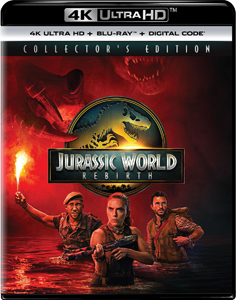
If I took a time machine from 1993 – the day after seeing “Jurassic Park” – to today, then watched the six sequels, I’d figure these are the most beloved movies on the planet for the consistent sense of wonder and scope about two species separated by 65 million years suddenly thrown together.
While the films have remained popular among kids – they’ve made $6 billion at the box office and more than $10 billion when merchandizing is factored in – and among Joe and Jane Schmoe (all rate at least a B-minus on CinemaScore), critics have grown tired of them. Four of the entries rank at 51 percent (or 51 points out of 100) or lower on Rotten Tomatoes and Metacritic.
YouTube critics have surpassed tired into outright anger, with (admittedly this is unscientific, but please prove me wrong) 100 percent of them giving mixed-to-negative reviews to this summer’s “Jurassic World: Rebirth.” Search for “Jurassic World Rebirth review” on YouTube. (I found some neutral-toned videos that explain the film or note Easter eggs, but no positive reviews.)
I’ve genuinely liked all seven films, so within wider society I find myself as an apologist for the saga. In my opinion, they are – and unwaveringly always have been – B-monster-movies with A-list special effects, with a consistently Crichtonian bent.
Building on Crichton’s ideas
Director Steven Spielberg’s “Jurassic Park” and “The Lost World” (1997) come from Michael Crichton novels, the first warning of scientific hubris, the second of how life will find a way despite attempts to wipe it out.
The next five films come from people who respect and understand Crichton’s themes. “Jurassic Park III” (2001) and “Rebirth” are isolated horror movies, the former working in a theme of raptor communication, the latter reminding us of the medicinal value found in nature and experimentation – as long as it is measured rather than reckless.
“Jurassic World” (2015) is about how people don’t learn from history, and in fact repeat mistakes on grander scales. “Fallen Kingdom” (2018) shows how even the natural world can be exploited by the military-industrial complex, and “Dominion” (2022) riffs on Crichton’s “Prey” and “Next” by critiquing unchecked genetic engineering across all strains of nature.
Critics were lukewarm on “JP III” and – after having their sense of wonder perked in “JW” – cold toward the last three entries. Especially on YouTube, which makes sense, because it is a performative medium. I’m not saying that these critics secretly liked “Rebirth” and are performing angry rants for clicks. I am saying they were underwhelmed by the film, then they lean into a performance, similar to how a theater actor projects to the back row.
The algorithm rewards strong positions, and people click on critics’ facial expressions that promote a strong emotion rather than a neutral one. I myself am guilty of this. (I’m less likely to watch Chris Stuckmann’s reviews after his announcement that he’ll no longer post negative reviews.) Additionally, when a person likes a movie overall they are going to be much less critical of the details than if they dislike a movie overall.
YouTube critics aren’t the target audience
While I don’t believe critics went into “Rebirth” planning to hate it, I do believe they aren’t the “JP” target audience (and never have been). They are open to a total revamping of what a “JP” movie is, but they don’t know what that would entail. If they did, someone, somewhere would make that movie. They just know what they don’t like, and what they don’t like is humans going into dinosaur habitats. And vice versa: “Dominion” features dinos in human spaces, and it draws the most vitriol of the whole saga.
Setting aside that “JP” movies are impossible if humans and dinosaurs don’t interact, YouTube critics have near-zero tolerance for human characters operating at anything short of the level of consistently calm and measured genius.
Consider these complaints about “Rebirth” found in most of the YouTube reviews (SPOILERS FOLLOW):
- It’s dumb that a Snickers wrapper gets stuck in a vent and causes InGen’s security system to reboot.
- It’s dumb that blood samples from three large dinos (mosasaur, titanosaurus, quetzalcoatlus) could be key to curing heart disease, and it’s dumb that anyone would risk trying to get the samples.
- It’s dumb that scientists keep making mutant dinosaurs.
- It’s dumb that little human Bella brings little Aquilops Dolores with her because it’s just to sell toys, and also the baby would die if removed from the equatorial zone.
- It’s dumb that the family tries to use a raft to travel down the river to the comparative safety of the old InGen facility.
- It’s dumb that the humans stop and marvel at the titanosauruses, in a mirror of Grant and company marveling at the brachiosaurus in the first movie.
- It’s dumb that the humans leave via the water, considering that they arrived via the water and were attacked by mosasaur and a Spinosaurus herd.
Why aren’t scared movie characters allowed to act dumb?
None of these things are worthy of the rage expressed by YouTube critics. The fact that the critics don’t like these things is valid, in the sense that everyone can have an opinion (and opinions on art can be emotional), but they are inoffensive elements in screenwriting terms.
- The “JP” films have always been about hubris and random bad luck. A worker grown lazy through a long stretch without accidents could lose track of a Snickers wrapper. My work computers randomly freeze and shut down all the time. InGen is a large corporation; it cuts corners. John Hammond’s “We spared no expense” is meant literally by him (from his isolated bubble), but we’re meant to take it ironically.
- After the heavy genetic engineering theme in “Dominion,” where people raged at the story’s inclusions of locusts, “Rebirth” writer David Koepp (who wrote the first two films) drops the Biblical stakes for a simpler mission. He still taps into the zeitgeist of a post-COVID age when scientific experimentation in pursuit of wonders (or proprietary weapons) can lead to terrors. It fits with movie logic that long-lived beasts with strong hearts could hold valuable information. That people would risk their lives for money or (in the case of the idealistic one) to save humanity is easily plausible.
- The saga has always been about the absurdity of scientists bringing dinosaurs back to life. The increasingly horrifying mutants are a borderline satirical (necessary in a world wherein satire is almost dead) continuation of Crichton’s ideas while also serving the monster-movie principles. For those who want “real” dinosaurs, “Rebirth” is a smorgasbord. The three sought-after dinos are real; the Distortus rex is merely the bookend.
- It’s clear to me the baby is an orphan. That’s why it stays with Bella and why it has a well-honed sense of fear regarding nearby predators. While we don’t see Dolores’ parents’ corpses, the overall effect of director Gareth Edwards’ portrayal of this prehistoric island is such that we know death is a regular part of life here. In a movie era of heavy exposition, it’s refreshing that he and Koepp trust us here. As for the issue of living conditions, it’s never stated that the family does not live on the equator, and it’s also never stated that there are no equatorial nature preserves where Dolores could be relocated. Additionally, dinos can live outside the equator (we see a brontosaurus in NYC to start the film), it’s just that they don’t prefer it. As for the idea of a Dolores toy or plushie, so what? – as long as Dolores is naturally in the narrative. It’s much less egregious than Spielberg’s lascivious “Spaceballs”-esque pan over merchandise in the first film.
- When they decide to try to acquire the boat in the shed, they don’t see the T-rex napping nearby. Yes, Teresa loudly inflates the raft, but scared people do stupid things in the real world all the time. I sometimes act stupid alone in my apartment. I don’t understand why stupidity is not allowed in movies set amid the most terrifying circumstances imaginable.
- Yes, it’s an homage to Spielberg’s film, but the meaning here is not that the people have never seen dinosaurs before. Rather, they are marveling at the peaceful love shown between the two beasts. On an island of sheer horror, they see beauty among gentle giants, and their perspectives get leveled out.
- The expedition originally planned to leave via helicopter, but with the chopper destroyed and their arrival boat marooned, they need the next best plan, since staying on the dangerous island is not a desirable option now that they have the blood samples. Leaving on the small boat does not guarantee they won’t be killed on the way out, but they have a chance. It’s a big island and a big ocean, and Spinosauruses are animals; they aren’t a militia guarding the coastline. In not encountering Spinos on the way out, the group gets lucky. I believe luck should be allowed in movies.
Are the movies dumber? Or are viewers more demanding?
To watch the YouTube videos, you’d assume the “JP” films get increasingly stupid. I’d argue they’ve become increasingly concerned with logic and – for better or worse – spell things out to a viewer, reflecting modern moviegoers’ desires. (Granted, “Rebirth’s” simplified story is a step back from the complex mythology of the previous three films. But it still has a line where a character explains the fiscal-policy reason why InGen didn’t kill the D-rex.)
People complain less about the early films because they like them more (maybe this is because they are better – overall, Spielberg is more skilled than the later directors – but it’s also because they were more novel at the time). Also, YouTube couldn’t be an opinion leader back then because it didn’t exist.
Yet it can’t be denied that:
- In “Jurassic Park,” the T-rex is in a sunken enclosure with high cement walls topped by a wire fence, and somehow it just steps from that enclosure onto the elevated road.
- Also in that movie, Alan Grant says he won’t leave the terrified kids, and soon after, he does – for no compelling reason. He also throws a stick at a fence to test if it is electrified, but that’s not a sufficient way to test it.
- In “The Lost World,” a drugged T-rex kills an entire ship’s crew by escaping its hold (we don’t know how), but then dutifully returns to its hold to be trapped again in the last action of a dying crew member at the controls.
- A Pteranodon is free from its enclosure at the end of “The Lost World,” and all Pteranodons are caged again in “JP III.” Both films take place on Isla Sorna.
While people certainly have noted these plot holes, conveniences and less-than-smart behaviors by a heroic character, it’s done with an air of “Even Spielberg’s films have flaws; ha-ha.”
The “Jurassic Park” films have not gotten substantially worse, and they have not abandoned their Crichtonian themes; they’ve doubled down on them. YouTube critics have gotten noticeably louder and less forgiving as their tastes have changed in relation to a franchise that has not.