
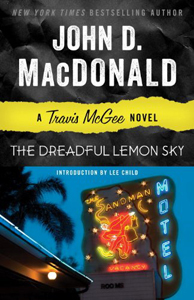
Travis McGee is a spiritual continuation of Philip Marlowe, but with a difference that’s nicely illustrated in “The Dreadful Lemon Sky” (1974), John D. MacDonald’s 16th novel about the P.I. who lives on a Florida houseboat.
Raymond Chandler’s white knight Marlowe stood apart from society with his impeccable morals, but McGee is under the radar. Marlowe is an archetype, admirable but also a cautionary tale of the loner life; McGee operates in reality more so than in stylized hardboiled fiction. He’s a guy doing what looks from the outside to be a mundane job, and he doesn’t care if that’s inaccurate; he doesn’t seek fame.
The media doesn’t even care about this string of killings after a while, as outlined by narrator McGee in chapter 17: “A news story is a fragile thing. It is like a hot air balloon. It needs a constant additive of more hot air in the form of new revelations, new actions, new suspicions. With this the air cools, the big bag wrinkles, sighs, settles to the ground, and disappears.”
“The Dreadful Lemon Sky” (1974)
Author: John D. MacDonald
Series: Travis McGee No. 16
Genre: Hardboiled mystery
Setting: Bayside, Fla., 1974
Not only does workaday McGee not become famous, but even his grisly cases – with mysterious, violent deaths worthy of being splashed across the news — fade completely from the public’s interest. That adds a nice extra tinge of melancholy to “Lemon Sky.”
A woman McGee once knew, Carrie, asks him to hold a bag containing $100K (and to take a $20K holders’ fee) until she comes back for it. When she’s killed in a supposed traffic accident, he has to know the whole story, and get the money to Carrie’s sister, so he travels down the coast to the heart of the mystery in Bayside.
Following the money down the coast
Despite “Lemon Sky” being short on internal hype — not featuring a hook beyond “Follow the money” – it’s definitely not a lemon in MacDonald’s catalog. He’s a melancholy character writer who works in the genre of action/mystery; in fact, character is so much at the forefront that a reader might overlook a well-crafted puzzle.
“Lemon Sky” ends with a great “answer was right under my nose” twist, yet MacDonald doesn’t show it off. McGee solves it by gathering information and thinking through the puzzle pieces with his friend and traveling companion Meyer, who uses the metaphor of astronomers finding invisible planets by measuring the gravitational action of visible planets.
McGee doesn’t even become famous in P.I. circles – let alone among the public. He’s like the anti-Poirot. Instead of taking center stage, he – along with his temporary-ally cop, Captain Harry Max Scorf – has a final showdown with the culprit on a deserted side street. This is close on the heels of another great action scene peppered with revelations. Then Scorf wants McGee to split town (I guess because cops and P.I.s must always be enemies).

“Lemon Sky” gives good insight into America’s Drug War, and what the actual aims might be, somewhere between the government’s stated aims (to wipe out all drug sales and use) and the close observer’s presumed aim (the government wants to preserve its power). This middle ground is outlined by Scorf, who admits McGee’s digging did some good.
“Anyway, one thing looks better. … Somebody has knocked all them amateur wholesalers into a tight line. Some professional outfit has moved in like overnight and took over the whole county. Speaking purely as a cop, it’s a relief. It’s the amateurs screw everything up. With these pros, I know which way they’ll jump, and what will make them jump and what won’t. If they keep it tidy, we’ll lay back and let it roll. … If these pros start to get into any heavier action around here, then what we’ll do is make their operation so expensive it’ll take the cream off, and they’ll back off to what they’ve got right now.”
The Drug War, up close
Here we get a boots-on-the-ground, workaday view of the Drug War. Obviously drugs can’t be stopped; obviously laws don’t help the problem. But if you’re in the middle of it as a cop, you want to maintain a clear, organized, regulated (albeit by bad guys) black market rather than the chaos of amateur competition. This makes their job easier in addition to maintaining a status quo that the major players (Baptists and bootleggers, cops and criminals) can live with.
Oddly, it’s not organized crime that dooms “Lemon Sky’s” victims, it’s unorganized crime – a crime of irresistible opportunity, carried out in part by decent people. (And by some bad people who pull decent people into their circle.)
Even as he solves this one for Carrie, and mourns a second woman who becomes a victim in a string of cover-up killings, McGee gets involved with Cindy, the widow of still another person of interest who winds up dead. As they hit it off, Cindy brings up the reasons their relationship won’t work in the long run. McGee takes it for what it is: a relationship that doesn’t survive, amid a case no one cares about.
Although MacDonald is not lacking in recognition, these McGee novels are like under-chronicled stories taking place outside the spotlight that shines on more famous sleuths. “The Dreadful Lemon Sky” is another strong one that sneaks into a corner of illumination.
Sleuthing Sunday reviews the works of Agatha Christie, along with other new and old classics of the mystery genre.