
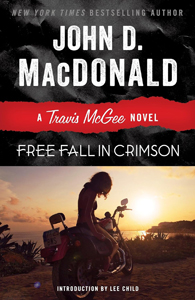
“Free Fall in Crimson” (1981) is a particularly rich entry in the Travis McGee series. The 19th book makes me further appreciate how John D. MacDonald, working as the analog age gradually turned to the digital age, was prescient about issues that would permeate culture for 50 years or more. He was to hardboiled mysteries what Philip K. Dick was to science fiction.
This novel also is a great example of the balance wherein MacDonald uses the mystery format, in the sense that we get a whodunit and clue-gathering, yet McGee exists in the real world where not all cases are solved. Or if they are functionally solved they are not legally solved; justice is not served. And also, while cops serve a purpose in McGee’s world of crime detection, they are much less reliable than in a Christie, or even a Hammett or Chandler.
Character insights
Above all, MacDonald’s strength in “Free Fall” is character writing, starting with McGee, as diagnosed by his friend Meyer. I wouldn’t say McGee is as much in his own head as Marlowe, but he is more so than the Continental Op. I imagine many readers can relate to McGee’s overthinking, as in this chapter seven passage:
“Free Fall in Crimson” (1981)
Author: John D. MacDonald
Series: Travis McGee No. 19
Genre: Hardboiled mystery
Settings: Florida, Iowa and Los Angeles, 1981
Meyer says that if I could, for once and all, stop my puritanical ditherings about emotional responsibility, I would be a far happier and less interesting man. In childhood I was taught that every pleasure has its price. And as an adult I learned that the reprehensible and dreadful sin is to hurt someone purposefully, for no valid reason except the pleasure of hurting.
Of course, he nonetheless does get deeply involved with hotelier Anne, and with significant violence. MacDonald writes a well-researched hot-air balloon action sequence in what seems like the book’s climax on the set of a film shoot in Iowa, but it’s actually a precursor to a final showdown with an increasingly scary biker-turned-actor-turned-lunatic.
MacDonald adds late insight into Meyer – usually the one providing the deep analysis – and revisits “The Quick Red Fox’s” sexy ingenue Lysa Dean for a continuation of her relationship with McGee I didn’t realize I wanted. But “Free Fall’s” standout character is Peter Kesner, a filmmaker who breaks through with low-budget but stylish biker action movies and gets a shot at a big-budget balloon movie. Kesner lives safely before the #MeToo era, doesn’t even know such a thing is coming, and openly discusses his on-set liaisons.
When Travis, posing as a researcher for a TV series about filmmaking, meets Kesner, the filmmaker immediately offers him his drugged-out, sexed-up, underage assistant Jeannie as a gesture of friendship. (“She said she was 19,” would be his go-to explanation, if needed.) Like a naïve Harvey Weinstein, Kesner ebulliently reveals his life and lifestyle, and we are simultaneously engaged by him and feel sorry for him, knowing his safe societal pocket will last only as long as his fame and power.
Predictions and perspectives
MacDonald is great at previewing 21st century issues. Rather than being cautious by hiding his big predictions, he puts them in his novels. They now serve as a historical record of his views, and mostly demonstrate his intelligence. Consider this passage in chapter 11 where Meyer warns McGee (who eschews using credit cards) of the rise in digital footprints that can be tracked by the government or other villains. And conversely, the way a lack of a footprint makes you an object of suspicion:
“If you try to hide, you are easy to find. You are leaving only one trail in the jungle, and the hounds can follow that one. Leave forty trails, crossing and recrossing. The computers are strangling on data. The courts are strangling on caseload. Billions of pieces of paper are floating around each month, clogging the inputs, confusing the outputs.”
While computer processing is no longer slow, and printer paper is no longer required, MacDonald’s general concept of trails and hiding one’s trail remain a reasonable principle for both criminals and privacy-seekers.
The author also makes good points about fame and perspective. Kesner becomes a legend after his death even though he didn’t deserve it based on his behavior and possibly not even based on his art. In chapter 18, Meyer talks about “the artistic conundrum we all struggle with. … How, in these days of intensive communication on all levels, can you tell talent from bullshit? Everybody is as good, and as bad, as anybody wants to think they are.”
The more I read his stuff, the more I think MacDonald is as good as people say he is. And “Free Fall in Crimson” is a prime example of his talent.
Sleuthing Sunday reviews the works of Agatha Christie, along with other new and old classics of the mystery genre.