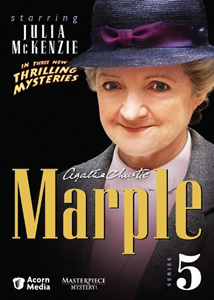
Had “Agatha Christie’s Marple” kept going beyond its 23 episodes, it likely would’ve adapted all or most of the Marple short stories. The first one attempted, Season 5’s (2010-11, ITV, A&E) “The Blue Geranium,” is excellent, showing no signs of padding. A casual observer would have no idea it comes from a short story, not a novel.
By this time, the writers had lots of practice adding new elements to Christie’s work; often the alterations would be controversial – diversity replacing conservative casting, sex appeal replacing demure interactions – but sometimes the writers improved on the source material. Or at least made smart changes to fit with TV rather than with literature.
As such, “The Pale Horse” and “The Secret of Chimneys” are both strong episodes despite the books not featuring Marple. The first one is actually a great character piece for Marple, showing her devotion to justice and her dogged sleuthing skills in a case that’s complex enough to be worth her addition. And “The Mirror Crack’d from Side to Side” is at least an … interesting … episode.
“Agatha Christie’s Marple” Season 5 (2010-11)
ITV, A&E; four episodes
Directors: Andy Hay (1), John Strickland (2), David Moore (3), Tom Shankland (4)
Writers: Russell Lewis (1), Paul Rutman (2), Stewart Harcourt (3), Kevin Elyot (4)
Stars: Julia McKenzie, Joanna Lumley, Jonathan Cake
Here are my rankings of the four episodes from the penultimate “Marple” season:
1. “The Blue Geranium” (episode 3, written by Stewart Harcourt)
For the first time in screen history, a Marple short story gets adapted. Though the same length as the novel adaptations, this entry doesn’t feel padded. Harcourt rather brilliantly blends mystery and suspense – two opposite genres that Hitchcock claimed were difficult to make compatible (although even he did it sometimes).
We get the suspenseful “ticking clock” because Marple is trying to convince her retired Scotland Yard friend, Sir Henry Clithering (Donald Sinden), that she has evidence to add to a court hearing that’s currently happening. (“Have you ever known me to be wrong?” she inquires, getting his ear.) And the mystery comes from the story she’s telling. Though a traditional manor whodunit, it’s filled with colorful characters amid a sprawling love octagon and riffs on Gillian Flynn’s 2006 novel “Sharp Objects” by advancing a theory of Munchausen’s-by-proxy.
Short story: “The Thirteen Problems” (1932)
2. “The Pale Horse” (1, Russell Lewis)
Lewis cracks the code of how to make a non-Marple novel into not only a smooth “Marple” episode, but a pretty great one: Marple aggressively inserts herself into the story, as she is a friend of the first victim, Father Gorman. Perhaps the writer was inspired by “A Pocket Full of Rye.”

Marple’s interplay with Inspector Lejeune (Neil Pearson) – wherein she pursues the case over his annoyed objections and keeps finding key clues – feels very Christie-ish. And Jonathan Cake (“Poirot’s” “The Hollow”) is a welcome “that guy” presence as Marple’s ally Mark Easterbrook. A slight tinge of the supernatural via the titular hotel rounds this episode into fine Halloween-time viewing, even if no viewer is likely to think there’s truly something otherworldly going on.
Novel: “The Pale Horse” (1961)
3. “The Secret of Chimneys” (2, Paul Rutman)
Technically, there are no original (as in: not adapted from a Christie work) “Marple” episodes, but “Chimneys” finds a secret back-door workaround. The novel does not feature Marple and it’s considered by critics to be a relatively clunky work by a young author. Rutman keeps the appealing tropes – like a love triangle wherein Virginia (Charlotte Salt) must choose between staid stability with courter Lomax (Adam Godley) and unpredictable love with Cade (Jonas Armstrong) – and adds not only our titular sleuth but also grandeur.
Instead of a basic manor mystery, “Chimneys” hosts international diplomacy and a suave Austrian count (Anthony Higgins) who wants to buy the ancient castle for some reason. Caterham (uniquely voiced Edward Fox) is an intriguing patriarch but in a different way from the novel.
Novel: “The Secret of Chimneys” (1925)
4. “The Mirror Crack’d from Side to Side” (4, Kevin Elyot)
This is the season’s least interesting entry for incongruous reasons. The novel’s solution is so memorable that it’s hard to go into the episode cold, especially if you’ve already seen the Lansbury and Hickson versions. Elyot (wisely) doesn’t do the “Marple” thing of changing things up; it’s too classic of a tale for even this show to mess with.
As such, performances would seem to be the hook, but as Marina Gregg, Lindsay Duncan doesn’t have Elizabeth Taylor’s fading-superstar quality and the episode has several flat turns. Hannah Waddingham (“Ted Lasso”) is an exception, playing it up as Marina’s rival Lola, whose cleavage flusters a young assistant detective.
The bustling production of “Nefertiti,” the movie Gregg is filming in London while staying at her new St. Mary Mead home, adds spice (and might also be a nod to the never-adapted ancient-Egypt mystery “Death Comes as the End”). Because it captures the Hollywood-star craze of the Fifties better, this is arguably the best of the three “Mirror Crack’d” adaptations, but its familiarity hurts it.
Novel: “The Mirror Crack’d from Side to Side” (1962)
Sleuthing Sunday reviews the works of Agatha Christie, along with other new and old classics of the mystery genre.