
It had bothered me that the Turtles seem to be at April’s apartment for months while Shredder and the Foot Clan “simultaneously” regroup in days in “Teenage Mutant Ninja Turtles II: The Secret of the Ooze” (1991). Mikey puts up a poster (albeit with tape), April has a good sense of each Turtle’s and Splinter’s domestic habits, and enough pizza has been ordered from her address that she has a reputation with Keno.
Plus, the sequel came out one year after the first film, and it has a different tone and cinematography, so it seems like significant time must’ve passed. However, it has to be days at the most in order to explain Shredder’s survival, Tatsu’s raw emotional response, and the fact that Foot soldiers are only now arriving at the fallback spot.
We can explain it as: Channel 3 immediately hooks April up with a new apartment as a perk of getting her back, and although the Turtles stay with her for mere days, if they order pizza for every meal and Keno has been taking lots of delivery shifts, he would take note.

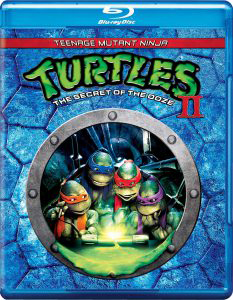
“Teenage Mutant Ninja Turtles II: The Secret of the Ooze” (1991)
Director: Michael Pressman
Writer: Todd W. Langen
Stars: Paige Turco, David Warner, Ernie Reyes Jr.
Dumping on logic
With that “plot hole” resolved, I move on to one that’s inexplicable: Why is Shredder at the garbage dump? At the end of the 1990 film, the crowd of ex-Foot members see Shredder fall into the garbage truck and Casey smash him. They are cooperative when Chief Sterns arrives.
It seems logical that they would tell Sterns about their leader’s body being in the garbage truck. (I believe they would’ve kept their lips zipped about Casey pulling the lever, so I’m OK with the “Casey would’ve been arrested for murder” “plot hole.”)
But canonically, they did not, because Shredder is at the dump. This could’ve been solved with Shredder waking up in the morgue, Michael Myers style. Or getting up from his ICU bed. Why didn’t returning writer Todd Langen – such a deft hand on the first film – take one of these paths? Possibly to avoid that very Myers comparison … possibly on a directive from Eastman & Laird. Though Myers has been resurrected in many ways, it’s never happened at a garbage dump.
Although E&L were too busy running their surprise empire to micromanage the adaptations in various media, they had significant power of approval. Around the time “TMNT II” came out, they were shaping “TMNT III” (1993) with writer-director Stuart Gillard; “no Shredder” was among the caveats. The animated “TMNT IV” (2007), written and directed by Kevin Munroe but supervised by Laird, is likewise sans Shredder.
Endless Shredders, not endless Oroku Sakis
From the start, E&L did not want Oroku Saki to be Michael Myers. Issue 1 (1984) was intended to be one-and-done. When it was a hit, they had to devise an ongoing storyline but they stuck to their guns that Saki is dead. This might surprise casual observers: “TMNT II” marks the only case in the pre-Viacom era where Saki returns from a presumed death.

E&L loved the Shredder iconography, and they returned to it regularly, but without resurrecting Saki. The Foot Mystics create a clone Shredder, who pops up in a classic moment in the “Leonardo” one-shot (1986). Leo kills the clone – made up of worms who combine into a sentient form — in “Return to New York” (1989), which finds his brothers fighting three deformed clones.
In “City at War” (1992-93), Foot leader Karai dons the Shredder garb. So does Raph (!) in Volume 3 (1996-99), which also includes a mysterious Lady Shredder.
The Laird-overseen Fox Kids animated series (2003-09) uses a bucketful of tactics to give us non-Saki Shredders. In fact, the show has no pure Saki version of the Shredder! As explained in Season 5, Saki lived in the third century; he is one of five great warriors who defeat a supernatural Shredder. This “tengu” (demon) entices Saki to let it inhabit his body and rule Japan’s dark age.
As seen in Season 2’s “Secret Origins,” in the 10th century the evil Utrom Ch’rell takes on the mantle of the Oroku Saki Shredder (which has been split into five boxes and is overseen by the Ninja Tribunal, which also wears Shredder-style helmets). In modern times, as seen in Season 4, Karai dons the Shredder garb and takes the name.
He’s back, in supernatural (?) form
In “TMNT II: The Secret of the Ooze,” Saki simply survives, as is the wont of Michael Myers, who eventually is confirmed to be supernatural in “Halloween 6: The Curse of Michael Myers” (1995). My friend Michael Olinger, a big “Halloween” fan, assumed Shredder fit the same mold: “As a kid I always took it as he is superhuman. Even though there is nothing to say that.”
It’s likely that many children viewed Shredder this way, and Mirage readers might’ve head-canonized a mystical resurrection. But movies are always simpler than comics. In the films’ canon, his fall is cushioned by the garbage, and while the masher renders him unconscious and scars his face, it does not do serious damage. Within days, he’s up and about and has a solid revenge scheme rolling.
“TMNT II,” one of those sequels that repeats the original’s plot but is just different enough, ends with the Shredder again being crushed. We go further down the “invincible” path that could lead to a “TMNT 6: The Curse of Oroku Saki.” Having drank a small vial of ooze, he’s Super Shredder when a waterfront dock falls on him. So what? He’s probably fine, I would think.
Except Raph says “Nobody could’ve survived that!” and Shredder’s hand goes limp and Leo adds “That’s the end of the Shredder.” Langen likely thought “Kids will trust Raph and Leo, and adults will get what we’re intending, even if the visual isn’t convincing.”
To really kill off Shredder required Eastman & Laird saying “No more Shredder” to Gillard and Munroe.
Granted, Shredder is in “The Next Mutation” (1997-98), wherein the Turtles reside in the movies’ subway lair.
But that’s a topic for a post that will never happen.
On some Tuesdays, RFMC looks back at a “TMNT” movie, TV show or comic book. Click here to visit our “TMNT” Zone.